Posts Tagged ‘journalism’
“As if the main object were to talk fast and not to talk sensibly”*…

As Josie Harvey reports, unlimited access to “doomscrolling” and the resultant emotional toll of constant negative news has led to record-high news avoidance…
News has never been more accessible – but for some, that’s exactly the problem. Flooded with information and relentless updates, more and more people around the world are tuning out.
The reasons vary: for some it’s the sheer volume of news, for others the emotional toll of negative headlines or a distrust of the media itself. In online forums devoted to mindfulness and mental health, people discuss how to step back, from setting limits to cutting the news out entirely…
… Globally, news avoidance is at a record high, according to an annual survey by the Reuters Institute for the Study of Journalism published in June. This year, 40% of respondents, surveyed across nearly 50 countries, said they sometimes or often avoid the news, up from 29% in 2017 and the joint highest figure recorded.
The number was even higher in the US, at 42%, and in the UK, at 46%. Across markets, the top reason people gave for actively trying to avoid the news was that it negatively impacted their mood. Respondents also said they were worn out by the amount of news, that there is too much coverage of war and conflict, and that there’s nothing they can do with the information…
[Harvey reviews the dynamics at play– overabundance, challenges to mental health– concluding that limited, mindful access may be the key…]
… Benjamin Toff, director of the Minnesota Journalism Center at the University of Minnesota, studied the trend in his book Avoiding the News. He draws a key distinction between those who consistently avoid the news and those who simply limit their consumption – the latter, he says, is “perfectly healthy”.
“We live in a world in which you can access news 24/7 and be inundated with information at all times. But that doesn’t mean you should,” he said.
What worries him and his co-authors is when withdrawal turns into a cycle that deepens social divides, leaving some groups less likely to participate in political life.
“The more you disengage, disconnect from the news, the harder it becomes to try to make sense of what’s happening on any given story,” he explained.
The authors observed that consistent news avoidance tends to be more common among young people, women, and lower socioeconomic classes.
“If you believe as we do, that normatively, we want people to be able to have the same opportunities to engage politically, to vote, to be vocal about the political issues that matter, then we think it’s a problem that people are disengaging from news,” Toff said.
If “printer’s ink” is the lifeblood of democracy, we have an issue: “Why more and more people are tuning the news out: ‘Now I don’t have that anxiety’,” from @josieharvey.bsky.social in @theguardian.com.
* Henry David Thoreau, Walden
###
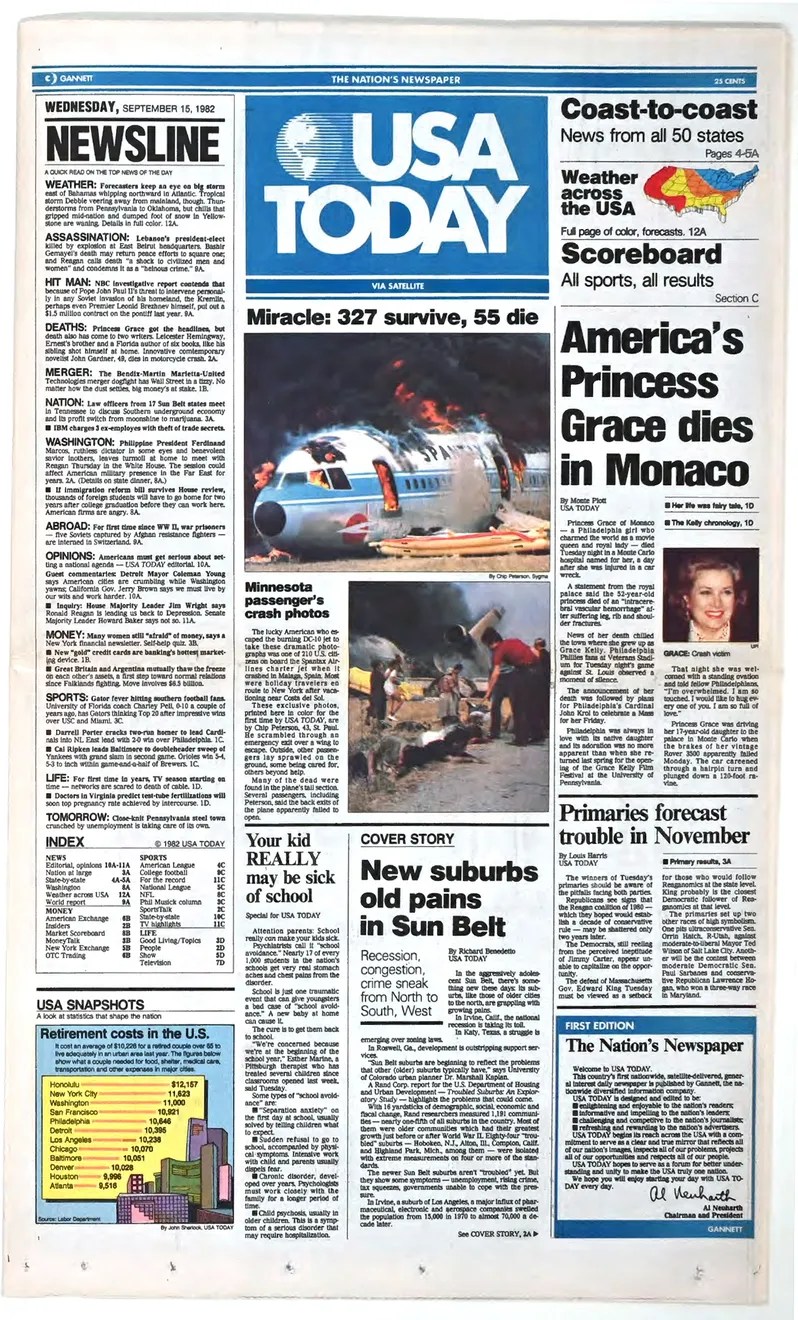
As we survive the surfeit, we might recall one of the larger steps toward the media environment in which we wallow was taken on this date in 1982: USA Today dropped its first issue.
The paper’s overall style– shorter articles, color photographs, an elevated use of graphics… and no longer, in-depth stories– was unique among newspapers at the time. Critics were largely unamused, referring to it as a “McPaper” or “television you can wrap fish in.” But as it succeeded, it changed the appearance and feel of newspapers around the world (in ways that anticipated the content and form/design of online jouranlism). Today, of course, while a print version survives, USA Today’s primary footprint is digital.
“A free press can, of course, be good or bad; but, most certainly without freedom, the press will never be anything but bad”*…

Your correspondent is writing this post a few days early, on Friday, the 18th, the day after Congress passed the bill terminating federal funding for public broadcasters, now at the White House for signature. It’s a dark day, especially for those rural areas that stand to lose their only local media outlets and journalistic sources. But while this is, your correspondent believes, tragic, it is only a corner of the larger media “battlefield,” most of which isn’t non-commerical…
Rusty Foster on the frankly terrifying moves afoot on that broader terrain…
Yesterday Washington Post Opinion columnist Philip Bump announced he was parachuting out of the Post’s extremely hardcore new right-wing reinvention by taking a buyout. Bump was the last remaining reason to visit the Post’s Opinion section, where he was a thoughtful and methodical practitioner of what we would have called “data journalism” before the spectacular flameout of Nate Silver’s career and the entire existence of David Leonhardt made the term too embarrassing to use. His last column was titled “When institutions crumble, strongmen step in,” and looked at a range of polls quantifying the decades-long decline of Americans’ trust in our institutions, including the news media. Bump’s tenure at the Post ended with the words:
Trump has for years stoked the idea that actually, having your own facts is fine. And even as his base chooses facts that he finds inconvenient in the moment, he’s still pushing toward the next phase: Everyone is entitled to the facts that Trump presents.
What institutions of power will be left to disagree?
In his monologue Tuesday, CBS Late Show host and my former boss’s former boss Stephen Colbert called his (soon to be) former boss’s current boss Paramount Corporation’s $16 million settlement with Donald Trump “a big fat bribe.”
Last night, Colbert announced that CBS will cancel The Late Show entirely at the end of his current contract, in May 2026. Colbert is currently the number one show in late night, and according to Jed Rosenzweig in LateNighter, “CBS’s Late Show was the only show among the nine tracked by LateNighter to draw more total viewers in Q2 than it had in the first quarter of 2025.” CBS released a statement saying that “This is purely a financial decision against a challenging backdrop in late night. It is not related in any way to the show’s performance, content or other matters happening at Paramount.”
It’s definitely not part of the Trump bribe. Do not put in the newspaper that this is part of the Trump bribe. We’re just canceling the number one show in its time slot because of… reasons. Backdrops! Headwinds! Serious TV business.
This is, of course, obvious bullshit. Parker Molloy pulled together all the red yarn better than I would’ve had the patience to, so just go read why it’s bullshit over at The Present Age. But the main thing to know is that this whole CBS/Paramount/Trump settlement happened in order to secure Trump administration approval for a media holding company called Skydance to “merge with” (i.e. purchase) Paramount. Skydance is run by David Ellison, a large adult Butthead and the number one boy of Oracle founder, Donald Trump pal, and the world’s second-richest person Larry Ellison, who gave his son $8 billion to buy Paramount and turn it into more of the same cynical garbage that every other media company has become.
Earlier this week I met someone new and he asked me what I do for a living, and I said “I’m a writer,” and he said “Oh, what do you write?” This conversation happens often enough, and in virtually the same words, that I recognized right away where we were headed. I told him about Tabs and at that point although my new friend didn’t know it yet, we were already on a greased slide toward the moment where I would say: “…but these days I only write it once or twice a week, because the American news media has been systematically and intentionally destroyed by a handful of billionaires.”
“I realize that sounds a little crazy!” I always add with an apologetic laugh, because while outwardly he’s nodding and making a polite “oh really!” face, I can tell that on the inside he’s expecting me to bring up MKULTRA and possibly the JFK assassination next. But it’s not crazy, and you don’t need to believe in any conspiracy theories to see what’s happened. For example:
In 2008, Sam Zell bought the Tribune Corp, loaded it with debt like it was a distressed office building, and installed a drunk1 radio DJ to run it. The Tribune Corp promptly went bankrupt and as part of its ensuing slow-motion collapse sold the LA Times to biotech tycoon Patrick Soon-Shiong in 2018. By 2025, Soon-Shiong had purged the LA Times of any elements distressing to his distinctly South African sensibility, such as institutional commitment to newsroom diversity or informing the public about things he would prefer we didn’t know.
Jeff Bezos bought the Washington Post for a pittance in 2013, and for several years operated it as a reasonable and hands-off steward. But ten years later, Bezos would have a jacked new physique, a buxom new girlfriend, and soon he’d have a whole new set of buddies to impress. Claiming the Post was “on a pace to lose about $100 million in 2023,” (an amount of money it would take Jeff Bezos fully 28.5 hours of existing in the world to earn back) the newsroom job cuts began. By last summer, Bezos was bigfooting his own Opinion section’s Presidential endorsement and as of today, with craven former British tabloid bagman and drunk2 Will Lewis nominally in charge, almost everyone in the newsroom who could get out has gotten out and the paper continues hemorrhaging subscribers.
Peter Thiel paid just $10 million to kill Gawker outright, without even the pretense of capitalism justifying it, although he did eventually bid to purchase its remains as a bit. Elon Musk paid $44 billion to turn Twitter into a Matrix-style battery farm feeding a slurry of racist posts into his A.I. MechaHitler. Three days after Trump’s second inauguration, as one witty and perceptive media watcher reported at the time, “CNN head Mark Thompson offered Jim Acosta the option of moving his show from 10am to midnight and renaming it “The Jim Acosta Sucks Fake News Hour (Do Not Watch).” Facebook built a trillion dollar business in part by providing its users a centralized and individualized feed of interesting news stories, and then shut off the click tap as soon as Mark Zuckerburg felt he could afford to. Google built a $2 trillion business indexing news stories for search, as well as absorbing something like one third of online ad spend, with much of that also coming from news websites. But the moment that Google could use A.I. to ingest all that news content and serve it up muddled and lightly de-plagiarized right there on google dot com instead, news publishers immediately saw their search traffic crater too.
This list is by no means comprehensive, it’s just what I could immediately pull off the very top of the domepiece before I got tired of typing. Suffice it to say: many such cases.
When I told my new friend that the American news media has been systematically and intentionally destroyed by a handful of billionaires, he asked an extremely reasonable question, which was: “but why?” And what makes this feel like a conspiracy is that there is no single answer to “why?” Sometimes it’s arrogance, sometimes it’s ideology, sometimes it’s purely money. Often it’s a messy combination of all three.
But if you really want to step back a bit, the reason why is that we have a socioeconomic system that concentrates nation-state level wealth and power in the hands of a few individuals, with virtually no checks on what they can choose to do with it. So if Larry Ellison wants to turn CBS News into Bari Weiss’s Free Press TV, or Jeff Bezos wants to make The Washington Post into an ideological subsidiary of the Cato Institute… what institutions of power will be left to disagree?
It’s not a conspiracy, it’s simply what happened: “Billionaires Destroyed American News Media On Purpose,” from @rusty.todayintabs.com in his essential newsletter Today in Tabs.
Every last one of the links above is worth clicking– but perhaps especially Parker Malloy‘s piece.
(Image above: source)
* Albert Camus
###
As we pray for the press, we might send investigative birthday greetings to Paul Reuter; he was born on this date in 1819. A pioneer of telegraphy and news reporting, he was a reporter, media owner, and the founder of the Reuters news agency (that provides stories both to new outlets and directly to the public).
In 2008, Reuters was acquired by the Thompson Corporation of Canda, resulting in the the Thomson Reuters Corporation. Reuters reporting has been hudged fair and fact-based by three independent assessors.

“Were it left to me to decide whether we should have a government without newspapers, or newspapers without a government, I should not hesitate a moment to prefer the latter”*…

Of course, we don’t have to choose… but, if only by default, we are choosing. Local news is collapsing– and that’s a problem of just the sort that Thomas Jefferson (author of the quote above) feared. A recent report from Muck Rack and Rebuild Local News unpacks the scary details…
In 2000, many Americans lived in a community with journalists — people whose job it was to cover school board decisions, announce small business openings and closures, root out corruption at city hall, warn commuters about road work and trumpet the exploits of the high school teams. Today, most of those journalists are gone. The evaporation of local news coverage has hit small towns and big cities, suburbs and rural areas. Even as the country has grown, we’ve lost journalists.
Using data that’s never been tapped before, we now know just how severe this local journalist shortage has become. Less than a quarter-century ago, the United States had about 40 journalists per 100,000 residents on average. Now, the equivalent number is 8.2 Local Journalist Equivalents, about a 75% decline. (Local Journalist Equivalent is a new measure we’re introducing, akin to a Full Time Equivalent or FTE).
This means that big chunks of the country have severe shortages. Stunningly, more than 1,000 counties — one out of three — do not have the equivalent of even one full-time local journalist. And the “better off” parts of the country are in lousy shape, too. About two-thirds of the counties — home to 217 million people — are below even that already-catastrophic national average of 8.2 Local Journalist Equivalents.
To put that statistic in perspective, that means that if you live in a county of 10,000 people, there wouldn’t be even one full-time reporter to cover all of the schools, the town councils, the economic development projects, basketball games, environmental decisions, local businesses, and local events. There are 97,000 cities, towns, counties and other units of government. This report shows that there are the equivalent 27,000 local journalists. Most governments, most neighborhoods, and most residents are being covered poorly or not at all.
We also cannot assume the local news crisis is largely a rural phenomenon. The new data shows the extent to which the layoffs of journalists over time have left acute reporting shortages in many urban and suburban areas. If you’re in a big city like Los Angeles, which has a mere 3.6 Local Journalist Equivalents per 100,000 people, your neighborhood might be covered if there’s a serious crime but not much else. You may get little reliable information on local candidates in many of L.A. County’s cities, whether the schools in your neighborhood are improving, whether the hospital nearby has a bad mortality rate, or how inspiring people might be working to repair your playground.
The crisis is more severe and widespread than previously thought…
A map of how many local journalists cover each U.S. county reveals in stark detail the stunning collapse in local reporting: “Local Journalist Index 2025,” from @muckrack.com and @rebuildlocalnews.bsky.social. Eminently worth reading in full.
And note that many of the journalists who have survived are toiling under private equity ownership… which is effectively managing further decline.
Please consider supporting your local, non-profit public media organizations. They face threats from the Trump Administration (and several states, e.g.), and beyond those, face the challenges of continuing to adapt to a changing media environment. Despite that, they continue to do the work sessential to an effective democracy.
* Thomas Jefferson
###
As read all about it, we might recall that it was on this date in 2003 that Robert Novak violated journalistic ethics when he used his column in the Washingtom Post to “out” Valerie Plame as a CIA operative…
Plame was the wife of Ambassador Joseph Wilson, a career diplomat that had been the US Ambassador to a few minor countries and had served other diplomatic roles. Plame, who was already a CIA agent when she married Wilson, was used to good advantage by the CIA with her husband providing diplomatic cover.
All that changed when Wilson angered the administration of George W. Bush by publicly opposing the expected invasion of Iraq, explaining that on a fact finding mission to Africa he had discovered the alleged attempt by Iraq to acquire uranium was false.
Information was leaked to [conservative columnist] Robert Novak of the Washington Post about Plame’s job as a CIA agent, and he dutifully published the information. Plame’s position as a CIA agent was compromised, and having been outed made her useless to the CIA, resulting in her resignation and the end of her 18 year career in the CIA. This vindictive act of political dirty tricks undermined the security of the United States, but apparently the perpetrators cared more about their own politics than the good of the country. Plame was clearly sacrificed to get at Wilson for having the gall to (honestly) undermine the false case for invading Iraq.
Lewis “Scooter” Libby, a high ranking Bush administration official was not charged with illegally revealing Plame’s position with the CIA or with also revealing secret intelligence estimate information to the New York Times. Libby was indicted, however, for various counts of lying and obstructing justice. He was convicted of 4 of those counts and received a 30 month prison sentence. President George W. Bush commuted the sentence, removing the jail time but leaving the fine and probation and allowing the conviction to stand. It was later revealed that Richard Armitage, a deputy secretary of state, was the actual source of the leak to Novak.
After the trial, baffled jurors wondered to the press why Karl Rove and vice-president Dick Cheney had not been on trial. Many observers wondered the same thing. Wilson and Plame found federal courts to be unsympathetic to their lawsuits and the Obama administration was also unsupportive.
Plame had a book published about the incident titled Fair Game in 2007, and in 2010 a movie by the same name was released…

“Just the facts, ma’am”*…

It’s getting harder and harder to sift the wheat from the chaff– the truth from the misinformation, disinformation, and just plain noise. Here to help, Rocky Parker, with a collection of verification tools– aimed at journalists, but available to us all…
Presenting accurate information to readers is crucial to journalists maintaining trust with their readers. But despite journalists’ best efforts, trust in the media continues to be an issue. The latest American Views report from Gallup and the Knight Foundation found that more U.S. adults have no trust at all in the media (36%) than trust it a great deal or fair amount.
The explosion of AI-generated content on the internet has only added another layer and more complications as readers and journalists work to determine who (or what) created a piece of content and if it’s accurate. And if you’re sourcing story ideas from social media, the recent removals of fact-checking teams from several platforms will make your verification even more difficult.
In light of these challenges… we thought it’d be a good time to round up a few verification tools that journalists should bookmark…
“20 Helpful Verification Tools for Journalists” (and the rest of us).
* Stan Freberg’s parody of “Sgt. Joe Friday” (Jack Webb) on Dragnet
###
As we confirm, we might might recall that it was on this date in 1941 that Orson Welles’ first feature film, Citizen Kane, premiered at the Palace Theater in New York. A quasi-biography (based on the life of William Randolph Hearst, with elements of those of Joseph Pulitzer and Chicago tycoons Samuel Insull and Harold McCormick), it was nominated for Academy Awards in nine categories, winning Best Writing (Original Screenplay) for Herman Mankiewicz and Welles.
Considered by many critics and filmmakers to be the greatest film ever made, Citizen Kane was voted number 1 in five consecutive British Film Institute Sight & Sound polls of critics, and it topped the American Film Institute’s 100 Years … 100 Movies list in 1998, as well as its 2007 update.
Citizen Kane is particularly praised for Gregg Toland‘s cinematography, Robert Wise‘s editing, Bernard Herrmann‘s music, and its narrative structure, all of which were innovative and have been precedent-setting.
- Kane (in his role as owner of The Inquirer): Read the cable.
- Mr. Bernstein (Kane’s business manager): “Girls delightful in Cuba. Stop. Could send you prose poems about scenery, but don’t feel right spending your money. Stop. There is no war in Cuba, signed Wheeler.” Any answer?
- Kane: Yes. “Dear Wheeler: you provide the prose poems. I’ll provide the war.”

“The sole aim of journalism should be service”*…

Journalism in the U.S. is in turmoil, beset by cultural shifts, technology, economics, and politics. Today, two thoughful pieces on what its future could hold.
First, from Richard Gingras, a long (and fascinating and provocative) piece that diagnoses the situation, traces its evolution, and posits (at least approaches to) solutions. Eminently worth reading in full. Here, an excerpt especially resonant for your correspondent…
… I recently revisited the work of Robert Putnam. Putnam has researched the connection between effective governance and community engagement for five decades. He began his work in Italy, which in 1975 shifted power from the central government to the provinces. He found that the strongest corollary with effective governance was community engagement.
Basically, people in regions of ineffective governance were not joining clubs, they weren’t going on picnics or joining bowling leagues. They weren’t getting to know people who were different from them. They weren’t building a shared reality. They weren’t building social capital.
This is the result of many factors: the rise of television, increased suburbanization, the impact of technology and the Internet. The result is increased isolation, a narrowing of empathy, a reduction in common interest. Without community and real world social engagement we are not exposed to the diversity of our communities. We lose the opportunity to understand the challenges and the attributes of people who are not like us. If we don’t engage with the other, with those who are not like us, we become more vulnerable to perceiving the other from an isolated, removed, silo of fear.
Our greatest opportunity may be at the community level, by rethinking the role of a community news organization as a community platform suited to our modern digital world.
First, its explicit mission would be to strengthen the community, to both address the community’s information needs and create opportunities for engagement. In seeking to bring the diversity of a community together, it would also strive to be assiduously apolitical. Again, we inform, you decide.
Second, it would celebrate the community’s hopes and dreams, giving focus to its successes, to examples of civic empathy, as well as being the watchdog for misbehavior.
It would purposely address the community’s broad information needs — community events, local sports, the progression of life from birth to obituary. It would leverage topics of community interest that aren’t controversial. A recent mega-study coordinated by Stanford University determined the best method of addressing divisiveness is to engage the community on non-controversial subjects. This can help unify a community and build the trust necessary to address more difficult topics.
We see accountability journalism as the priority, to ferret out corruption, to expose criminal behavior. It is critical. But the audience for serious accountability journalism is small, in the low single digits. By addressing a community’s comprehensive information needs with service journalism, we can provide value to the community and gain exponentially higher engagement. This both drives the business model and increases the impact of accountability journalism by exposing it to those who might not seek it out…
– “The evolution of media and democracy. How we got here. How we might move forward.“
Next, a piece from Patrice Schneider, the Chief Strategy Officer of Media Development Investment Fund, suggesting a funding approach that might make (more quality) journalism (more) viable. While his lens is global, the applicability to the U.S. is clear…
In the dynamic landscape of independent media funding, a three-decade-old model is gaining renewed attention among European foundations. It challenges the traditional dichotomy between grant support and market-driven investments. This innovative approach, known as the Third Way, offers a nuanced economic strategy that quantifies the intrinsic societal value of quality public interest information.
The Third Way recognizes quality information as critical infrastructure, akin to highways or electrical grids. Its value extends beyond immediate monetary returns, encompassing its capacity to sustain democratic dialogue, enable informed citizenship, and provide systemic transparency…
… The Third Way’s most profound insight is recognising the broad constituency invested in quality information:
- Corporations require reliable, unbiased data for strategic decision-making.
- Financial institutions depend on transparent market intelligence.
- Civil society organizations need independent reporting to monitor power structures
- Individual citizens seek credible narratives to navigate complex global challenges
- Sustainable Development Goals (SDGs) fundamentally rely on access to accurate, independent information
By aligning these diverse interests, the model transcends traditional funding dichotomies; grants versus investments or market versus public funding.
And it’s not just about extracting more from philanthropy, but about creating a blended infrastructure of funding that recognises information as a shared societal resource...
– “The Third Way of Funding Independent Media” (again, eminently worth reading in full)
(Full disclosure, both Richard and Patrice are colleagues. MDIF– originally Media Development Loan Fund– was founded by an old friend, Saša Vučinić, and your correspondent was an early investor.)
* Mahatma Gandhi
###
As we nourish the news, we might spare a thought for Alistair Cooke; he died on this date in 2004. While best known ot American audiences as a television host (Omnibus, Masterpiece Theatre), he had a long career as a journalist (for the BBC, NBC, The Gaurdian, and others) and author.
After Alistair Cooke’s death the Fulbright Alistair Cooke Award in Journalism was established as a tribute to his life and career achievements. The award supports students from the United Kingdom to undertake studies in the United States, and for Americans to study in the United Kingdom.

You must be logged in to post a comment.