Posts Tagged ‘Italy’
“Everyone sees what you appear to be, few experience what you really are”*…

Riverside Shakespeare Company production of The Mandrake Root, at the Casa Italia, New York, 1979, with a young Tom Hanks (center). Photograph by W. Stuart McDowell – Source
Most familiar today as the godfather of Realpolitik and as the eponym for all things cunning and devious, the Renaissance thinker Niccolò Machiavelli also had a lighter side, writing as he did a number of comedies. Christopher S. Celenza looks at perhaps the best known of these plays, Mandragola [The Mandrake Root], and explores what it can teach us about the man and his world…
More at “Machiavelli, Comedian.”
* Niccolò Machiavelli
###
As we ponder power, we might recall that it was on this date in 1515 that Thomas Wolsey was invested as a Cardinal. Henry VIII became King of England in 1509; Wolsey became the King’s almoner. Wolsey’s affairs prospered, and by 1514 he had becomeLord Chancellor, the King’s chief adviser– the controlling figure in virtually all matters of state, and extremely powerful within the Church. (His elevation to Cardinal gave him precedence even over the Archbishop of Canterbury.)
He fell from the King’s graces after failing to negotiate an annulment of Henry’s marriage to Catherine of Aragon and was stripped of his government titles. He retreated to York to fulfill his ecclesiastical duties as Archbishop of York, a position he had nominally held but had neglected during his years in government. He was recalled to London to answer to charges of treason—a common charge used by Henry against ministers who fell out of favor—but died en route of natural causes.

“The map is not the territory”*…

As regular readers will know, (Roughly) Daily is extremely enthusiastic about maps. So your correspondent is especially grateful to Andrew Wiseman for his very helpful “readers’ guide”: “When Maps Lie- Tips from a geographer on how to avoid being fooled.”
###
As we uninstall Apple Maps, we might recall that it was on this date in 1871 that Victor Emmanuel II set up the capital of the newly-unified Italy in Rome (recently “acquired” from the Papal States). The first king of a united Italy since the 6th century, he had been king of Sardinia before– the second “Victor Emmanuel” in that role. On claiming the Italian crown, he decided to keep “II,” a missed PR opportunity, as he could have proclaimed himself “I” (of Italy), signaling a fresh start.

“TWO AND TWO MAKES FIVE”*…

George Orwell and Aldous Huxley
In October of 1949, a few months after the release of George Orwell‘s dystopian masterpiece, 1984, he received a letter from fellow author (and Orwell’s French tutor at Eton) Aldous Huxley — who had, 17 years earlier, published his own grim vision of society’s future, Brave New World. What begins as a letter of praise becomes a comparison of the two novels– and an explanation of why Huxley believes his own, earlier work to be the more realistic prediction…
Wrightwood. Cal.
21 October, 1949Dear Mr. Orwell,
It was very kind of you to tell your publishers to send me a copy of your book. It arrived as I was in the midst of a piece of work that required much reading and consulting of references; and since poor sight makes it necessary for me to ration my reading, I had to wait a long time before being able to embark on Nineteen Eighty-Four.
Agreeing with all that the critics have written of it, I need not tell you, yet once more, how fine and how profoundly important the book is. May I speak instead of the thing with which the book deals — the ultimate revolution? The first hints of a philosophy of the ultimate revolution — the revolution which lies beyond politics and economics, and which aims at total subversion of the individual’s psychology and physiology — are to be found in the Marquis de Sade, who regarded himself as the continuator, the consummator, of Robespierre and Babeuf. The philosophy of the ruling minority in Nineteen Eighty-Four is a sadism which has been carried to its logical conclusion by going beyond sex and denying it. Whether in actual fact the policy of the boot-on-the-face can go on indefinitely seems doubtful. My own belief is that the ruling oligarchy will find less arduous and wasteful ways of governing and of satisfying its lust for power, and these ways will resemble those which I described in Brave New World. I have had occasion recently to look into the history of animal magnetism and hypnotism, and have been greatly struck by the way in which, for a hundred and fifty years, the world has refused to take serious cognizance of the discoveries of Mesmer, Braid, Esdaile, and the rest.
Partly because of the prevailing materialism and partly because of prevailing respectability, nineteenth-century philosophers and men of science were not willing to investigate the odder facts of psychology for practical men, such as politicians, soldiers and policemen, to apply in the field of government. Thanks to the voluntary ignorance of our fathers, the advent of the ultimate revolution was delayed for five or six generations. Another lucky accident was Freud’s inability to hypnotize successfully and his consequent disparagement of hypnotism. This delayed the general application of hypnotism to psychiatry for at least forty years. But now psycho-analysis is being combined with hypnosis; and hypnosis has been made easy and indefinitely extensible through the use of barbiturates, which induce a hypnoid and suggestible state in even the most recalcitrant subjects.
Within the next generation I believe that the world’s rulers will discover that infant conditioning and narco-hypnosis are more efficient, as instruments of government, than clubs and prisons, and that the lust for power can be just as completely satisfied by suggesting people into loving their servitude as by flogging and kicking them into obedience. In other words, I feel that the nightmare of Nineteen Eighty-Four is destined to modulate into the nightmare of a world having more resemblance to that which I imagined in Brave New World. The change will be brought about as a result of a felt need for increased efficiency. Meanwhile, of course, there may be a large scale biological and atomic war — in which case we shall have nightmares of other and scarcely imaginable kinds.
Thank you once again for the book.
Yours sincerely,
Aldous Huxley
Source: Letters of Aldous Huxley, (via Letters of Note); image: George Orwell (via) & Aldous Huxley (via).
* George Orwell, 1984
###
As we reach for the Soma, we might recall that it was on this date in 1919 that Benito Mussolini reformed the Milan fascio (literally, “bundle” or Sheaf”; here, a small political party) as the Fasci Italiani di Combattimento (Italian Combat Party). Its 200 members, answering Mussolini’s call for men “ruthless and energetic enough to make a clean sweep,” were the seed from which the Italian Fascist Movement grew.

The platform of Fasci italiani di combattimento, as published in Il Popolo d’Italia in 1919

Mussolini a few years later, in his self-proclaimed role as Il Duce (The Leader).
“Perhaps catastrophe is the natural human environment, and even though we spend a good deal of energy trying to get away from it, we are programmed for survival amid catastrophe”*…

On January 21, a huge boulder smashed through a farm in Northern Italy after being dislodged by a landslide. The massive rock narrowly missed a farm house, destroyed a barn, and stopped in a vineyard at the property in Ronchi di Termeno.

A second giant boulder detached during the landslide stopped behind the house.

The family living there was unharmed.
[via the BBC]
* Germaine Greer
###
As we count our blessings, we might recall that it was on this date in 1938 that a series of freak waves struck Bondi Beach in Sydney, Australia. The waves, which pulled people back into the sea, caused 5 deaths by drowning and necessitated the rescue of a further 250 who been dragged hundreds of yards off shore. The day has become known as “Black Sunday” in Australia.

Bondi Beach in more placid times
Freudian Slips…
From Fox News, announcing the big news story of May 1:
 BREAKING NEWS
Obama Bin Laden Dead
Still, Happy World Press Freedom Day!
As we remember that, to paraphrase Craig Newmark, a free press is the immune system of a democracy, we might wish a crafty Happy Birthday to Niccolò di Bernardo dei Machiavelli; he was born on this date in 1469. Machiavelli wrote comedies, poetry, and some of the best-known personal correspondence in Italian; but he is best remembered as a Man of Affairs, first as a servant of the Florentine Republic in a time during which Medici influence was on the wane. His most famous work, The Prince— first published as a pamphlet in 1513– was written mid-career to gain favor with the Medici, who were at that point regaining dominance in Florence. The essay on the exercise of power (inspired by Cesare Borgia) not only failed to win over the Medici, it alienated Machiavelli from the Florentine public; he never again played an important role in government. Indeed, when the Florentine Republic was established in 1527, Machiavelli was effectively ostracized.
But published in book form posthumously (in 1532), The Prince began its steady growth in influence. And indeed today, Machiavelli is considered one of the fathers of modern political theory.
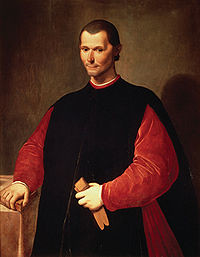 Niccolò Machiavelli by Santi di Tito (source)
You must be logged in to post a comment.