Posts Tagged ‘Inquisition’
Atavistic Tendencies: what’s old is new…

A team of astrobiologists, working with a a group of oncologists, has suggested that cancer resembles ancient forms of life that flourished between 600 million and 1 billion years ago. The genes that controlled the behavior of these early multicellular organisms still reside in our own cells, managed by more recent genes that keep them in check. It’s when these newer “control genes” fail that the older mechanisms take over, the cell reverts to its earlier behaviors– and cancer does its growing-out-of-control damage.
Reporting in the journal Physical Biology, Paul Davies and and Charles Lineweaver explain
“Advanced” metazoan life of the form we now know, i.e. organisms with cell specialization and organ differentiation, was preceded by colonies of eukaryotic cells in which cellular cooperation was fairly rudimentary, consisting of networks of adhering cells exchanging information chemically, and forming self-organized assemblages with only a moderate division of labor…
So, they suggest, cancer isn’t an attack of “rogue cells,” evolving quickly to overpower normal biological-metabolic routines; it’s a kind of atavism, a throwback… In conversation with Life Scientist, Lineweaver elaborates
Unlike bacteria and viruses, cancer has not developed the capacity to evolve into new forms. In fact, cancer is better understood as the reversion of cells to the way they behaved a little over one billion years ago, when[life was] nothing more than loose-knit colonies of only partially differentiated cells.
We think that the tumors that develop in cancer patients today take the same form as these simple cellular structures did more than a billion years ago…
The explanation makes a powerful kind of sense, at least at a systemic level: cancers occur in virtually all metazoans (with the exception of the altogether weird naked mole rat). As Davies and Lineweaver note, “This quasi-ubiquity suggests that the mechanisms of cancer are deep-rooted in evolutionary history, a conjecture that receives support from both paleontology and genetics.”
The good news, Life Scientist observes, is that this means combating cancer is not necessarily as complex as if the cancers were rogue cells evolving new and novel defence mechanisms within the body.
Instead, because cancers fall back on the same evolved mechanisms that were used by early life, we can expect them to remain predictable, thus if they’re susceptible to treatment, it’s unlikely they’ll evolve new ways to get around it.
“Given cancer’s formidable complexity and diversity, how might one make progress toward controlling it? If the atavism hypothesis is correct, there are new reasons for optimism,” [Davies and Lineweaver] write.
[TotH to slashdot]
As we resist the impulse, remembering that there are other good reasons not to smoke, we might recall spare a thought for Giordano Bruno, the Dominican friar, philosopher, mathematician and astronomer whose concept of the infinite universe expanded on Copernicus’s model; he was the first European to understand the universe as a continuum where the stars we see at night are identical in nature to the Sun. Bruno’s views were considered dangerously heretical by the (Roman) Inquisition, which imprisoned him in 1592; after eight years of refusals to recant, on this date in 1600, he was burned at the stake.

“There are now about as many different varieties of letters as there are different kinds of fools”*…
From the web design house Squidspot,
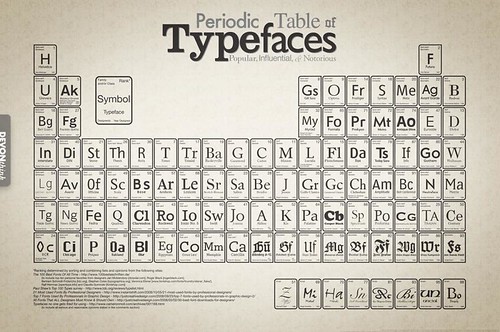 The Periodic Table of Typefaces (click here for zoomable version)
* a quote from Eric Gill, the creator of, among other fonts, the redoubtable Gill Sans (on the chart above).
As we make an effort to be as careful in choosing our letters as we are our words, we might recall that it was on this date in 1633 that the formal inquest of Galileo Galilei by the Inquisition began. Readers will recall that two months later the Holy Office in Rome forced Galileo to recant his conclusion that the Sun, not the Earth, is the center of the Universe. Galileo is said to have muttered “Eppur si muove!” (“Yet, still, it moves!”).
 Cristiano Banti’s 1857 painting, “Galileo facing the Roman Inquisition”
Remembrance of Things Vast…
From the Himalayas, through our atmosphere, then dark space all the way out– that’s to say, back– to the afterglow of the Big Bang: the American Museum of Natural History presents The Known Universe.
Every star, planet, and quasar seen in the film is possible because of the world’s most complete four-dimensional map of the universe, the Digital Universe Atlas that is maintained and updated by astrophysicists at the American Museum of Natural History. The new film, created by the Museum, is part of an exhibition, Visions of the Cosmos: From the Milky Ocean to an Evolving Universe, at the Rubin Museum of Art in Manhattan through May 2010.
For more information visit the Museum’s web site.
(ToTH to Jesse Dylan)
As we stand in the places we are, we might recall that it was on (or about, historians are imprecise) this date in 1232 that Pope Gregory IX sent the first Inquisition team to the Kingdom of Aragon, in Spain, to prosecute the Albigensian heresy.
 Saint Raymond of Penyafort, who codified the Canon Law for Gregory IX
You must be logged in to post a comment.