Posts Tagged ‘folding’
“Simplicity, carried to the extreme, becomes elegance”*…

Jordana Cepelewicz on a very different approach to computing…
In 1936, the British mathematician Alan Turing came up with an idea for a universal computer. It was a simple device: an infinite strip of tape covered in zeros and ones, together with a machine that could move back and forth along the tape, changing zeros to ones and vice versa according to some set of rules. He showed that such a device could be used to perform any computation.
Turing did not intend for his idea to be practical for solving problems. Rather, it offered an invaluable way to explore the nature of computation and its limits. In the decades since that seminal idea, mathematicians have racked up a list of even less practical computing schemes. Games like Minesweeper or Magic: The Gathering could, in principle, be used as general-purpose computers. So could so-called cellular automata like John Conway’s Game of Life, a set of rules for evolving black and white squares on a two-dimensional grid.
In September 2023, Inna Zakharevich of Cornell University and Thomas Hull of Franklin & Marshall College showed that anything that can be computed can be computed by folding paper. They proved that origami is “Turing complete” — meaning that, like a Turing machine, it can solve any tractable computational problem, given enough time…
Read on for more on how folding paper can, in principle, be used to perform any possible computation: “How to Build an Origami Computer” from @jordanacep in @QuantaMagazine.
* Jon Franklin
###
As we contemplate calculation, we might send entropic birthday greeting to Rolf Landauer; he was born on this date in 1927. A physicist, we made important contributions made important contributions in several areas of the thermodynamics of information processing, condensed matter physics, and the conductivity of disordered media… most of which important to the development of computing (of the electronic variety).
He is best known for his discovery and formulation of what’s known as Landauer’s principle: that in any logically irreversible operation that manipulates information, such as erasing a bit of memory, entropy increases and an associated amount of energy is dissipated as heat– a “thermodynamic cost of forgetting,” relevant to chip design (how closely packed elements can be on a chip and still handle the heat), reversible computing, quantum information, and quantum computing… but not an issue for origami.)

“Luxury lives in the finer details. It’s a cloth napkin at a dinner table.”*…
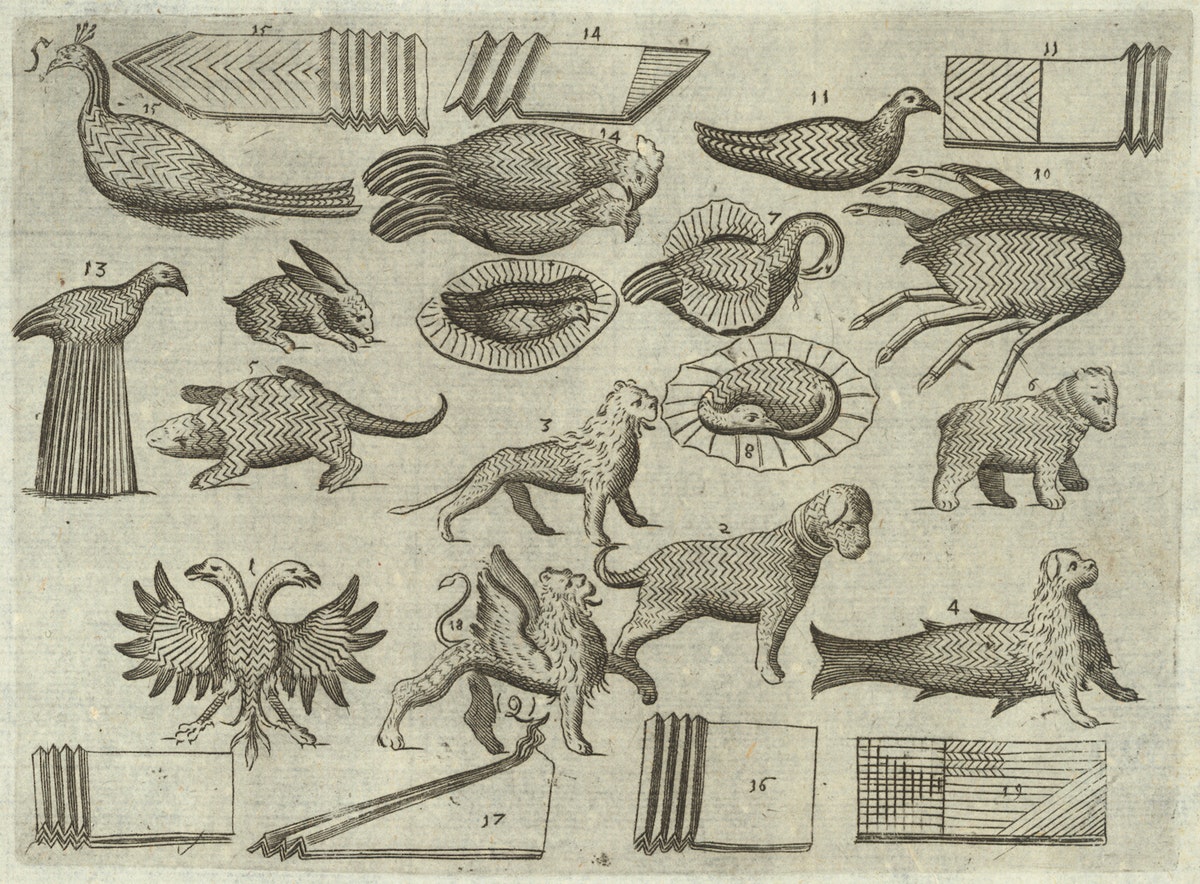
“There should always be a pretty centerpiece”, instructs Sarah Field Splint in The Art of Cooking and Serving, a Depression-era etiquette guide that greased the rails for Crisco shortening’s steady slide into the American home. During Margaret Atwood’s 2006 short story named after Splint’s book, her preteen protagonist weighs decoration against utility. “The charm of my centrepiece would not however cancel out the shabbiness of our paper napkins”. Mattia Giegher’s 1629 Trattato delle piegature (Treatise on folding) offers an elegant solution to the young girl’s quandary: nix the centerpiece and fold your napkins into finery worthy of display.
Giegher’s Trattato appeared as part of Li tre tratatti (1629), joining his earlier works on meat carving (Il trinciante) and stewardship (Lo scalco). While we crease modern napkins as an entrée to the main task — a lap dam for gravy, say, or neck-tucked against crustacean spray — Giegher’s creations were never meant for dabbing. These were starched objets d’art.
During the fifteenth century in northern Italy and southern Germany, technical knowledge of the mechanical arts (think: crafts, machinery, and culinary recipes) began to appear in vernacular writing. “Why around 1400 did artisans take up pen and paper with such gusto?” asks Pamela H. Smith about these early modern how-to guides. Her answer involves war technologies, state power, and urban, cultural exchange. Come the seventeenth century, with literacy on the rise in pockets of Europe, the proliferation of manuals on carving, table service, and, in Giegher’s case, napkin folding suggests a widening interest in knowledge once exclusive to the princely domain…
The history and cultural significance of a lost art (plus lots of nifty pictorial examples): “Serviette Sculptures: Mattia Giegher’s Treatise on Napkin Folding.”
* Iggy Azalea
###
As we practice pleating, we might send amusing birthday greetings to John Garnet Carter; he was born on this date in 1883. A hotelier who ran a lodge at Lookout Mountain, Tennessee/Rock City, Georgia, he built the first “Tom Thumb Golf” course to keep the children of his guests occupied– only to find that the attraction was a hit with adults.
Miniature golf dates back to the 19th century in the UK and the earlier 20th century in the U.S., when putting greens became attractions in their own right. But Carter’s patented “Tom Thumb” approach– which incorporated tile, sewer pipe, hollow logs, and other obstacles, along with fairyland statuary– earned him the honorific “Father of Miniature Golf.”

You must be logged in to post a comment.