Posts Tagged ‘epistemic collapse’
“Vladimir: I don’t understand. Estragon: Use your intelligence, can’t you? Vladimir uses his intelligence. Vladimir (finally): I remain in the dark.”*…
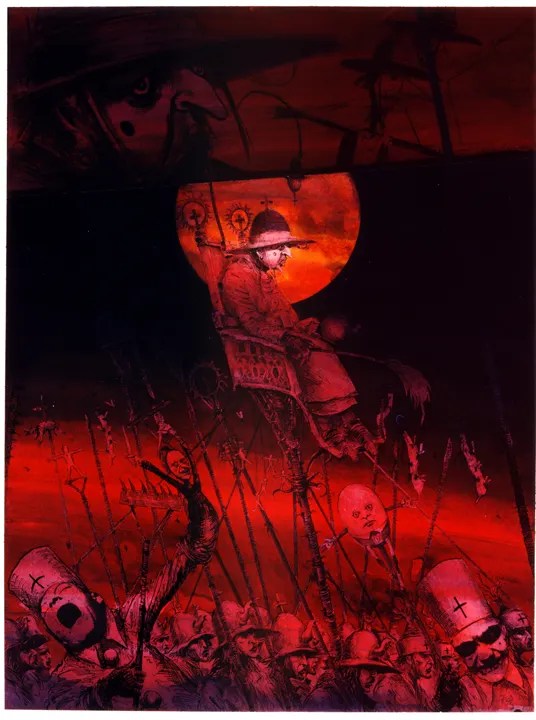
Henry Farrell on the selection of M. John Harrison‘s The End of Everything as the winner of this year’s Booker Prize…
M. John “Mike” Harrison just won the Booker Prize, to everyone’s surprise, including his own. He’s one of the great writers of our era, and perhaps the best single chronicler of the time we’re in, but most people probably hadn’t heard of him before last night. I imagine many people are uncertain where to start so here is my guide…
The TLDR is that Harrison has been walking ahead of us for decades into a strange and uncertain future. That he has received the Booker (with generous comments from judges suggesting that they very much get what he’s up to) suggests that we’re finally beginning to catch up.
You can’t and shouldn’t describe Mike as a science fiction and fantasy writer; you can’t and shouldn’t describe him as not being one either. When you say that someone has a complicated relationship to a genre, you are usually committing a euphemism. In Mike’s case, it is the visible truth.
The best way that I can explain it is that he has taken the limitations of these genres and used them not as an excuse for escaping into “literature,” but as a means for mapping the limitations of literature too; its difficulties in capturing the realities of a world that is being rebuilt by technology and suffused by fantasies and science fictional dreams that regularly resemble the worst and most limited extrusions of genre fiction…
I too have read the novel (and like Farrell, several of Harrison’s other works), and I too was pleasantly shocked at its victory. Farrell provides a brisk, informative (and appetizing) tour through Harrison’s work-to-date. Here, let me share Farrell’s assessment of why the Booker judges and the world are, finally, taking notice…
It is not coincidental that this is the moment at which Harrison’s work has really begun to get broader interest and acclaim. The political and moral entropy he describes in his very early story, “Running Down,” (which tackles some of the themes that re-emerge in Sunken Land, but more simply and directly); the confusion of fantasy and the real; the construction of vast science fictional dreams of universal flight that keep on landing us back in the mire and shit. That is the world around us, and we are finally beginning to see it. AI gurus like Elon Musk claim to be building some bland and delightful future along the lines of that predicted in Iain M. Banks’ Culture novels. Banks in fact shared Harrison’s sensibilities: his introduction to a collection of Harrison’s Viriconium stories celebrated not only Harrison’s delight in the particular, but the understanding of the “faint, not even ironic hiss” of the universal zero that suffuses everything that Harrison writes. LLMs are only the latest, and perhaps most literal, version of the fabulous anti-syntax drive that will propel us to the stars.
At last, we are beginning to catch up to where Harrison has been at for a long time. I can’t do better than to finish with his own description of the new novel and what it sets out to do:
One of TEoE’s major differences from an ordinary post-disaster story is that its core event is an explanatory collapse, a cloud of unknowing. This is not a side issue, it is the nature of the disaster described in and by the book. …. Everyone in the book has an opinion about what’s happened: everyone in the book’s opinion is different: that doesn’t amount to a condition describable as “knowledge”. And yet that’s exactly where we find ourselves now. In an age in which speculation is daily offered as a means of managing the real; in which the consumers and editorial staff of a middle class newspaper or broadcast can no longer claim to have any better handle on the world than AN Other Conspiracy Theorist. …
One of the first things about epistemological failure is that you don’t know what you don’t know. A novel which makes that its central thought–and which rigorously passes that condition on to the reader–offends every possible traditional idea about the novel: about the hallowed privilege of knowing and the controlled communication of that knowing to a reader. No wonder the odd Goodreads feather gets ruffled. On the other hand I’m charmed to meet so many readers who have no difficulty whatsoever with these concepts.
It’s lovely that those readers include the Booker Prize committee, which awarded the prize unanimously. I know that he’ll have been particularly delighted that one of the judges compared the book to the stories of Katherine Mansfield, who is one of his touchstones. This is wonderful news altogether.
I couldn’t agree more completely.
“Mike Harrison has won the Booker Prize,” from @himself.bsky.social.
Semi-divergent opinion: Rusty Foster, toward the end of this edition of his always-illuminating newsletter, Today in Tabs (in which he too quotes Farrell’s piece :)
* Samuel Beckett, Waiting for Godot
###
As we read it and reap, we might send never-ending birthday greetings to August Möbius; he was born on this date in 1790. An astronomer and mathematician, he studied under mathematician Carl Friedrich Gauss while Gauss was the director of the Göttingen Observatory. From there, he went on to study with Carl Gauss’s instructor, Johann Pfaff, at the University of Halle, where he completed his doctoral thesis The occultation of fixed stars in 1815. In 1816, he became Extraordinary Professor in the “chair of astronomy and higher mechanics” at the University of Leipzig, where he remained for the rest of his career. Möbius made many contributions to both astronomy and the math that underlay it: he was among the first to conceive the possibility of geometry in more than three dimensions; he introduced homogeneous coordinates into projective geometry; and he pioneered the barycentric coordinate system.
But while he was an influential scholar and professor, he is best remembered for his creation of the “Möbius strip.”

You must be logged in to post a comment.