Posts Tagged ‘working class’
“We won because we insisted that no longer would politics be something that is done to us. Now, it is something that we do.”*…
Further, in a fashion, to yesterday’s post: Noam Lupu and Nicholas Carnes on a glaring imbalance in our electorial politics…
Both major U.S. political parties regularly tout their commitment to working-class Americans and claim to be the party of the working class. However, neither the Democrats nor the Republicans nominate many candidates who spent substantial time in working-class jobs.
This near-absence of people from working-class jobs in the halls of power matters. According to research in the U.S. and in other democracies, safety net programs are stingier, business regulations are flimsier and protections for workers are weaker than they would be if people from working-class jobs went on to hold office at higher rates. Working-class people can sometimes influence policy in other ways, but the fact that so few former workers hold elected office means that working-class interests often fall by the wayside in the world’s political institutions.
We research the causes and effects of the shortage of politicians from working-class jobs. We define working-class jobs as manual labor jobs, like construction worker, service industry jobs like restaurant server, and clerical jobs like receptionist.
We don’t include small-business owners or people who work in jobs that require extensive formal education. Instead, we focus on people in jobs that offer employees little stability or security.
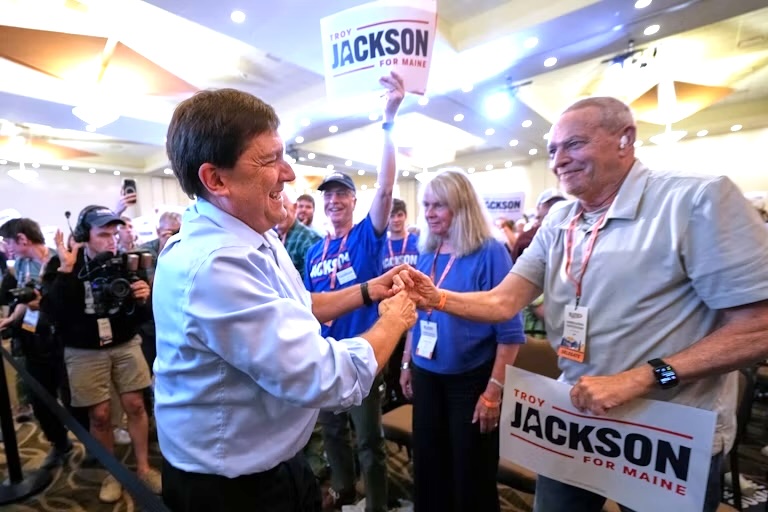
There are, of course, a small number of notable politicians from these kinds of occupations. U.S. Rep. Alexandria Ocasio-Cortez, a New York Democrat, was a bartender before she became a lawmaker. Troy Jackson, Maine’s Democratic Senate candidate, worked as a logger before entering state politics. Indiana state Sen. Jim Tomes, a Republican, worked as a truck driver and union steward.
There are also examples outside the U.S., such as Stefan Löfven, the former prime minister of Sweden, and Luiz Inácio Lula da Silva, the president of Brazil.
Politicians like these often attract outsized media attention, but overall, people from working-class jobs are sharply underrepresented in political institutions.
By our count, about half of all Americans in the labor force have working-class jobs. However, people who last had working-class jobs when they got into politics make up only about 1% of the average state legislature, regardless of their party affiliation. The same goes for Congress.
And the U.S. isn’t alone. Starting in 2016, we partnered with a team of researchers to collect data on 97 of the 103 democracies with more than 300,000 citizens. Like the U.S., the average global democracy draws just 2% of the members of its national legislature from people who last had working-class jobs.
People sometimes blame the shortage of working-class people in office on features of American elections, such as soaring campaign spending or the decline of labor unions.
But even in Germany and Belgium, which offer public financing to candidates, or Finland, where the vast majority of the labor force is unionized, people from working-class jobs make up around 5% or less of the national legislature.
There doesn’t seem to be any shortcoming on the part of working-class Americans that would explain why they so rarely go on to hold office.
Working-class candidates tend to be about as qualified in the ways we can measure as white-collar professionals, about as interested in running for office and about as likely to win when they run.
Our new book, “Keeping Workers Off the Ballot,” shows that what keeps working-class Americans – and their counterparts around the world – out of elected office is that they so rarely run. And that’s because campaigning anywhere for any office at any level of government is personally burdensome, as we show in our book. It takes time and energy, it entails personal risks ranging from embarrassment to physical violence, and the outcome is always uncertain…
… We believe there are ways to overcome the obstacles that keep working-class people out of office.
In a report we wrote for the American Academy of Arts and Sciences, we outline a range of options. Some of the reforms we’re proposing would help in the short term, such as creating candidate training programs or political scholarships that target working-class people. Some examples already exist, such as the New Jersey AFL-CIO’s Labor Candidates School.
Other options, which admittedly might be less likely to happen in the current political environment, would create long-lasting paths to office for working-class people, such as the creation of party or institutional quotas for people from working-class jobs, or randomly selected citizen juries that advise policymakers.
But without serious reform efforts that target the factors that keep workers off the ballot, our research suggests that working-class people will never make up more than tiny fractions of elected officials in the U.S. and in democracies around the world…
Putting the “representative” back into representative democracy: “Why working‑class people account for around 1% of lawmakers in the US – and only 2% in the average democracy around the world,” from @theconversation.com.
And of course some of our elected officials appoint others to office… which has led to our situation becoming even more egregious: “Trump’s Billionaire Boys Club: How Donald Trump has stacked his administration with investment bankers and billionaire businessmen and women.”
See also: “Class wars and the midterms” (“The US economic conversation is expanding to include things such as corruption and the Wall Street-Main Street divide…” Gift article from the Financial Times) and “Upend the trickle-down” (“Neoliberal policies have hollowed out democracies and spawned unchecked oligarchs. Grasping their structure points to a fix…” From Aeon)
* Zohran Mamdani
###
As we play fair, we might recall that it was on this date in 1819 that the Philadelphia Balloon Riot occurred at Vauxhall Garden in Philadelphia.
In the early 1800s, balloon aviation was a novelty in the U.S. So, when the Franklin Gazette of Philadelphia announced that French aeronaut Monsieur Michel would perform a balloon ascension and parachute leap at Vauxhall Garden, tens of thousands arrived to witness the balloon launch. But the one dollar admission fee (equal to $24.77 in 2024) prevented all but the wealthy from taking a closer look at the balloon. After guards beat a boy unconscious for attempting to get a better view by climbing atop a fence separating the paying guests from those who couldn’t afford the expensive entry fee, crowds broke down the fence and ripped the hot air balloon to shreds.

“Despair is perfectly compatible with a good dinner, I promise you”*…

And it’s even more compatible with a dinner that’s not so good…
Today’s prominent food writers… do not hesitate to instruct us on the types of food we should buy (healthy, fresh, organic), the way it should be prepared and served (at home, from scratch, family style), and how harmful it would be—for our bodies, our families, and the planet—to deviate from this model.
In Pressure Cooker: Why Home Cooking Won’t Solve Our Problems and What We Can Do About It, the anthropologists Sarah Bowen, Joslyn Brenton, and Sinikka Elliott do not deny the value of healthy, home-cooked dinners. Instead, they argue that the way our food gurus talk about dinner is fundamentally disconnected from the daily lives of millions of Americans, especially but not exclusively low-income Americans. This discrepancy matters, the authors insist. When Michael Pollan, Mark Bittman, and Jamie Oliver preach their influential, well-compensated sermons about how you—yes, you!—can (and should) improve your family members’ lives by buying healthier food and preparing it at home, they implicitly frame the quality of our dinners as something over which we all wield a considerable degree of control. If you aren’t doing dinner right, it’s because you aren’t trying hard enough for your family: not shopping smartly enough, not doing the right prep work, not using the best recipes. In addition to creating a lot of angst and guilt whenever we fall short, this censorious approach shifts our collective attention away from the bigger forces shaping our lives and meals, blocking the way to more realistic solutions located beyond the kitchen…
Insights into the cooking habits—and daily struggles—of working-class Americans: “The Limits of Home Cooking.”
* William Makepeace Thackeray
###
As we ponder prandial pressure, we might spare a thought for Wilhelm Koppers; he died on this date in 1961. A cultural anthropologist, he developed influential theories on the origins and development of societies based on his studies of hunter-gatherer tribes. A Jesuit priest, who began his career in the intellectual embrace of the Vienna School, his later work– conducted in India and elsewhere while he was a refugee from his home due to his criticism of Nazism– was more scientifically neutral.

You must be logged in to post a comment.