Posts Tagged ‘journalism’
“Writing headlines is a specialty”*…
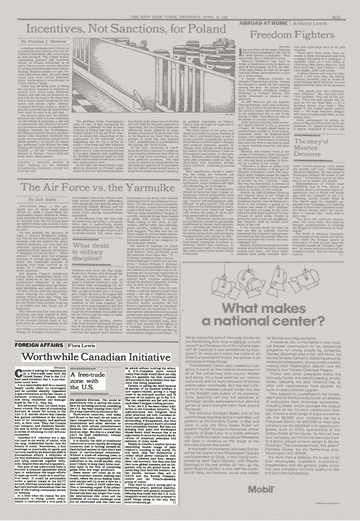
… and some are better at it than others. Greg Ross at Futility Closet illustrates, with an example from kinder, gentler times…
In 1986, Michael Kinsley, editor of The New Republic, spotted the headline “Worthwhile Canadian Initiative” in the New York Times and challenged his readers to come up with a more boring one. This was a tall order: The Times head, someone said, manages to be “not only boring as a whole, but boring word by word.” Submissions included:
- “U.S. Leadership Needed” (New York Times)
- “Trade, A Two-Way Street” (New York Times)
- “Beyond the News, Larger Issues” (New York Times)
- “Thoughts at Graduation Time” (New York Times)
- “Continue Manned Flight in Space” (New York Times)
- “Chill Falls on Warming Relations Between Australia and Indonesia” (New York Times)
- “University of Rochester Decides to Keep Name” (New York Times)
- “Dramatic Changes Fail to Materialize on Hill” (Washington Post)
- “Surprises Unlikely in Indiana” (Chicago Tribune)
- “CIA Analysis Sees Soviet Economy in Need of Changes” (San Diego Union)
- “Prevent Burglary by Locking House, Detectives Urge” (Boston Globe)
- “Methodists Oppose Use of Nuclear Arms” (New York Times)
- “Economist Dies” (Wisconsin State Journal)
- “Turbulent Days for Donald D. Engen” (New York Times)
The winner was found in the New York Times science section: “Debate Goes on Over the Nature of Reality.”
“Strike Up the Bland” (TotH to @frauenfelder.bsky.social and @boingboing.net)
* legendary copy editor Bill Walsh
###
As we reminisce, we might recall that it was on this date in 2022 that the Chinese Communist Party elected Xi Jinping as General Secretary for an unprecedented third term, consolidating his position as China’s paramount leader. The election broke decades of leadership succession tradition (with had limited a supreme leader to two terms) within the Communist Party. A party organ’s headline read “Xi Jinping leads CPC leadership in meeting the press.”

“There is nothing inherently gloomy about the newspaper obituary page. Done well, it should capture life rather than wallow in death.”*…

In an excerpt from his new book, veteran New York Times obituary writer Sam Roberts muses on the form and on how words give shape to legacies…
Tuck Everlasting is a cautionary tale about a family of the same surname who, by inadvertently discovering the proverbial Fountain of Youth, is forced to reconcile with eternity. When I was assigned to write the obituary of the book’s author, Natalie Babbitt, I wondered whether she had continued pondering immortality herself. It turned out she had. Not surprisingly, her own take on eternal life echoed that of the fictional family patriarch, Angus Tuck. “I think that living forever would be a terrible thing,” I quoted her as saying in her Times obituary. “It would be boring, sad and lonely.” Babbitt died when she was 84. But Tuck and her other novels endure as Babbitt’s legacy for readers. So does my obituary, which in 2016 revealed her motivation to become an author: She was inspired to write Tuck, she said, when her four-year-old daughter woke from a nap crying because she was scared of dying. Babbitt had intended to become an illustrator, not an author, but pivoted after taking one writing course in college. She had enrolled because her husband hoped to become a novelist and she wanted to understand the challenges he faced.
Back at the Daily News, obituaries weren’t the best way to achieve immortality. We mostly ran one-paragraph squibs for members of the paper’s family, of printers, pressmen, and their immediate relatives. Instead, like most tabloids, the News thrived on the reported details of murders, assassinations, and suicides. Few news stories generated more of a sensation than death in all its dimensions. No less an authority once defined “news” than the ancient newspaper deliverer—a beloved man known as Bo Gee, who was decades too old to be described as a newsboy—weaving up Second Avenue with a wire shopping cart brimming with Chinese-language newspapers, calling out the headlines as he delivered the papers to Chinese bars and restaurants on Manhattan’s East Side. He began his route in Chinatown, where the papers were printed. Subscribers on Manhattan’s Upper East Side were often a day or two behind the headlines because the last stop on his evening route depended largely on the number of drinks he had finagled from bartenders along the way before he was too wobbly to walk any farther. When a colleague of mine, the columnist Jimmy Breslin (who described him as “a small, thirsty man”), asked him which headlines sold the most papers, he responded unhesitatingly. He didn’t need a public opinion poll or a focus group of readers or a real-time digital analysis of clickbait: Two were surefire circulation boosters. One was war! The other: big guy dies!
Taken separately, obits constitute an individual’s legacy. In aggregate, they can capture the social and cultural currency of an era. Which people are worth remembering? Which values are worth celebrating? How do we measure success and failure, good and evil, achievement and defeat, social rank and professional standing? How many of the one hundred thousand people now immortalized in the periodically printed historical compilation Who Was Who were deemed worthy of obituaries at the time of their death? How many of the more than 33,000 contemporary notables included in the latest editions of Who’s Who will get obituaries when they die? (That the titles of those reference books don’t include question marks suggests that the listings themselves are indisputable, a questionable supposition when the price of inclusion by some publishers seems to be for the “whos” to buy at least one copy of the book. An entry for Michael Fowler Cullis, a former British diplomat, describes his recreation as “writing obituaries for friends.”)
People want to be remembered, and we want to remember them, or, at least, we do. “Obituaries commemorate a life at the point where it is completed by death. Yet the completion is also depletion, in the sense that the life is constructed as meaningful precisely at the point where it stops,” Professor Clare Brant, who teaches literature and culture at Kings College London, has written. “They act as the first version of a biography—sometimes the only one, although Wikipedia has closed the gap with each life story seemingly waiting for a death sentence.” But as valuable as Wikipedia can be, the New York Public Library notes, “Obituaries provide an important tool to researchers by offering biographical information on individuals that may not be readily available elsewhere. In many cases, the obituary supplies the only biographical data extant on a person.” Philip Sutton, a genealogy librarian at the library, told Legacy.com, the self-proclaimed world’s largest commercial provider of online memorials and guest books, that obituaries may reveal the married name of a daughter identified years earlier in the census only by her maiden name; that by identifying an immigrant’s specific birthplace, obituaries can also invigorate research on a family’s roots.
To me, obituaries evoke the heartrending backstories of the characters in Thornton Wilder’s play Our Town, the unfulfilled promise of Joe Crowell, who got a scholarship to the Massachusetts Institute of Technology and graduated first in his class: “Goin’ to be a great engineer, Joe was. But the war broke out and he died in France. All that education for nothing.” Emily is dead, too, but so consumed by nostalgia—before being persuaded that “live people don’t understand, do they?”—that she descends from the town’s cemetery and wants to return to her past life in Grover’s Corners, New Hampshire, until the Stage Manager reminds her, “You not only live it but you watch yourself living it. And as you watch it, you see the thing that they, down there, never know. You see the future. You know what’s going to happen afterwards.” “When I think of an obituary, it’s as objective as journalism can be, a story on someone’s life,” Holly Shreve Gilbert, a journalism instructor at Oakland University who was the interim president of the Funeral Consumers Information Society, told Molly Birnbaum of Atlas Obscura. But “hyper-local journalism is dying, and so is the obituary of the local person.” Gilbert added, “Now, if it’s on Legacy.com or Facebook or a blog, we’re basically whitewashing everyone’s lives. We’re all happy. Everyone is happy.”
Well, not everyone.
Obituaries are a reminder that when you die, someone else gets the last word on your legacy—or, at least, the first of the last words. And for all the beloved and respected and cherished and valued that punctuate paid obituaries, don’t forget that families can try to perpetuate irreverent descriptions unilaterally to settle scores when one is no longer in a position to retaliate or respond. In Shakespeare’s Macbeth, Malcolm declaims of the repentant Thane of Cawdor, who was executed for treason, “Nothing in his life became him like the leaving it.” If the Thane got the benefit of ambiguity, Florence Harrelson of Chelsea, Maine, had no such luck when she died in 2024 and her daughter, Christina Novak, placed a paid obituary in the Kennebec Journal. Wasting no words, the four-line obit read that the 65-year-old Henderson died “without family by her side due to burnt bridges and a wake of destruction left in her path.” It continued, “Florence did not want an obituary or anyone including family to know she died. That’s because even in death, she wanted those she terrorized to still be living in fear looking over their shoulders. So, this isn’t so much an obituary but more of a public service announcement.”…
Read on… The art of the obituary: “Speaking for the Dead,” from @longreads.com.
###
As we remember, we might send healthy birthday greetings to William Oliver; he was born on this date in 1695. A physician and philanthropist, he was a founder of the Royal Mineral Water Hospital in Bath, England, which opened in 1742 and continued to serve patients until 2019, often with treatments involving the geothermal springs at the Roman Baths.
But Oliver is better remembered for a culinary contribution. In a search for food that would suit his dyspeptic patients, he created the Bath bun. But as that proved too fattening for his rheumatic patients, he invented the “Bath Oliver” biscuit, a hard, dry cracker made simply from flour, butter, yeast and milk, and often eaten with cheese. Shortly before his death, Oliver confided the recipe to his coachman Atkins, giving him at the same time £100 in money and ten sacks of the finest wheat-flour. The fortunate recipient opened a shop in Green Street, and soon acquired a large fortune. The “Bath Oliver” is still a well-known type of cracker.


“A free press can, of course, be both good and bad; but, most certainly, without freedom, the press will never be anything but bad”*…

The Fourth Estate is, of course, hugely influential in civic and political life; a free press is essential to the healthy functioning of a democracy, in the U.S. and around the world— more generally to effective self-determination in any society. So the latest World Press Freedom Index from Reporters Without Borders (RSF) is concerning. Indeed, the global state of press freedom has reached a 25-year low.
RSF has been compiling the Index since 2002; as of this year:
• Less than 1% of the global population lives in a country rated as having “good” press freedom.
• More than half of countries and territories now fall into the “difficult” or “very serious” categories, up from 13.7% in 2002.
• The U.S. ranks 64th globally in 2026, down from 17th when the index began.
The index ranks 180 countries and territories based on five indicators: political context, legal framework, economic context, sociocultural context, and journalist safety.
This world map shows press freedom scores around the world in 2026, revealing a widening divide between Europe, the only region with countries rated “good,” and much of the rest of the world.

More on what’s happening and why: “Mapped: Press Freedom Around the World in 2026,” from @voronoiapp.bsky.social (and, of course, much more in the RSF Index)
(Image above: source)
* Albert Camus
###
As we challenge censorship (and oligopolistic control), we might recall that it was on this date in 1917 that the first Pulitzer Prizes were awarded. In his will, Joseph Pultizer specified solely four awards for excellence in journalism, four in books and drama, one for education, and five traveling scholarships.
In journalism, prizes were to recognize “the most disinterested and meritorious public service rendered by any American newspaper during the preceding year” (a gold medal worth $500 with no monetary component); “the best editorial article written during the year, the test of excellence being clearness of style, moral purpose, sound reasoning, and power to influence public opinion in the right direction” ($500); and “the best example of a reporter’s work during the year, the test being strict accuracy, terseness, the accomplishment of some public good commanding public attention and respect” ($1,000). (A $1,000 prize for the best history of services rendered to the public by the American press in the preceding year was only awarded once; similarly, a $1,000 prize for a paper on the development of the School of Journalism was never awarded due to a dearth of competitors.)…
… the Pulitzer Prize Board, has increased the number of awards to 23 and introduced poetry, music, photography, memoir and audio journalism as subjects, while adhering to the spirit of the founder’s will and its intent…
– source
The awards were administered/bestowed by Columbia University (the journalism school at which Pulitzer had endowed). Herbert B. Swope received the first Pulitzer for journalism (the only one awarded in that first year of the program) for his series “Inside the German Empire” for the New York World… as it happens, a Pulitzer paper.
The Internet Archive has the book that Swope’s series became)

“Give me a place to stand, and I will move the earth”*…

It’s all about leverage… perhaps nowhere more painfully than in the philanthropic sector: so many problems; so little bandwidth!
Dick Tofel (a media advisor who was founding general manager and first employee of ProPublica, and its president from 2013 until 2021) weighs in with a “modest proposal.” It’s largely aimed at his field (public media, writ large), an altogether worthy focus; but the general principal is surely much broadly applicable…
I read a fascinating history over the recent holidays and it made me wonder about whether we ought to be fundamentally rethinking institutional philanthropy in this challenging moment. Because that philanthropy provides critical support to so much of nonprofit journalism, I think the question is worth exploring here this week.
The book is The Radical Fund: How a Band of Visionaries and a Million Dollars Upended America [here] by John Fabian Witt [here], a professor at Yale Law School. It charts the history of the American Fund for Public Service, a progressive foundation (to use our contemporary lingo) that operated in the 1920s and ‘30s, and produced some remarkable results with fairly limited resources (roughly $36 million over its entire run in current dollars).
The American Fund was rocked by conflicts between what we would now call progressives and literal Communists, and it made a few foolish grants, including some funding for Stalin-era Soviet agriculture, but it also accomplished an astonishing number of big things. It provided critical support for the NAACP, from its early anti-lynching campaign to launching the litigation program that culminated in Brown v. Board of Education, and including the earlier first moves toward salary equalization for public school teachers and desegregation of public graduate schools in the South; funded lifelines for Sidney Hillman’s industrial unionization drive that eventually produced the CIO, and for A. Philip Randolph’s pathbreaking Black union, the Brotherhood of Sleeping Car Porters; and supported the defenses of Sacco and Vanzetti, the Scopes “monkey trial” and the Scottsboro Boys.
In all, as Witt concludes, “People and movements touched by the American Fund did more for twentieth-century American liberalism than all the money of the era’s much larger and more famous foundations.”
Here’s what got me to thinking: Over well more than a decade, the American Fund spent only $67,000 (about $1.25 million today), or 3.5% of its total spending, on its own operations—the rest went to gifts and grants. This was possible because the Fund hired essentially no staff, with its work being done by its many impressive directors, including Roger Baldwin, founder of the ACLU, James Weldon Johnson, leader of the NAACP, Norman Thomas, the perennial Socialist Party presidential candidate (he got almost 900,000 votes in 1932), Freda Kirchwey of The Nation and attorney Morris Ernst. Among the giants they consulted were W.E.B. du Bois, Felix Frankfurter and Reinhold Niebuhr.
And here’s what it made me wonder: Especially in this moment of overwhelming needs across the social sector, as the federal government withdraws from so many crucial activities it had undertaken and supported for a half century, should institutional foundations recast themselves in the model of the American Fund, dispensing with their large staffs and instead restocking their boards with leaders who could directly disperse their largess?
Before you object that that’s simply impractical, you need to reckon with the fact that this is actually the operating model of most of what we call “major donors,” wealthy individuals, occasionally with family foundations, some of them making very large grants. Mackenzie Scott is the overwhelmingly largest funder of this sort, but in our own field such funders have included those who sparked Voice of San Diego, ProPublica, the Texas Tribune, the Marshall Project, CalMatters, Mississippi Today, the Flatwater Free Press, Baltimore Banner, Tulsa Flyer and others. The track record for initiatives spurred by institutional foundation funding is, well, a bit less stellar.
The costs of the current model are also much larger than you may imagine. The Ford Foundation, in 2024 alone, spent more than $212 million on its own operations, while making $840 million in grants and gifts (about 20% of the total). Nor is Ford an outlier in this respect: the MacArthur Foundation spent almost $68 million on itself, while paying out $356 million (16%) and the Knight Foundation incurred $32 million in expenses to grant and gift $148 million (18%).
I’m not complaining about these “overhead” rates as such—they are not at all unreasonable by contemporary foundation standards. (The 2024 rate for the Rockefeller Foundation, where I once worked, was 38%!) But for just these three major news funders, the aggregate cost comes to more than $300 million in one year alone. (Of course, news is just one of many things these giants fund.) That total spent on running three foundations is more than half of the rescinded federal support of public broadcasting. The difference between the American Fund’s 3.5% and the 18% median rate for Ford, MacArthur and Knight would be $250 million available for additional grants each year from these three funders alone.
I headlined this column a “modest proposal” because I do not expect it to be adopted, nor perhaps to be taken entirely literally. But I do hope it is directionally provocative. As I have said more than once with respect to public broadcasting, revolutionary changes require an extraordinary response. Essentially every objective of the major institutional foundations is under unprecedented pressure. In that setting, doing business in the usual way may no longer make sense. Looking to the American Fund suggests another path might be possible…
Repurposing overhead: “A Modest Proposal for Big Philanthropy in a Tale from the Past,” from @dicktofel.bsky.social.
For a broad history of philanthropy from the 16th century, see here.
[Image above from “Philanthropy on the Defensive,” also worth a read for a conservative take that inches toward some of the same conclusions…]
* Archimedes (brandishing his lever)
###
Lest we even imagine that philanthropy can do it all, we might recall that it was on this date in 1940 that the first Social Security check– for $22.54– was issued to Ida May Fuller.
The Social Security Program had been created in 1935, with qualification for eligibility (covered earnings) beginning in 1937. So Ms. Fuller, a teacher-turned legal-secretary, had been accumulating credit for three years. She lived to 100 years old and collected a total of $22,888.

“The new media are not ways of relating to us the ‘real’ world; they are the real world and they reshape what remains of the old world at will.”*…

There is a vortex of forces shaping the future of journalism. Censorship, both direct and indirect, is on the rise in the U.S. and around the world. Concentration of media ownership is homogenizing coverage and creating “news deserts.”
At the same time, new technology and new applications of that technology are reshaping the Fourth estate. The Reuters Institute at Oxford surveyed 280 digital leaders from 51 countries and territories to learn what they are seeing– and planning. From the Executive Summary…
We are still at the early stages of another big shift in technology (Generative AI) which threatens to upend the news industry by offering more efficient ways of accessing and distilling information at scale. At the same time, creators and influencers (humans) are driving a shift towards personality-led news, at the expense of media institutions that can often feel less relevant, less interesting, and less authentic. In 2026 the news media are likely to be further squeezed by these two powerful forces.
Understanding the impact of these trends, and working out how to combat them, will be high up the ‘to do list’ of media executives this year, despite the unevenly distributed pace of change across countries and demographics.
Existential challenges abound. Declining engagement for traditional media combined with low trust is leading many politicians, businessmen, and celebrities to conclude that they can bypass the media entirely, giving interviews instead to sympathetic podcasters or YouTubers. This Trump 2.0 playbook – now widely copied around the world – often comes bundled with a barrage of intimidating legal threats against publishers and continuing attempts to undermine trust by branding independent media and individual journalists as ‘fake news’. These narratives are finding fertile ground with audiences – especially younger ones – that prefer the convenience of accessing news from platforms, and have weaker connections with traditional news brands. Meanwhile search engines are turning into AI-driven answer engines, where content is surfaced in chat windows, raising fears that referral traffic for publishers could dry up, undermining existing and future business models.
Despite these difficulties many traditional news organisations remain optimistic about their own business – if not about journalism itself. Publishers will be focused this year on re-engineering their businesses for the age of AI, with more distinctive content and a more human face. They will also be looking beyond the article, investing more in multiple formats especially video and adjusting their content to make it more ‘liquid’ and therefore easier to reformat and personalise. At the same time, they’ll be continuing to work out how best to use Generative AI themselves across newsgathering, packaging, and distribution. It’s a delicate balancing act but one that – if they can pull it off – holds out the promise of greater efficiency and more relevant and engaging journalism.
These are the main findings from our industry survey:
- Only slightly more than a third (38%) of our sample of editors, CEOs, and digital executives say they are confident about the prospects for journalism in the year ahead – that’s 22pp lower than four years ago. Stated concerns relate to politically motivated attacks on journalism, loss of USAID money that previously supported independent media in many parts of the world, and significant declines in traffic to many online news sites.
- By contrast, around half (53%) say they are confident about their own business prospects, similar to last year’s figure. Upmarket subscription-based publishers with strong direct traffic can see a path to long-term profitability, even as those that remain dependent on advertising and print worry about sharp declines in revenue and the potential impact of AI powered search on the bottom line.
- Publishers expect traffic from search engines to decline by more than 40% over the next three years – not quite ‘Google Zero’ but a substantial impact none the less. Data sourced for this report from analytics provider Chartbeat shows that aggregate traffic to hundreds of news sites from Google search has already started to dip, with publishers that rely on lifestyle content saying they have been particularly affected by the roll out of Google’s AI overviews. This comes after substantial falls in referral traffic to news sites from Facebook (-43%) and X, formerly Twitter (-46%) over the last three years.
- In response, publishers say it will be important to focus on more original investigations and on the ground reporting (+91 percentage point difference between ‘more’ and ‘less’), contextual analysis and explanation (+82) and human stories (+72). By contrast, they plan to scale back service journalism (-42), evergreen content (-32), and general news (-38), which many expect to become commoditised by AI chatbots. At the same time, they think it will be important to invest in more video (+79) – including ‘watch tabs’ – more audio formats (+71) such as podcasts but a bit less in text output.
- In terms of off-platform strategies, YouTube will be the main focus for publishers this year with a net score of +74, up substantially on last year. Other video-led platforms such as TikTok (+56) and Instagram (+41) are also key priorities – along with working out how to navigate distribution through AI platforms (+61) such as OpenAI’s ChatGPT, Google’s Gemini and Perplexity. Google Discover remains a critical (+19), if slightly volatile, source of referral traffic, while some publishers are looking to find new audiences via newsletter platforms such as Substack (+8). By contrast, publishers will be deprioritising effort spent on old-style Google SEO (-25) – as well as traditional social networks Facebook (-23) and X (-52)
- Last year we predicted the emergence of ‘agentic AI’, but this year we can expect to start to see real-world impact of these more advanced technologies. Some sources suggest that there will soon be more bots than people reading publisher websites, as tools like Huxe and OpenAI’s Pulse offer personalised news briefings at scale. Three-quarters of our respondents (75%) expect ‘agentic tools’ to have a ‘large’ or ‘very large’ impact on the news industry in the near future.
- Alongside the traffic disruption from AI, news executives also see opportunities to build new revenue from licensing content (or a share of advertising revenue) within chatbots. Around a fifth (20%) of publisher respondents – mainly from upmarket news companies – expect future revenues to be substantial, with half (49%) saying that they expect a minor contribution. A further fifth (20%), mostly made up of local publishers, public broadcasters, or those from smaller countries, say they do not expect any income from AI deals.
- More widely, subscription and membership remain the biggest revenue focus (76%) for publishers, ahead of both display (68%) and native advertising (64%). Online and physical events (54%) are also becoming more important as part of a diversified revenue strategy. Reliance on philanthropic and foundation support (18%) has declined this year, after cuts of media support budgets in the United States and elsewhere.
- Meanwhile news organisations’ use of AI technologies continues to increase across all categories, with back-end automation considered ‘important’ this year by the vast majority (97%) of publisher respondents, many of whom integrated pilot systems into content management systems in the last year. Newsgathering cases (82%) are now the second most important, with faster coding and product development (81%) also gaining traction.
- Over four in ten (44%) survey respondents say that their newsroom AI initiatives are showing ‘promising’ results, but a similar proportion (42%) describe them as ‘limited’. Two-thirds of respondents (67%) say they have not saved any jobs so far as a result of AI efficiencies. Around one in seven (16%) say they have slightly reduced staff numbers but a further one in ten (9%) have added new roles/cost.
- The rise of news creators and influencers is a concern for publishers in two ways. More than two-thirds (70%) of our respondents are concerned that they are taking time and attention away from publisher content. Four in ten (39%) worry that they are at risk of losing top editorial talent to the creator ecosystem, which offers more control and potentially higher financial rewards.
- Responding to the increased competition and a shift of trust towards personalities, three-quarters (76%) of publisher respondents say they will be trying to get their staff to behave more like creators this year. Half (50%) said they would be partnering with creators to help distribute content, around a third (31%) said they would be hiring creators, for example to run their social media accounts. A further 28% are looking to set up creator studios and facilitate joint ventures.
More widely, could 2026 be the year when AI company stock valuations come down to earth with a bump, amid concerns about whether their trillion-dollar bets will pay back their investors? Meanwhile the amount of low-quality AI automated content, including so-called ‘pink slime’ sites, looks set to explode, with platforms struggling to distinguish this from legitimate news.
We can expect more public concern about the role of big tech in our lives. This may include individual acts of ‘Appstinence’ and other forms of digital detox and a desire for more IRL (In Real Life) connection. Governments will also come under pressure to do more to protect young and other vulnerable groups online, even in the United States.
The creator economy will continue to surge, fuelled by investments from video platforms and streamers. At the top end creators will look more like Hollywood moguls with big budgets and their own studio complexes. Within news, we’ll also see the emergence of bigger, more robust, creator-led companies delivering significant revenues as well as value to audiences – offering ever greater competition for traditional journalism…
Read the report in full: “Journalism, media, and technology trends and predictions 2026,” from @reutersinstitute.bsky.social.
* Marshall McLuhan
###
As we ponder the prospects of the press, we might type a birthday note to John Baskerville, a pioneering English printer and typefounder, who was born on this date in 1706. Among Baskerville’s publications in the British Museum’s collection are Aesop’s Fables (1761), the Bible (1763), and the works of Horace (1770)– many printed on a stock he invented, “wove paper”, which was considerably smoother than “laid paper”, allowing for sharper printing results. And as for his fonts, Baskerville’s creations (including the famous “Baskerville,” a predecessor to the very similar Times New Roman) were so successful that his competitors resorted to claims that they damaged the eyes.


You must be logged in to post a comment.