Posts Tagged ‘Marx’
“All that is solid melts into air”*…

Paul North finds a prescient analysis of the (still only possible) end of the American republic in Karl Marx’s The Eighteenth Brumaire of Louis Bonaparte…
An autocrat takes over. Why does the legislature permit him to hijack government, pervert institutions and norms, and unburden them of their legitimate power? Why would a representative body like the US Congress willingly injure its own authority? Karl Marx gave an answer in 1852, in his fiery postmortem for the French Republic, The Eighteenth Brumaire of Louis Bonaparte.
Marx’s answer to the question of why the powerful willingly abandon their own power is unusual because it does not find a rational plan behind the move. A legislature, faced with a potential autocrat, is caught between two impulses and ends up following the wrong one—one that is, in fact, self-destructive. That Democratic legislators do not stand up to Trump is one thing, but the litmus test, according to Marx, was not the actions of the centrists or leftists but of the true Right. Putatively at least, the Right is in power, as it was in the French Second Republic. While Democrats may see what’s going on but are cowardly or weak, the Right is either simply blind or making a dangerous but rational calculation. In his century, Marx called the Right blind, for interesting reasons.
It is hard to imagine what drives the Right today to support the Trump regime. Take Tom Cole, the 10th-term Republican from Oklahoma’s fourth district, poster child for conservative principles and head of the Appropriations Committee, arguably the most powerful position in the House—at least formerly. Regarding Social Security, Cole’s website states that his goal is to “sustain and protect the program for current beneficiaries and future retirees.” Yet, as a recent article by Russell Berman demonstrates, “even Tom Cole is defending DOGE,” which has the hallowed safety net in its sights…
… It is common to think of The Eighteenth Brumaire as the chronicle of a self-aggrandizing, power-hungry “serious buffoon,” Louis Napoleon Bonaparte. He had failed twice to take power through coups d’état, in 1836 and again in 1840. No one who knew him could deny that coups were his thing. Then, in the confusion after the revolutions of 1848 and on the strength of his name and dynastic ties to his uncle, Louis Napoleon returned to France and, third try’s the charm, became leader of France. No coup was needed this time—he won the new republic’s first presidential election by a wide margin.
In the years that followed, Louis Napoleon engineered a repeal of universal male suffrage, hobbled parliament, and manipulated ministers and generals to his purposes. When it became clear that the Constituent Assembly would not amend the constitution to extend his term in office, he decided (surprise, surprise) to instigate yet another coup: he had opponents arrested by the thousands, constrained the press, and, in November 1852, became emperor of France…
… A coup d’état in miniature every day, to hold the public gaze—parallels between Louis Napoleon and Donald Trump are vivid and many. Peter Gordon drew out the important ones in an essay for the Boston Review. At the most basic level, Trump and Louis Napoleon dress up restoration in the tunic of revolution: both leaders rode in on the backs of the disenfranchised, and both promised a return to a golden age that never existed.
Yet The Eighteenth Brumaire is not primarily the anatomy of an autocrat. For most of its approximately 100 pages, Marx analyzes in detail how other actors in the republic misidentified Louis Napoleon as good for their interests. He focuses particularly on members of the Constituent Assembly, whose influence flowed directly from the existence of the republic itself. Marx skewers assembly members, ministers, and military leadership for their ignorant, self-destructive complicity. The first lesson of his depressing and hilarious pamphlet is not to focus on the autocrat, since it takes a nation to make one, after all…
… New interests do produce vigorous sap, and that sap needs to flow, vigorously, toward something concrete. If we concentrate, as Marx does, not on the Caesar but on the political parties, their platforms, and their representatives in the Constituent Assembly, we can ask how they failed to foresee the obvious and forestall the republic’s end.
All the drama in The Eighteenth Brumaire happens in the assembly. Louis Napoleon may be farcical, but the legislature is tragic. “The history of the Constituent National Assembly since the June days is the history of the domination and the disintegration of the republican faction of the bourgeoisie,” Marx tells us. To avoid a real republic, right-wing elements circumvented checks and balances, first and foremost the constitution. And then, when Louis Napoleon circumvented the assembly itself in 1851 in order to extend his rule, conservatives suddenly remembered the republic. It was republicanism, they realized, that had brought them to power, and republicanism that had allowed them to exercise it. With its end, they ended.
Just a few years before, the Revolution of 1848 had brought down the French king and introduced liberal freedoms of press, speech, association, and assembly, all secured through a liberal constitution. It also brought about universal, unpropertied male suffrage. Some of these freedoms and entitlements were then progressively taken away by the assembly, the rest by the emperor. It wasn’t Louis Napoleon that caused the demise, however. Parliament dissected itself. It took away the basis of its own power by going around the constitution. Marx’s poignant lines evoke a feeling many of us have today that can only be called “rue.” On one side, Marx rues the way “the collective will of the nation” seeks “its appropriate expression through the inveterate enemies of the interests of the masses, until at length it finds it in the self-will of a freebooter.” The people stood with Louis Napoleon, although he was antithetical to their interests. On the other side, the assembly used its power to do away with its power. Two errors made a fatal combination…
… It is a general truth that an autocrat gets into power not by himself but through those who let him. Louis Napoleon came to power by legal means (at least the third time he tried), but he stayed in power through the complicity of those around him. What did they have to ignore in order to continue in their complicity? Marx does not mince words: “If ever an event has, well in advance of its coming, cast its shadow before, it was Bonaparte’s coup d’état.” The coming coup was so obvious, no one could have denied it and remained honest with themselves. This raises some questions. Why did the Right ignore what was in front of their faces? Why, in the presence of real danger, whose long-term effects would be devastating to their political goals, did this group default? Why did they defer to a lesser danger at the cost of denying the existence of a much greater one?…
… What holds a body of consummately rational actors in such an irrational state that they take losses as victories? What allowed the Right in mid-19th-century France to believe the steps they were taking toward irrelevance were in fact steps toward the triumph of their political vision? Marx has two answers. On one hand, behind the self-deception, he sees a simple wish: the bourgeoisie as a whole “longed to get rid of its own political rule in order to get rid of the troubles and dangers of ruling.” On this view, the Party of Order made a semirational choice—that a roiling populace would be worse for order than an autocratic fool. In the end, assembly members could relinquish governing and go back to the business of making money—which, according to Marx, was their material desire anyway: “[T]he bourgeois madly snorts at his parliamentary republic: ‘Rather an end with terror than terror without end!’”
This is a psychoanalysis not of complicity, however, but of capitulation. Marx may be correct about the way things ended. He is talking about the Right’s eventual acceptance of autocratic rule, after it became a fait accompli. Once it was clear that they had lost, they could say “There’s nothing we could have done. This way is better for business. It is what we wanted.” They could declare their actions to have been rational all along and go back to their farms or their industries. But why had parliament succumbed to this debacle in the first place? How did they catch the peculiar malady cretinism?…
Read on for an answer: “He’s a Cretin but We’ll Manage Him,” from @lareviewofbooks.bsky.social. Indeed, eminently worth reading in full.
* “All that is solid melts into air, all that is holy is profaned, and man is at last compelled to face with sober senses, his real conditions of life, and his relations with his kind.” – Karl Marx
###
As we contemplate capitulation, we might ponder the pre-history of the events in question and spare a thought for Louis Joseph, Dauphin of France (the second child and first son of King Louis XVI and Marie Antoinette); he died of tuberculosis on this date in 1789 at age 7… 40 days before the storming of the Bastille. At his death, the title of Dauphin passed to his younger brother Louis Charles, Duke of Normandy (1785–1795), who died during the French Revolution, at the Temple prison in Paris.

“All ancient books which have once been called sacred by man will have their lasting place in the history of mankind”*…

In 1999, Santa Cruz, California software engineer John Bruno Hare founded what he hoped would become “a quiet place in cyberspace”…
Welcome to the largest freely available archive of online books about religion, mythology, folklore, and the esoteric on the Internet… Texts are presented in English translation and, where possible, in the original language…
This site has no particular agenda other than promoting religious tolerance and scholarship. Views expressed at this site are solely those of specific authors, and are not endorsed by sacred-texts. Sacred-texts is not sponsored by any religious group or organzation.
This site strives to produce the best possible transcriptions of public domain texts on the subject of religion, mythology, folklore and the esoteric. The texts are posted for free access on the Internet. This site is like a public library: it is accessible to anyone, contains unfiltered information, and does not advocate any particular point of view. However, nobody is going to shush you if you make too much noise while using this site…
Sacred texts is one of the top 20,000 sites on the web based on site traffic, consistently one of the top 10,000 sites in Australia, the US and India, and is one of the top 5 most visited general religion sites (source: Alexa.com)…
Spirituality in all of its shapes: The Internet Scared Text Archive.
* “All ancient books which have once been called sacred by man will have their lasting place in the history of mankind; and those who possess the courage, the perseverance, and the self-denial of the true miner, and of the true scholar, will find even in the darkest and dustiest shafts what they are seeking for–real nuggets of thought, and precious jewels of faith and hope.” – Max Müller, Introduction to the Upanishads Vol. II
###
As we delve into the devotional, we might recall that it was on this date in 1848 that a document that isn’t in the Sacred Text Archive, but that is arguably apposite, was published– a political pamphlet by the German philosophers Karl Marx and Friedrich Engels, The Communist Manifesto. Commissioned by the Communist League and written in German, it appeared as the Revolutions of 1848 began to erupt. Subsequently, of course, Marx elaborated on his argument (with Engel’s help, after Marx’s death) in Das Kapital.
“If anything is certain, it is that I myself am not a Marxist”*…

Photographic portraits of Marx don’t suggest a guy who wrote poetry, loved his wife with a passion, doted on his kids, and was once a hellraiser of a student—getting drunk, causing mayhem, and being chased by the police after one too many for the road. He was also scarred in a duel and exiled from Germany, Belgium, and France over his barbed and satiric attacks on these countries often despotic rulers. Marx was a man of action always willing to lead the fight who eventually settled for a life of sedentary toil to produce works that changed the world.
He was also a voracious reader who loved the works of Shakespeare and could quote entire plays by the Bard—just as his children could—and generally took an interest in everything. “Art,” he said, “is always and everywhere the secret confession, and at the same time the immortal movement of its time.” No idea or philosophy or culture was foreign to him, and there was nothing that didn’t keen his interest.
Yet, he could also be bad tempered and foul to those who went against him. And on occasion was anti-semitic and racist—he described one poor frenemy (Ferdinand Lassalle) as a Jewish n-word. No saint, but all human.
Karl also enjoyed playing parlor games like Confessions, which is now probably better known as the set of questions devised by Marcel Proust. In April 1865, Marx was staying with relatives when he as asked by his daughters to answer a set of confessions. Marx’s responses give an interesting (and at times humorous) insight into the great political and economic philosopher, journalist and writer.
Your favourite virtue: Simplicity
Your favourite virtue in man: Strength
Your favourite virtue in woman: Weakness
Your chief characteristic: Singleness of purpose
Your idea of happiness: To fight
Your idea of misery: To submit
The vice you excuse most: Gullibility
The vice you detest most: Servility
Your aversion: Martin Tupper [popular Victorian author]
Your favourite occupation: Glancing at Netchen [“Netchen, or Nannette, was Antoinette Philips, aged 28 at the time, Marx’s cousin and a member of the Dutch section of the International”]
Your favourite poet: Aeschylus, Shakespeare
Your favourite prose-writer: Diderot
Your hero: Spartacus, Kepler
Your heroine: Gretchen
Your favourite flower: Daphne
Your favourite dish: Fish
Your favourite colour: Red
Your maxim: Nihil humani a me alienum puto [Nothing human is alien to me]
Your favourite motto: De omnibus dubitandum [Doubt everything]
A few of his favorite things: “The ‘Confessions’ of Karl Marx.”
* Karl Marx
###
As we hum a few bars of “The Internationale,” we might spare a thought for John Bunyan; he died on this date in 1688. A Puritan preacher and writer, he is best remembered for the Christian allegory The Pilgrim’s Progress, though he wrote nearly sixty titles, many of them expanded sermons.

“The welfare of a nation can scarcely be inferred from a measurement of national income as defined by the GDP”*…

Is the world becoming increasingly prosperous? It would be hard to answer “yes” right now, at least so far as the leading high-income economies are concerned. Yet the longstanding bellwether of economic progress – inflation-adjusted GDP – has been growing across most of the OECD since 2010, suggesting that everything is fine.
Some 80 years after GDP was introduced, nearly everyone (apart from the indicator’s stewards) has concluded that it is no longer a useful measure of economic progress. But there is no consensus yet on a possible replacement. Reaching agreement on an alternative will require a new concept of prosperity and a new way to measure whether living standards are improving…
Over eight decades after its introduction, there is a widespread consensus that GDP is no longer a useful measure of economic progress. Its successor will need to be compelling and tell a persuasive story, consistent with experience, of what is happening in our economies. Diane Coyle offers some leads on possible successors: “What Will Succeed GDP?”
###
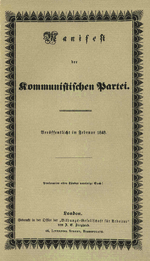
As we grope for good gauges, we might recall that it was on this date in 1848 that a political pamphlet by the German philosophers Karl Marx and Friedrich Engels, The Communist Manifesto, was published. Commissioned by the Communist League and written in German, it appeared as the Revolutions of 1848 began to erupt. Subsequently, of course, Marx elaborated on his argument (with Engel’s help, after Marx’s death) in Das Kapital.
Cover of the first edition
“All that is solid melts into air”*…

As a partner in a corporate advisory firm and a professor of law and finance, we are true believers in free-market capitalism — hardly natural latter-day communists, let alone successors to Marx and Engels. But we do believe the time is ripe for a rewrite of their Manifesto. Like the inhabitants of mid-19th century Europe, we live, according to Oxford University’s Professor Alan Morrison, “in the wake of a calamitous financial crisis and in the midst of whirlwind social change, a popular distaste of financial capitalists, and widespread revolutionary activity”. We have imagined what Marx and Engels would have written in 2018, naming the new, updated version “The Activist Manifesto”…
So how did the two of us come to take on the renovation of the Manifesto? The answer, improbably perhaps, is our interest in a linchpin of modern free-market capitalism: shareholder activism. We have published academic studies on the phenomenon. We have advised many of the largest hedge funds as they take substantial stakes in hundreds of companies, shaking up complacent boards and advocating for changes in corporate strategy and capital structure. And we have advised companies that themselves have pursued change. These activists may not be what Marx and Engels had in mind, but they are revolutionaries of a kind…
In our redrafting, we have had to go far beyond merely substituting “communism” with “activism”. The “Pope and Tsar, Metternich and Guizot, French Radicals and German police-spies” and others in Marx’s and Engels’ sights have gone. We have introduced their modern counterparts: “the corporate Haves, the elites, the billionaires, the establishment politicians of the Republican and Democratic parties, Conservatives and Labour, the talking heads at Davos, the echo chambers of online media and fake news.” But we have kept much of the rhetoric along with Marx’s and Engels’ relentless focus on economic inequality. Two centuries after Marx’s birth, and however much communism has rightly been discredited, a great deal of the argument is as relevant now as it was then. The Manifesto’s theories about the problems of capitalism and the capitalist mode of production continue to be cited in critiques of unfettered markets, and the document’s historical analysis is cited by modern scholars and taught in universities today. Some historians have cited it as the most influential text of the 19th century. Its reverberations are still felt today…
The original Manifesto’s top 10 “pretty generally applicable” proposals wouldn’t get a passing grade today in any setting. Left and right alike reject its arguments on labour and property. Even leaders of so-called communist states embrace markets and decentralisation. Take North Korea, the country that has most resisted capitalism: since 2012, it has started to encourage entrepreneurship and a formal (if reluctant) acceptance of brand-led marketplaces. However, one aspect of the original still resonates: the document was, fundamentally, an attack on inequality. We think it is obvious that Marx and Engels would be appalled by the present-day distribution of wealth. We imagine they would write something like this. “By the start of our 21st century, we are faced with the extraordinary fact that the top one per cent of the world’s population own the same resources as the remaining 99 per cent. Those at the bottom are less upwardly mobile than in previous generations; entrance to wealthy gated communities is blocked, not only by private security forces, but also by the increasingly prohibitive costs of healthcare, technology and education. There is the dominant force of mass incarceration, with millions of poor, minorities and powerless walled off from the rulers they might threaten. The Haves have never in history held so much advantage over the Have-Nots.”…
Two champions of capitalism, Rupert Younger (co-author of The Reputation Game and director of Oxford University’s Centre for Corporate Reputation) and Frank Partnoy (a writer and professor of law and finance who is joining the faculty at UC Berkeley this summer) explain their redrafting: “What would Karl Marx write today?“
Read their revised manifesto in full (and use the “rollover” function to compare it to the original) at activistmanifesto.org.
* Karl Marx and Friedrich Engels in Chapter One of The Communist Manifesto (also the title of a wonderful book by Marshall Berman)
###
As we reckon with revolution, we might send Hobbesian birthday greetings to Franz Oppenheimer; he was born on this date in 1864. An economist and sociologist, we wrote prolifically (40 books and 400 essays) and influentially on political organization and the idea of the nation. His best-known work is probably Der Staat (The State) which reflected his rejection of the concept of the “social contract” and his “conquest theory of the state.” Like Marx, Oppenheimer considered capitalism a system of exploitation, and capital revenues the gain of that exploitation; he saw the state as the original creator of inequality. So not surprisingly, his thinking has been influential among libertarians, communitarians, and anarchists.

You must be logged in to post a comment.