“Everything is destroyed by its own particular vice: the destructive power resides within”*…
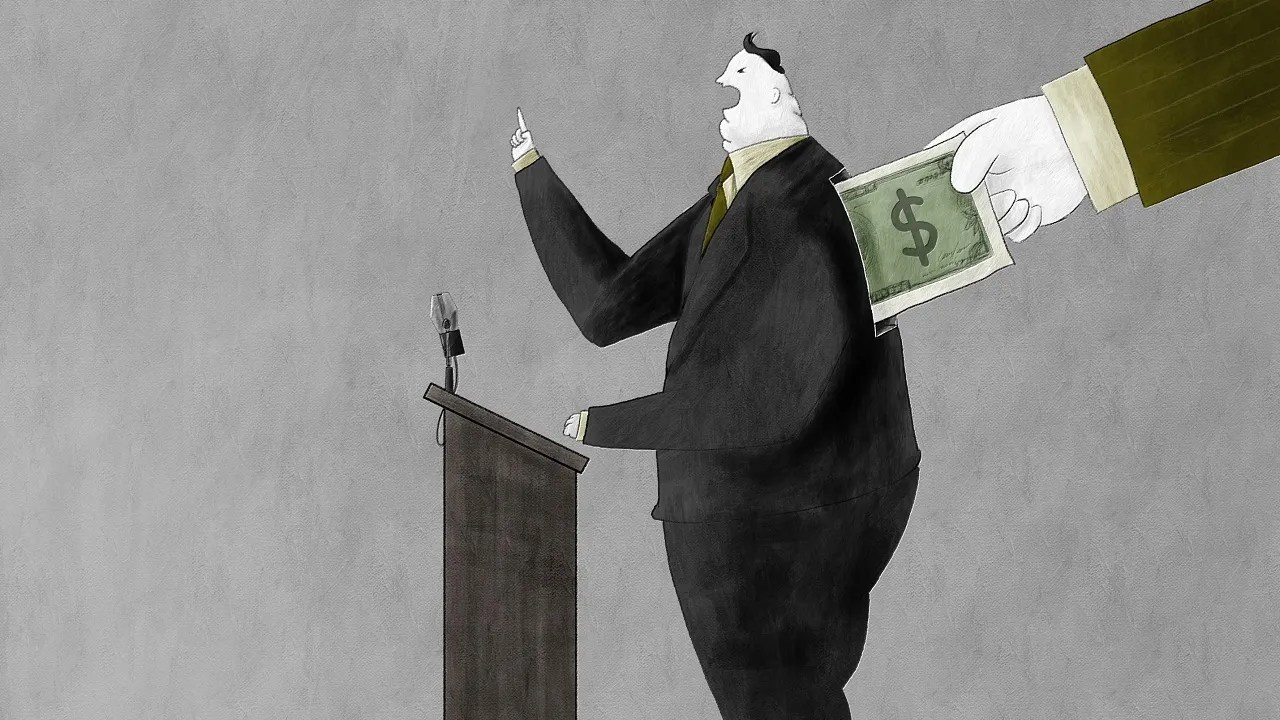
Government graft in the U. S. has a long (and unbroken) history; but there have been especially corrupt periods, for instance in the Jacksonian era and the Gilded Age… and again today.
Profiteering and insider trading, “pay-to-play”/influence peddling, foreign emoluments, conflicts of interest, regulatory and policy favors, purchased pardons (and commutations)– we’ve got it all, and at epic levels.
The estimable Cory Doctorow uses a telling comparison to drill down on one of the dominant strands: Trump’s (ironic) campaign to fight (what he identifies as) corruption…
… It’s a story about boss-politics anti-corruption, in which anti-corruption is pursued to corrupt ends.
From 2012-2015, Xi Jinping celebrated his second term as the leader of China with a mass purge undertaken in the name of anti-corruption. Officials from every level of Chinese politics were fired, and many were imprisoned. This allowed Xi to consolidate his control over the CCP, which culminated in a rule-change that eliminated term-limits, paving the way for Xi to continue to rule China for so long as he breathes and wills to power.
Xi’s purge exclusively targeted officials in his rivals’ power-base, kneecapping anyone who might have blocked his power-grab. But just because Xi targeted his rivals’ princelings and foot-soldiers, it doesn’t mean that Xi was targeting the innocent. A 2018 paper by an economist (Peter Lorentzen, USF) and a political scientist (Xi Lu, NUS) concluded that Xi’s purge really did target corrupt officials.
The authors reached this conclusion by referencing the data published in the resulting corruption trials, which showed that these officials accepted and offered bribes and feathered their allies’ nests at public expense.
In other words, Xi didn’t cheat by framing innocent officials for crimes they didn’t commit. The way Xi cheated was by exclusively targeting his rivals’ allies. Lorentzen and Lu’s paper make it clear that Xi could easily have prosecuted many corrupt officials in his own power base, but he left them unmolested.
This is corrupt anti-corruption. In an environment in which everyone in power is crooked, you can exclusively bring legitimate prosecutions, and still be doing corruption. You just need to confine your prosecutions to your political enemies, whether or not they are more guilty than your allies (think here of the GOP dragging the Clintons into Epstein depositions).
14 years later, Xi’s anti-corruption purges continue apace, with 100 empty seats at this year’s National People’s Congress, whose former occupants are freshly imprisoned or awaiting trial.
I don’t know the details of all 100 prosecutions, but China absolutely has a corruption problem that goes all the way to the upper echelon of the state. I find it easy to believe that the officials Xi has targeted are guilty – and I also wouldn’t be surprised to hear that they are all supporters of Xi’s internal rivals for control of the CCP.
As the Epstein files demonstrate, anyone hoping to conduct a purge of America’s elites could easily do so without having to frame anyone for crimes they didn’t commit (remember, Epstein didn’t just commit sex crimes – he was also a flagrant financial criminal and he implicated his network in those crimes).
It’s not just Epstein. As America’s capital classes indulge their incestuous longings with an endless orgy of mergers, it’s corporate Habsburg jaws as far as the eye can see. These mergers are all as illegal as hell, but if you fire a mouthy comedian, you can make serious bank.
And if you pay the right MAGA chud podcaster a million bucks, he’ll grease your $14b merger through the DoJ.
And once these crooks merge to monopoly, they embark on programs of lawlessness that would shame Al Capone, but again, with the right podcaster on your side, you can keep on “robbing them blind, baby!”
The fact that these companies are all guilty is a foundational aspect of Trumpism. Boss-politics antitrust – and anti-corruption – doesn’t need to manufacture evidence or pretexts to attack Trump’s political rivals. When everyone is guilty, you have a target-rich environment for extorting bribes.
Just because the anti-corruption has legit targets, it doesn’t follow that the whole thing isn’t corrupt…
On the practice of selective enforcement and prosecution: “Corrupt anticorruption,” from @pluralistic.net.web.brid.gy.
For thoughts on what we can do about all of this, see “Building political integrity to stamp out corruption: three steps to cleaner politics” (source of the image above)
* Menander
###
As we decide on disinfectants, we might recall that it was on this date in 37 CE, following the death of Tiberius, that the Roman Senate annulled Tiberius’ will and confirmed Caligula, his grandnephew, as the third Roman emperor. (Tiberius had willed that the reign should be shared by his nephew [and adopted son] Germanicus and Germanicus’ son, Caligula.)
While he has been remembered as the poster boy for profligacy and corruption, Caligula (“Little Boots”) is generally agreed to have been a temperate ruler through the first six months of his reign. His excesses after that– cruelty, self-dealing, extravagance, sexual perversity– are “known” to us via sources increasingly called into question.
Still, historians agree that Caligula did work hard to increase the unconstrained personal power of the emperor at the expense of the countervailing Principate; and he oversaw the construction of notoriously luxurious dwellings for himself. In 41 CE, members of the Roman Senate and of Caligula’s household attempted a coup to restore the Republic. They enlisted the Praetorian Guard, who killed Caligula– the first Roman Emperor to be assassinated (Julius Caesar was assassinated, but was Dictator, not Emperor). In the event, the Praetorians thwarted the Republican dream by appointing (and supporting) Caligula’s uncle Claudius as the next Emperor.

You must be logged in to post a comment.