“Mathematics is the music of reason”*…
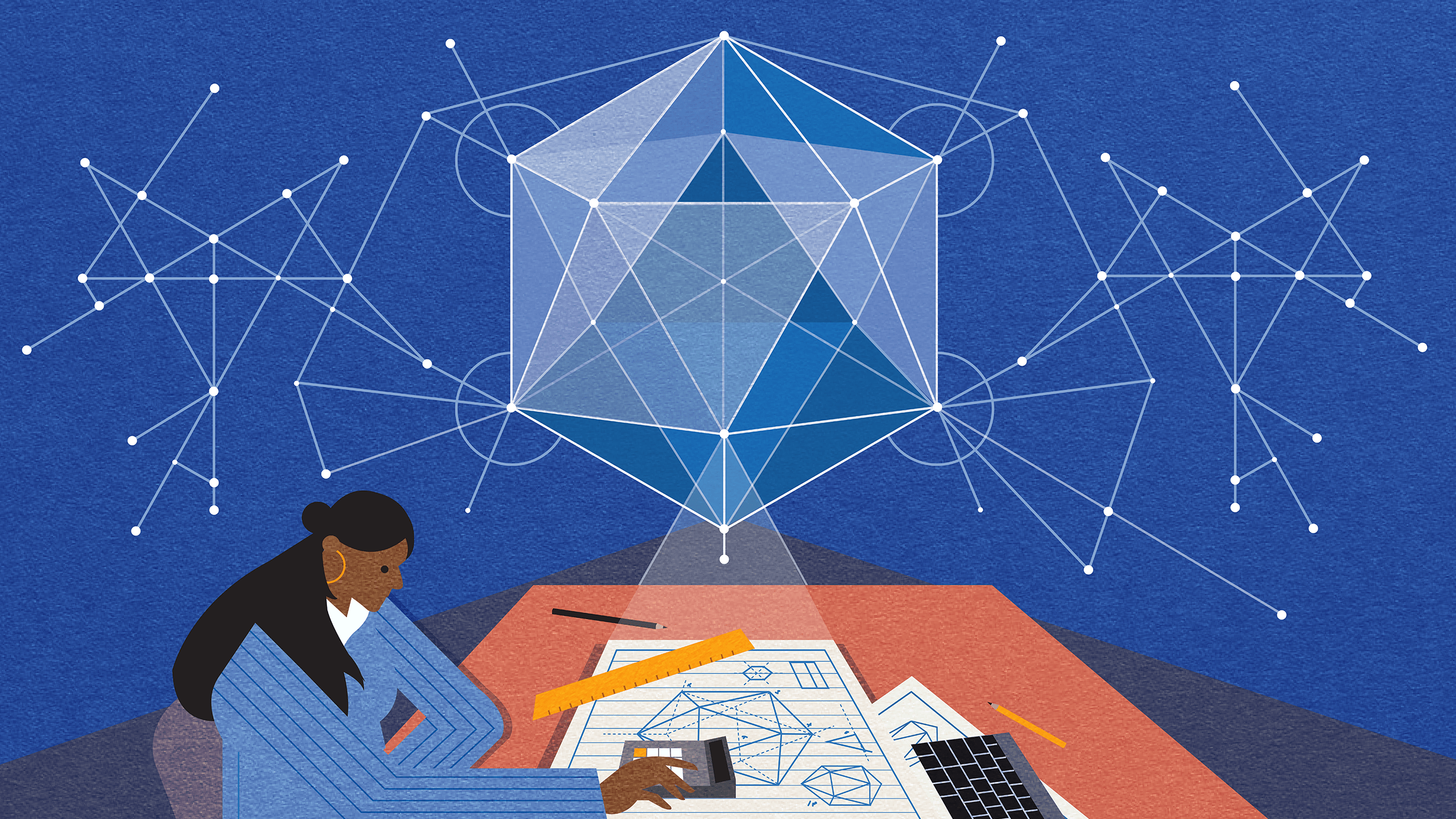
New technologies, most centrally AI, are arming scientists with tools that might not just accelerate or enhance their work, but altogether transform it. As Jordana Cepelewicz reports, mathematicians have started to prepare for a profound shift in what it means to do math…
Since the start of the 20th century, the heart of mathematics has been the proof — a rigorous, logical argument for whether a given statement is true or false. Mathematicians’ careers are measured by what kinds of theorems they can prove, and how many. They spend the bulk of their time coming up with fresh insights to make a proof work, then translating those intuitions into step-by-step deductions, fitting different lines of reasoning together like puzzle pieces.
The best proofs are works of art. They’re not just rigorous; they’re elegant, creative and beautiful. This makes them feel like a distinctly human activity — our way of making sense of the world, of sharpening our minds, of testing the limits of thought itself.
But proofs are also inherently rational. And so it was only natural that when researchers started developing artificial intelligence in the mid-1950s, they hoped to automate theorem proving: to design computer programs capable of generating proofs of their own. They had some success. One of the earliest AI programs could output proofs of dozens of statements in mathematical logic. Other programs followed, coming up with ways to prove statements in geometry, calculus and other areas.
Still, these automated theorem provers were limited. The kinds of theorems that mathematicians really cared about required too much complexity and creativity. Mathematical research continued as it always had, unaffected and undeterred.
Now that’s starting to change. Over the past few years, mathematicians have used machine learning models (opens a new tab) to uncover new patterns, invent new conjectures, and find counterexamples to old ones. They’ve created powerful proof assistants both to verify whether a given proof is correct and to organize their mathematical knowledge.
They have not, as yet, built systems that can generate the proofs from start to finish, but that may be changing. In 2024, Google DeepMind announced that they had developed an AI system that scored a silver medal in the International Mathematical Olympiad, a prestigious proof-based exam for high school students. OpenAI’s more generalized “large language model,” ChatGPT, has made significant headway on reproducing proofs and solving challenging problems, as have smaller-scale bespoke systems. “It’s stunning how much they’re improving,” said Andrew Granville, a mathematician at the University of Montreal who until recently doubted claims that this technology might soon have a real impact on theorem proving. “They absolutely blow apart where I thought the limitations were. The cat’s out of the bag.”
Researchers predict they’ll be able to start outsourcing more tedious sections of proofs to AI within the next few years. They’re mixed on whether AI will ever be able to prove their most important conjectures entirely: Some are willing to entertain the notion, while others think there are insurmountable technological barriers. But it’s no longer entirely out of the question that the more creative aspects of the mathematical enterprise might one day be automated.
Even so, most mathematicians at the moment “have their heads buried firmly in the sand,” Granville said. They’re ignoring the latest developments, preferring to spend their time and energy on their usual jobs.
Continuing to do so, some researchers warn, would be a mistake. Even the ability to outsource boring or rote parts of proofs to AI “would drastically alter what we do and how we think about math over time,” said Akshay Venkatesh, a preeminent mathematician and Fields medalist at the Institute for Advanced Study in Princeton, New Jersey.
He and a relatively small group of other mathematicians are now starting to examine what an AI-powered mathematical future might look like, and how it will change what they value. In such a future, instead of spending most of their time proving theorems, mathematicians will play the role of critic, translator, conductor, experimentalist. Mathematics might draw closer to laboratory sciences, or even to the arts and humanities.
Imagining how AI will transform mathematics isn’t just an exercise in preparation. It has forced mathematicians to reckon with what mathematics really is at its core, and what it’s for…
Absolutely fascinating: “Mathematical Beauty, Truth, and Proof in the Age of AI,” from @jordanacep.bsky.social in @quantamagazine.bsky.social. Eminently worth reading in full.
###
As we wonder about ways of knowing, we might spare a thought for a man whose work helped trigger an earlier iteration of this enhance/transform discussion and laid the groundwork for the one unpacked in the article linked above above: J. Presper Eckert; he died on this day in 1995. An electrical engineer, he co-designed (with John Mauchly) the first general purpose computer, the ENIAC (see here and here) for the U.S. Army’s Ballistic Research Laboratory. He and Mauchy went on to found the Eckert–Mauchly Computer Corporation, at which they designed and built the first commercial computer in the U.S., the UNIVAC.

You must be logged in to post a comment.