Archive for July 2015
“Summer will end soon enough”*…

As temperatures across the globe continue to rise, one might look to areas accustomed to extreme heat for tips on how to cope…


More helpful hints at “Genius/bizarre/insane methods of beating the summer sun- Vietnam style.”
[Vietnamnet.vn, via Dangerous Minds]
* George R.R. Martin, A Game of Thrones
###
As we search for shade, we might recall that it was on his date in 1934 that Thomas Midgley and a team of scientists working for Charles Kettering at GM’s Dayton Research subsidiary filed for a set of patents covering the use of chlorofluorocarbons (CFCs)– specifically, Freon– in refrigeration (and ultimately, air conditioning and aerosols). Midgley had earlier developed the tetraethyllead (TEL) additive to gasoline– that is, leaded gas– an effort from which he contracted lead poisoning.
While both of these inventions have been effectively banned for their contributions to climate change, they were celebrated in their time. Indeed, in 1941 Midgley was awarded the Priestley Medal (the American Chemical Society’s highest honor).

“Oh, I am fortune’s fool!”*…

Something on your mind? Ask the (interactive version of) xkcd’s oracle…
* Shakespeare, Romeo and Juliet
###
As we plan accordingly, we might recall, with gratitude, that it was on this date in 1935 that Alan Lane released the first ten titles in the Penguin paperback book series. At the time a junior player at a publisher called Bodley Head, he was frustrated by the lack of affordable contemporary literature. He wanted to offer cheap, quality books through outlets like railway stations and newsagents as well as traditional bookshops– to make good books accessible. So his volumes were priced at 6 pence each, while the typical hardcover book sold for 7 and 8 shillings. The experiment was a huge success: within a year, Penguin had sold 3 million paperbacks; skeptics– there were many (an earlier experiments in paperbacks in Germany had fizzled)– had been proved wrong; and Lane launched Penguin as a standalone publisher.
The original Penguins are an eclectic mix – a biography of Shelley, a Hemingway classic, a novel set in a pub, a novel about an old lady, two mysteries, an autobiography, and three more rather romantic novels– by authors both still widely read (Hemingway, Dorothy Sayers, Agatha Christie) and not so well remembered (e.g., Mary Webb, E.H. Young, Susan Ertz).
Today, 80 years later, more than 600 million paperbacks are sold annually worldwide.

The First Ten Penguins, 1985 reprint box set
“It is a damn poor mind that can think of only one way to spell a word”*…
The 9-15-year-olds who compete in the annual Scripps Spelling Bee tend to delight in words like “flibbertigibbet,” “onomatopoeia,” “schadenfreude,” “syzygy,” “tchotchke” and “triskaidekaphobia.” We normal humans are forced to seek help with much simpler words like “grey,” “cancelled” and “Hanukkah.” Vocativ used Google Trends data to learn which words were most frequently spellchecked in each state; along the way, they detected some interesting patterns, for instance:
Out of all the states, Idaho turned to Google for spelling assistance most often, and when it did, the state’s most Googled spelling was “antelope.” Idahoans struggled with “cevilian” [sic] and stumbled over “tongue”. On the bottom of the list of spellchecking states, the confident writers and readers of Oregon resorted to Google least often, only using it for spellchecks 28% as frequently as Idaho residents, according to Google data.
Here’s their summary chart:

Read more (and see a larger version) at “These Words Would Knock Your State Out Of the National Spelling Bee.”
* Andrew Jackson
###
As we spell “spell,” we might send acerbic birthday greetings to journalist, essayist, magazine editor, satirist, and critic Henry Louis “H. L.” Mencken; he was born on this date in 1880. Mencken is the author of the philological work The American Language, and is remembered for his journalism (e.g., his coverage of the Scopes Trial) and for his cultural criticism (and editorship of American Mercury— published by Alfred Knopf, also born on this date, but 12 years after Mencken ) in which he championed such writers as D.H. Lawrence, Ford Madox Ford, and Sherwood Anderson. But “H.L.” is probably most famous for the profusion of pointed one-liners and adages that leavened his work…
The difference between a moral man and a man of honor is that the latter regrets a discreditable act, even when it has worked and he has not been caught.
Civilization, in fact, grows more and more maudlin and hysterical; especially under democracy it tends to degenerate into a mere combat of crazes; the whole aim of practical politics is to keep the populace alarmed (and hence clamorous to be led to safety) by an endless series of hobgoblins, most of them imaginary.
I believe in only one thing and that thing is human liberty. If ever a man is to achieve anything like dignity, it can happen only if superior men are given absolute freedom to think what they want to think and say what they want to say. I am against any man and any organization which seeks to limit or deny that freedom. . . [and] the superior man can be sure of freedom only if it is given to all men.
Democracy is the theory that the common people know what they want, and deserve to get it good and hard.
Truth would quickly cease to be stranger than fiction, once we got as used to it.
And on spelling:
“Correct” spelling, indeed, is one of the arts that are far more esteemed by schoolma’ams than by practical men, neck-deep in the heat and agony of the world.

H.L. Mencken, photograph by Carl Van Vechten
“Puns are the highest form of literature”*…
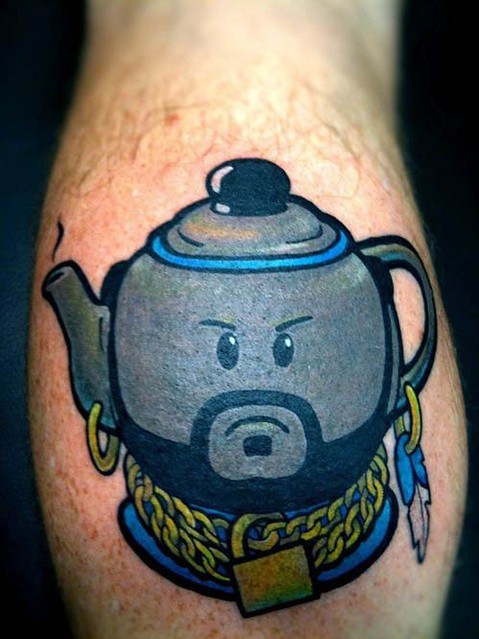
From tough guys to tramps…
… it’s all about the ink… and a sense of humor…
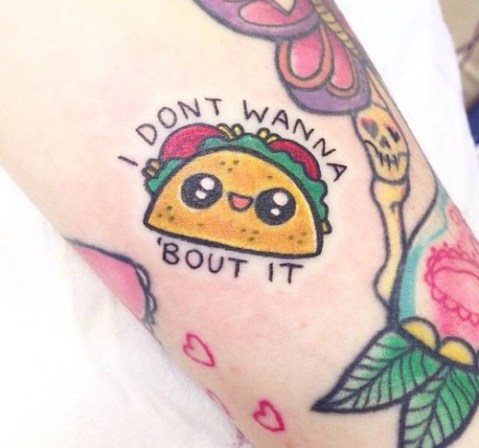
You can find the most hilarious puns ever as well as some cute pun tattoos all over the Internet.
* Alfred Hitchcock
###
As we noodle on the needle, we might send smiley birthday greetings to Joe E. Brown; he was born on this date in 1891. One of the most popular American stage and screen actors and comedians of the 1930s and 40s, he is perhaps best remembered for his role as Osgood Fielding III in Billy Wilder’s exquisite Some Like It Hot, in which Brown uttered the film’s immortal closing line, “well, nobody’s perfect.”

“Variety’s the very spice of life, that gives it all its flavor”*…

There was a time when “Sour Cream and Onion” was an exotic variety of potato chip…

No longer!

“25 Unique Potato Chip Flavors From Around The World You Probably Never Heard Of”
* William Cowper
###
As we reach for the dip, we might recall that it was on this date in 1880 that African-American inventor A.P. Abourne was awarded a patent for refining coconut oil– the oil of choice for today’s gourmet potato chips (and of course, for theater popcorn).
It is a sad comment on the conventions of the day that there are no photos of Mr. Abourne available– at least that your correspondent can find. So a generic coconut oil illustration will have to do…

You must be logged in to post a comment.