Posts Tagged ‘slavery’
“News is what someone wants suppressed. Everything else is advertising.”*…

Local newspapers hold their governments accountable. We examine the effect of local newspaper closures on public finance for local governments. Following a newspaper closure, we find municipal borrowing costs increase by 5 to 11 basis points in the long run. Identification tests illustrate that these results are not being driven by deteriorating local economic conditions. The loss of monitoring that results from newspaper closures is associated with increased government inefficiencies, including higher likelihoods of costly advance refundings and negotiated issues, and higher government wages, employees, and tax revenues…
A new piece of academic research on (one example) of the importance of local journalism: “Financing Dies in Darkness? The Impact of Newspaper Closures on Public Finance.”
* Katherine Graham
###
As we support our local journalists, we might recall that it was on this date in 1851 that Harriet Beecher Stowe‘s anti-slavery serial, Uncle Tom’s Cabin, or Life Among the Lowly, starts a ten-month run in the National Era, an abolitionist newspaper.

“The strength and power of despotism consists wholly in the fear of resistance”*…

Interference Archive was founded in 2011 by Kevin Caplicki, Molly Fair, Dara Greenwald, and Josh MacPhee. Our initial collection grew out of the personal accumulation of Dara and Josh… through their involvement in social movements, DIY and punk, and political art projects over the past 25 years…
The mission of Interference Archive is to explore the relationship between cultural production and social movements. This work manifests in an open stacks archival collection, publications, a study center, and public programs including as exhibitions, workshops, talks, and screenings, all of which encourage critical and creative engagement with the rich history of social movements…
The archive contains many kinds of objects that are created as part of social movements by the participants themselves: posters, flyers, publications, photographs, books, T-shirts and buttons, moving images, audio recordings, and other materials.
Through our programming, we use this cultural ephemera to animate histories of people mobilizing for social transformation. We consider the use of our collection to be a way of preserving and honoring histories and material culture that is often marginalized in mainstream institutions…
Visit the Archive online, and if you’re in the New York area, visit their current exhibit.

[TotH to the always-inspirational Ganzeer]
* Thomas Paine
###
As we question authority, we might recall that it was on this date in 1864 that the U.S. Senate passed the Thirteenth Amendment to the Constitution, declaring “Neither slavery nor involuntary servitude, except as a punishment for crime whereof the party shall have been duly convicted, shall exist within the United States, or any place subject to their jurisdiction.”
The House passed the Amendment January 31, 1865, and it was ratified by the required number of states on December 6, 1865. On December 18, 1865, Secretary of State William H. Seward proclaimed its adoption.

Thomas Nast’s engraving, “Emancipation,” 1865
“Good friends, good books, and a sleepy conscience: this is the ideal life”*…

‘Tis the season: best-of lists, and some leisure time in which to put them to use…
Here’s NPR’s Best Books of 2015— 260 volumes that one can filter by type or interest.
* Mark Twain
###
As we settle in, we might recall that it was on this date in 1865 that U.S. Secretary of State William Seward issued a statement verifying the ratification of the 13th Amendment to the U.S. Constitution. The amendment abolished slavery with the declaration: “Neither slavery nor involuntary servitude, except as a punishment for crime whereof the party shall have been duly convicted, shall exist within the United States, or any place subject to their jurisdiction.”
Thomas Nast’s engraving, “Emancipation,” 1865
“The one way of making people hang together is to give ’em a spell of the plague”*…
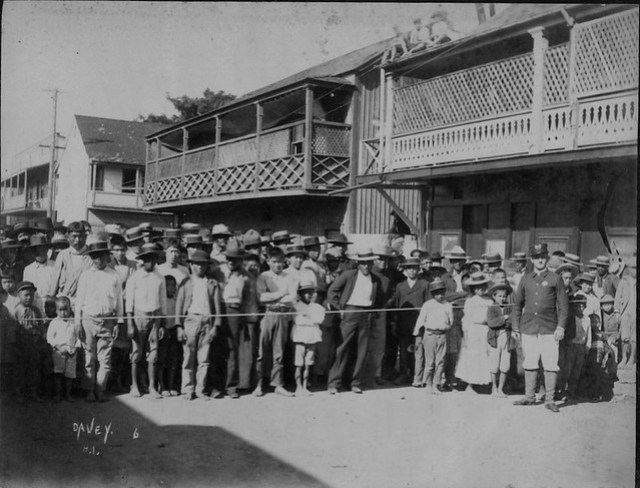
Officials in West Africa plan to erect a cordon sanitaire around areas affected by the Ebola virus. The drastic tactic—a strict quarantine encircling an infected area, allowing no residents to exit—has been only rarely used since the end of World War I… and then, as in China, for suspect reasons and of questionable effect (see here and here).
Writing at The Vault, Rebecca Onion recounts the story of Honolulu’s Chinatown inside a cordon sanitaire during an outbreak of bubonic plague in 1899-1900. In December 1899, You Chong, a 22-year-old Chinese bookkeeper, died of the disease, quickly followed by four neighbors. The Honolulu Board of Health isolated 14 blocks of the city, where ten thousand people lived.
Historian Nyan Shah writes that public health officials on the West Coast focused on Chinese and Japanese travelers in investigating the outbreak, “disregarding scientific evidence that rats were the primary conveyors of disease.” Facing the epidemic in Honolulu, officials acted on long-held stereotypes about the dirtiness of Chinese residences, turning to tactics of radical disinfection: spraying homes with carbolic acid; forcing residents to shower at public stations; throwing out belongings.
In Honolulu, officials finally escalated to fire, burning the home of one plague victim. But the blaze spread throughout the district. Historian Joseph Byrne writes that at first, after the fire burned out of control, fleeing citizens were “turned back by the National Guard and white vigilantes maintaining the cordon.” Finally, the cordonopened one exit to let people out. Eight thousand residents were displaced.
“Many bitterly insisted that the government had deliberately allowed the fire to spread,” Byrne writes, “a conviction only strengthened when one local newspaper printed an editorial celebrating the fire for wiping out the plague while simultaneously clearing off valuable real estate.”…
Read the whole– and horrifying– tale, and see more photos at “The Disastrous Cordon Sanitaire Used on Honolulu’s Chinatown in 1900.”
* Albert Camus, The Plague
###
As we remember to wash our hands, we might recall that is was on this date in 1619 that slavery arrived in North America, as “20 and Odd” Blacks landed in Jamestown, Virginia on a Dutch man of war, which traded them to settlers for provisions. These first African-Americans were not technically slaves, as slavery hadn’t yet been established as an institution in the Colony. But ownership was clear, and the the custom took hold (as reflected in the wills of original purchasers, who left “Negroes in service” to their children); was enshrined in law in 1662.

“I have always imagined that Paradise will be a kind of library”*…
From Babel…

The Library of Babel, “The Library of Babel,” Jorge Luis Borges
In Borges’s classic story, the entire universe is a library, a infinite labyrinth, which contains all books — that is, every possible ordering of letters and symbols, so that one full book of gibberish might differ from another only in the placement of a single comma. “Perhaps my old age and fearfulness deceive me,” Borges’s narrator muses at the story’s end, “but I suspect that the human species — the unique species — is about to be extinguished, but the Library will endure: illuminated, solitary, infinite, perfectly motionless, equipped with precious volumes, useless, incorruptible, secret.” Sigh.
… to Buffy…

Sunnydale High Library, Buffy the Vampire Slayer
At the other end of the cultural spectrum (but then again, maybe not really), sits the Sunnydale High Library, squarely on top of a Hellmouth. Don’t let that scare you away, though! This place has every book you’ll ever need on vampires, spirits, demons and beyond, and happens to be staffed by a very winsome librarian. There’s also a book cage full of weapons, just in case.
…”The Best Fictional Libraries in Pop Culture.”
* Jorge Luis Borges
###
As we renew our library cards, we might recall that it was on this date in 1829 that Henry Trumbull registered (officially published) his biography of Robert Voorhis (1770-1832), an African American slave who later became a recluse in Massachusetts:
LIFE AND ADVENTURES
OF
ROBERT,
THE
HERMIT OF MASSACHUSETTS,
Who has lived 14 Years in a Cave, secluded from human society.
COMPRISING,
An account of his Birth, Parentage, Sufferings, and
providential escape from unjust and cruel Bondage
in early life–and his reasons for becoming
a Recluse.
Taken from his own mouth, and published for his benefit.
PROVIDENCE:
Printed for H. TRUMBULL
— 1829 Price 12 1-2 Cents


You must be logged in to post a comment.