Posts Tagged ‘Ronald Ross’
“If all insects disappeared, all life on earth would perish. If all humans disappeared, all life on earth would flourish.”
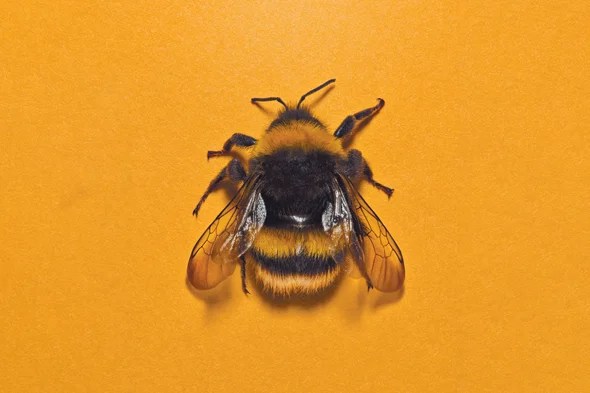
As Lars Chittka explains, insects have surprisingly rich inner lives—a revelation that has wide-ranging ethical implications…
In the early 1990s, when I was a Ph.D. student at the Free University of Berlin modeling the evolution of bee color perception, I asked a botany professor for some advice about flower pigments. I wanted to know the degrees of freedom that flowers have in producing colors to signal to bees. He replied, rather furiously, that he was not going to engage in a discussion with me, because I worked in a neurobiological laboratory where invasive procedures on live honeybees were performed. The professor was convinced that insects had the capacity to feel pain. I remember walking out of the botanist’s office shaking my head, thinking the man had lost his mind.
Back then, my views were in line with the mainstream. Pain is a conscious experience, and many scholars then thought that consciousness is unique to humans. But these days, after decades of researching the perception and intelligence of bees, I am wondering if the Berlin botany professor might have been right.
Researchers have since shown that bees and some other insects are capable of intelligent behavior that no one thought possible when I was a student. Bees, for example, can count, grasp concepts of sameness and difference, learn complex tasks by observing others, and know their own individual body dimensions, a capacity associated with consciousness in humans. They also appear to experience both pleasure and pain. In other words, it now looks like at least some species of insects—and maybe all of them—are sentient.
These discoveries raise fascinating questions about the origins of complex cognition. They also have far-reaching ethical implications for how we should treat insects in the laboratory and in the wild…
Insects are key enablers of much life on earth. They appear to exhibit intelligence, and maybe more: “Do Insects Feel Joy and Pain?” in @sciam.
Bugs are not going to inherit the earth. They own it now. So we might as well make peace with the landlord.
– Thomas Eisner
Pair with this helpfully skeptical (but respectful) review of Chittka’s book, The Mind of a Bee.
* Jonas Salk
###
As we ponder our place, we might recall that it was on this date in 1897 that physician Sir Ronald Ross made a key breakthrough when he discovered malaria parasites while dissecting a mosquito. This day is now known as World Mosquito Day, in celebration of his critical discovery.

“I never quite envisioned myself a proper doctor under that white coat”*…

“The Agnew Clinic” by Thomas Eakin, 1889
Toward the end of the 19th century, Western medicine had an image problem. Joseph Lister’s ideas about antiseptics were spreading, and John Snow had made a breakthrough in mapping the spread of cholera. But to the public, most medical “cures” were little more than quackery and mysticism, and the appearance of a physician merely presaged a painful death.
At the same time, the reputation of science was in rapid ascendancy. The Industrial Revolution was transforming the towns and cities of Europe and America, and new breakthroughs were reported on a weekly basis in more than a thousand different scientific journals.
So the medical establishment did a costume change. Doctors dropped their traditional black coats, which were worn either as a mark of formality (like a tuxedo) or to symbolize the solemnity of their profession, and instead opted for white coats like the ones worn by scientists in their laboratories…
Sartorial history at its most clinical: “Why the White Lab Coat Changed Medical History.”
###
As we battle “white coat hypertension,” we might spare a thought for Sir Ronald Ross; he died on this date in 1932. A physician, bacteriologist, and mathematician, he located the malarial parasite in the gut of the Anopheles mosquito, identifying it as the disease vector– for which he became the first British Nobelist, awarded the 1902 Prize for Physiology or Medicine.

You must be logged in to post a comment.