Posts Tagged ‘pop music’
“Music is liquid architecture and architecture is frozen music”*…
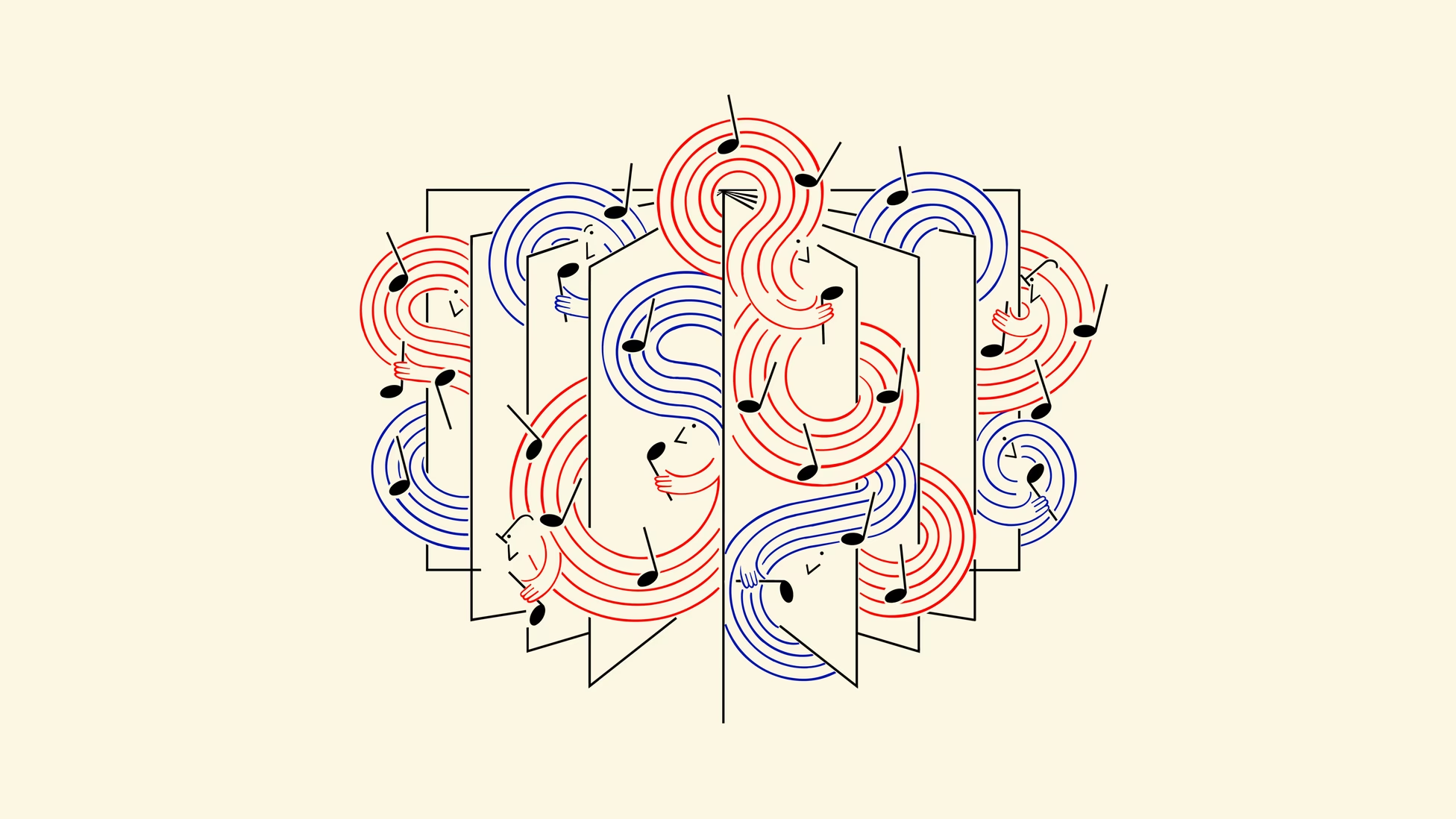
“Classical music” is a label applied to radically different compositions across more than 1,000 years of history. Composer, conductor, writer, pianist, and 2018 MacArthur Fellow Matthew Aucoin that we need a better definition…
… What is classical music, whom is it for, and what about it is worth defending?
Our answers to these questions will depend on what exactly we love about this music, and what we care about preserving, enriching, and expanding. Claiming that classical music deserves a prominent place in American culture merely because we want to safeguard a particular sound, style, or cultural or ethnic lineage—“music that sounds like Brahms,” or “music from one of three Central European countries”—would be a losing cause.
But a better answer is out there. Rather than defend the “classical” in classical music, I want to champion a particular creative process. What links Hildegard von Bingen and Kaija Saariaho, Johann Sebastian Bach and George Benjamin, is not a specific sound or aesthetic but a shared technology of transmission. At its core, classical music isn’t “classical.” It is written music.
By “written music,” I mean music that comes into being through the act of composition. Music from practically any tradition can, of course, be written down. If you’re a Beatles fan, you can buy a collection of Beatles sheet music, and if you want to plunk out your favorite jazz standard, you can order a copy of The Real Book, which contains the essential harmonic and melodic information for hundreds of well-traversed tunes. (Both a Real Book and a 1,136-page tome called The Beatles: Complete Scores are sitting on my piano as I write this.)
Though all music can be documented and experienced in multiple ways—scores, recordings, live performances—one approach to distinguishing musical traditions is to ask which form a given tradition treats as authoritative. It would be odd, for instance, to claim that a collection of printed scores constitutes a definitive document of the Beatles canon, because the unquestioned reference point is the band’s studio albums. My Beatles compendium proudly declares its own contingency: Printed on the front cover is an all-caps proclamation that its pages contain FULL TRANSCRIPTIONS FROM THE ORIGINAL RECORDINGS.
In other words: albums first, scores later. Taylor Swift’s 2019 decision to rerecord her earlier albums was a potent gesture, even a radical one, precisely because in pop music, the studio album typically possesses an authority upon which all subsequent iterations—whether live performances or written transcriptions—are based. Only by returning to the studio could Swift achieve control over her master recordings and literally set the record(s) straight.
Jazz musicians and aficionados tend to have a different perspective. Even though certain albums (Kind of Blue, A Love Supreme ) have attained the status of holy relics in the minds of many listeners, I think most jazz lovers would agree that the genre is not defined by the worship of specific studio recordings. Fans are more likely to value the evanescent moment of live performance, with its potential for spontaneous expression, for the very reason that a familiar tune can sound different every time it’s performed. A major artist such as Miles Davis might have performed and recorded a certain song—“My Funny Valentine,” for example—many times throughout his career, and there’s no reason to automatically treat a particular performance as the authoritative version. In spite of The Real Book’s name, jazz musicians rarely consider the printed score to be “the real thing” either. No self-respecting jazz musician would play a Real Book score exactly as written.
Western classical music is an unusual case. The reference point for a given piece of music is the score, rather than a studio recording or a live performance. Beethoven’s symphonies have been recorded hundreds—if not thousands—of times, and they’ve been performed many more times than that, but every one of those performances and recordings refers to the same score. For a composer, the score is the foundational site of creativity, and the act of score-making links together artists who could hardly sound more different from one another—say, an Italian composer of the late Renaissance and early Baroque period like Claudio Monteverdi and a 20th-century American avant-gardist like John Cage. Even an extreme case, such as Cage’s famous 4’33”—a work in which performers refrain from playing their instrument for four minutes and 33 seconds—depends on its score, a simple and playful set of written instructions. (In fact, to a greater degree than most notated music, 4’33” is inconceivable as a work of art without those directions.)
If we let ourselves be guided by this basic question—which musical artists regard the score as a creative starting point?—we arrive at the broadest and most welcoming definition of “classical” music. All kinds of unexpected affiliations and affinities emerge beyond music that’s typically thought of as belonging to the tradition. Many of the big-band masterpieces of Duke Ellington and Billy Strayhorn, for instance, strike me as indistinguishable, in their creative genesis, from orchestral works by Igor Stravinsky and Aaron Copland that were being written around the same time: They are notated in exquisite detail, usually for large ensembles, and Strayhorn’s gorgeously balanced wind and brass voicings remind me in particular of Stravinsky’s. To my ear, Strayhorn is a symphonist at heart. His work—in its fundamental writtenness—has more to do with that of many so-called classical composers than it does with, for example, that of an artist like Ornette Coleman, a free-jazz master who ostensibly hails from a tradition that is continuous with Strayhorn’s, but whose method could hardly be more different.
Written music matters for the same reason written langauge does: To write is to free oneself from the constraints of memory. It’s possible, in a novel or an essay or a nonfiction narrative or a book of poems, to devise an aesthetic structure full of details, depths, and digressions that would be far harder to construct in a purely oral storytelling tradition, one in which verbal transmission works through either memorization or improvisation. When you write, you don’t simply set down your thoughts; in the process of writing, your thoughts are transformed, and allowed to assume a newly complex shape—the miraculous scaffolding that emerges from the accumulation of thoughts on the page.
Our world is awash in written language, but not written music. The musical genres that dominate mainstream American culture are all more or less oral traditions….
… Musical literacy is a highly specialized skill; to become a fluent reader of music, a student needs to be given the kind of focused instruction that not all public schools have the funding to provide. Exposure to music education, beyond the rudiments, all too often becomes a question of whose family can afford expensive private lessons. We can react to this fact by feeling guilty about it, and letting notated music be tainted by its association with elitism, or we can push for an expansion of musical education. We all understand that to teach a child to read and write is to endow them with potent means of expression and self-discovery. Why should musical literacy be any different? Even a basic grounding in musical notation can transform a child’s sense of what can be communicated to another human being, especially—and this is crucial—if notation is treated as a tool of creativity rather than simply an unpleasant test of the ability to play all the right notes or else.
If we understand that writing, in music as in language, has the potential to be a force for liberation, and that it can transcend localized questions of style and aesthetic, we might come to a fuller sense of what music can be in our lives—the many forms it can take, the many truths it can tell. And if I could prescribe one thing for our world at this moment, it would be to deepen and expand our understanding of what it is to listen…
Eminently worth reading in full: “Do You Actually Know What Classical Music Is? Does Anyone?” (gift article) from @theatlantic.com.
* Johann Wolfgang von Goethe (though we might recall that Martin Mull observed that “writing about music is like dancing about architecture”)
###
As we read and write, we might recall that this date– National Opera Day— is the anniversary of the premiere in 1874 of Modest Mussorgsky‘s (and here) Boris Godunov at the Mavrinsky Theater in St. Petersburg. (Some sources give the date as January 27 of that year.) Mussorgsky’s only completed opera, it is considered his masterpiece.
Mussorgsky composed the work, based on Pushkin‘s 1825 play Boris Godunov (and here), between 1868 and 1873. By the 1980s In the 1980s, Boris Godunov had moved closer to the status of a repertory piece than any other Russian opera, even Tchaikovsky‘s Eugene Onegin, and is the most recorded Russian opera.

“There is nothing permanent except change”*…

Menudo has been ranked one of the Biggest Boy Bands of All Time by several publications (Billboard, Us Weekly, Seventeen, and Teen Vogue, among others)– the only Latin band on their lists. The Puerto Rican boy band, founded by producer Edgardo Díaz in 1977, has had 39 members– who’ve been routinely replaced as they “age out,” usually at 16. It has launched the careers of a number of popular international stars, including Ricky Martin (in Menudo 1984–89) and Draco Rosa (1984–87), and sold over 20 million albums worldwide.
The band disbanded in 2009, but re-formed on its old template in 2019. And it’s just announced its latest roster, bringing its count of members up to 44…
Nearly a year after Menudo Productions announced they were on the search for new members to form the next generation of Menudo, the band has officially unveiled the five boys that will comprise the group.
On Monday (March 20), Nicolas Calero (10), Gabriel Rossell (13), Andres Emilio (14), Alejandro Querales (15) and Ezra Gilmore (12) were announced as the new faces of the eternally youthful boy band. And, in celebration of the announcement, the group also released their very first single “Mi Amore,” the first song off their upcoming debut album…
What’s old is new again: “New Menudo Boy Band Members Unveiled,” from @billboard.
* Heraclitus
###
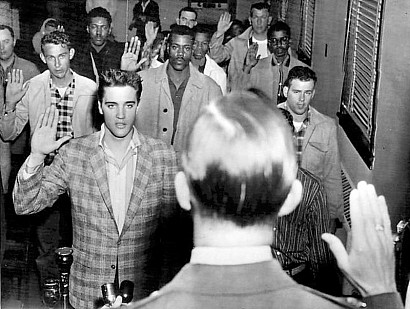
As we board the Ship of Theseus, we might recall that it was on this date in 1958, at 6.35am, that Elvis Presley reported to the Memphis draft board to be inducted in the U.S. Army. From there Elvis and twelve other recruits were taken by bus to Kennedy Veterans Memorial Hospital where the singer was assigned Army serial number 53310761.
“I find it hard to focus looking forward. So I look backward.”*…

In 1995, “the Godfather of Punk,” Iggy Pop published a review in the scholarly journal Classics Ireland…
In 1982, horrified by the meanness, tedium and depravity of my existence as I toured the American South playing rock and roll music and going crazy in public, I purchased an abridged copy of The Decline and Fall of the Roman Empire (Dero Saunders, Penguin). The grandeur of the subject appealed to me, as did the cameo illustration of Edward Gibbon, the author, on the front cover. He looked like a heavy dude. Being in a political business, I had long made a habit of reading biographies of wilful characters — Hitler, Churchill, MacArthur, Brando — with large profiles, and I also enjoyed books on war and political intrigue, as I could relate the action to my own situation in the music business, which is not about music at all, but is a kind of religion-rental.
I would read with pleasure around 4 am, with my drugs and whisky in cheap motels, savouring the clash of beliefs, personalities and values, played out on antiquity’s stage by crowds of the vulgar, led by huge archetypal characters. And that was the end of that. Or so I thought.
Eleven years later I stood in a dilapidated but elegant room in a rotting mansion in New Orleans, and listened as a piece of music strange to my ears pulled me back to ancient Rome and called forth those ghosts to merge in hilarious, bilious pretense with the Schwartzkopfs, Schwartzeneggers and Sheratons of modern American money and muscle myth. Out of me poured information I had no idea I ever knew, let alone retained, in an extemporaneous soliloquy I called ‘Caesar’.
When I listened back, it made me laugh my ass off because it was so true. America is Rome. Of course, why shouldn’t it be? All of Western life and institutions today are traceable to the Romans and their world. We are all Roman children for better or worse. The best part of this experience came after the fact — my wife gave me a beautiful edition in three volumes of the magnificent original unabridged Decline and Fall, and since then the pleasure and profit have been all mine as I enjoy the wonderful language, organization and scope of this masterwork.
Here are just some of the ways I benefit:
1 I feel a great comfort and relief knowing that there were others who lived and died and thought and fought so long ago; I feel less tyrannized by the present day.
2 I learn much about the way our society really works, because the system-origins — military, religious, political, colonial, agricultural, financial — are all there to be scrutinized in their infancy. I have gained perspective.
3 The language in which the book is written is rich and complete, as the language of today is not.
4 I find out how little I know.
5 I am inspired by the will and erudition which enabled Gibbon to complete a work of twenty-odd years. The guy stuck with things. I urge anyone who wants life on earth to really come alive for them to enjoy the beautiful ancestral ancient world…

Iggy Pop on the relevance of Gibbon’s Decline and Fall in particular, and of history in general: “Caesar Lives.” (Free JSTOR registration may be required.)
* Iggy Pop
###
As we note, with Faulkner, that “the past is never dead. It’s not even past,” we might recall that on the pop music charts on this date in 1967, The Monkees continued into the New Year at #1 with “I’m A Believer.” “Snoopy Vs. The Red Baron” by the Royal Guardsmen was second, with Aaron Neville making a push for the top with “Tell It Like It Is”. Former #1 “Winchester Cathedral” by the New Vaudeville Band grabbed the #4 spot, followed by Nancy Sinatra (“Sugar Town”), and Dad Frank (“That’s Life”). The rest of the Top 10: Boise, Idaho’s Paul Revere & the Raiders with “Good Thing”, the Mamas and the Papas climbed from 19 (to #8) with “Words Of Love”, the Four Tops nearly matched that with “Standing In The Shadows Of Love,” while Donovan took a turn downward with “Mellow Yellow.” On the album chart, The Monkees made it nine weeks on top with their eponymously-titled first release.

“A Room of One’s Own”*…

Interiors of real living and working spaces from an unusual perspective. It seems as if someone has lifted the ceiling and replaced it with a scanner. In fact, the photographs consist of up to a hundred individual shots taken with a remote control and then digitally assembled. One associates doll’s houses and at the same time thinks of surveillance…
Menno Aden‘s photos evoke the spirit of our “Surveillance Capitalist” age: “Room Portraits.”
* An extended essay by Virginia Wolff
###
As we duck and cover, we might recall that it was on this date in 1954 that Rosemary Clooney hit the top of the U.S. pop chart with “This Ole House,” which soon topped the British chart as well. Written earlier that year by Stuart Hamblen, it was a #1 hit again in the U.K. in 1981 for Shakin’ Stevens.
“If you had a sign above every studio door saying ‘This Studio is a Musical Instrument’ it would make such a different approach to recording”*…

At 706 Union Avenue, Memphis, Tennessee, you’ll find a reconstruction of the legendary Sun Records studio (home to Howlin’ Wolf, BB King, Elvis Presley, Jerry Lee Lewis, Roy Orbison, Carl Perkins and Johnny Cash, anog others). complete with a recording studio where the likes of U2 and John Mellencamp have recorded. Photo: Paul McGuinness
When The Beatles were photographed in August 1969, striding over a zebra crossing in St John’s Wood, London, for the cover shot of their album Abbey Road they were celebrating a building that had played an essential part in helping them take the music world by storm – and, in the process, turned Abbey Road into one of the most famous recording studios in the world.
The names of iconic recording studios – Sun, Muscle Shoals, Motown, Electric Lady, Trident, Sunset – have become almost as famous as the musicians who have created masterpieces at these venues.
Important recording studios are more than just bricks, mortar and audio equipment to musicians. The Rolling Stones named a song in honour of the Chess Records Studio and Sonic Youth acknowledged New York’s Echo Canyon Studios by naming their 12th studio album, Murray Street, in tribute to a site that had played a key role in their success…
A history of the recording and a celebration of some of music’s storied studios: “Sound Matters: A History Of Legendary Recording Studios.”
* Brian Eno
###
As we hum along, we might recall that this date in 1963 was the “official” release date of Introducing… The Beatles, the Fab Four’s first U.S. album. But confusion at Vee-Jay, the album’s label, delayed the actual release until January 10 of the following year… one week before Capitol’s Meet the Beatles!. The latter album, however, entered the U.S. album chart one week before the former. And so, while Meet The Beatles! peaked at No. 1 for eleven consecutive weeks, Introducing…The Beatles stalled at No. 2 where it remained nine consecutive weeks.
Coincidentally, it was on this same day (July 22, 1963) that The Beatles began their first U.K. tour (with Gerry and the Pacemakers) at the Odeon Cinema in Weston-Super-Mare.

You must be logged in to post a comment.