Posts Tagged ‘Napoleon’
In memoriam…
From the sublime to the ridiculous is but a step.
– Napoleon, on the invasions of Russia (10 December 1812),as recorded by Abbé du Pradt

“Napoleonland”, the brainchild of former French minister and history buff Yves Jégo, is being touted as a rival to Disneyland – assuming, that is, it can gather the £180 million needed to leave the drawing board.
The plan is to build the unlikely amusement park on the site of the brilliant but doomed French leader’s final victory against the Austrians in the Battle of Montereau in 1814 just south of Paris.
With its reenactments (including a water show re-staging of Trafalgar), a ski run through a battlefield “surrounded by the frozen bodies of soldiers and horses,” and a recreation of Louis XVI being guillotined during the revolution, “it’s going to be fun for the family,” Mr Jégo promises.
Read the whole story in The Telegraph.
As we contact our travel agents, we might compose a birthday verse in dactylic hexameter for Decimus Iunius Iuvenalis, AKA Juvenal; the author of the Satires was (at least insofar as tradition has it; the records are scant-to-the-point-of-nonexistent) born on this date in 55 CE.
quis custodiet ipsos custodes (Who will watch the watchmen?)
– Satires, 6.347-48
 Frontispiece of Dryden’s translation of Satires (source)
Indigestion through the ages…

It’s only fair, after Friday’s post, to give equal time to culinary pursuits less thoughtful. And so, to Aspic and Other Delights, a Tumblr devoted to food that’s both bad and bad for one…

More (more perhaps than readers can stomach) at Aspic and Other Delights.
As we reach for the ipecac, we might wish a disciplined Happy Birthday to playwright, poet, artist, biologist, theoretical physicist, and philosopher Johann Wolfgang von Goethe; he was born on this date in 1749. Probably best remembered these days for Faust, he was “the master spirit of the German people,” and, after Napoleon, the leading figure of his age.

Fun with Food!…
TotH to the ever-amusing eBaum’s World.
As we contemplate what, exactly, goes on in our stomachs, we might might recall that it was on this date in 1815 that Napoleon escaped from Elba. Following his disastrous Russian Campaign, Napoleon French Empire was attacked by the Sixth Coalition (a collection of the Emperor’s enemies who found solidarity in their desire to be rid of him). After a successful invasion of France in 1814, the Coalition exiled Napoleon to the Tuscan island. But in less than a year, he escaped and made his way back to France and to power for the period now called “The Hundred Days”– which ended with his defeat at Waterloo, and was followed by another exile, this time to the island of St. Helena (2,000 km into the Atlantic from the nearest land mass).

… Oil that is– black gold, Texas tea…

With thanks to Suzanne Lainson for the tip, The Guardian‘s “From extraction to consumption: Oil, an exhibition by Edward Burtynsky.”
As we consider all things crude, we might recall that that on this date in 1781, Cornwallis, after a loss at Yorktown, surrendered to The Continental Army (and the French who’d joined them), effectively ending the Revolutionary War (as it’s known over here)…
 click to enlarge
… then, just 31 years later, on this date in 1812, Napoleon threw in the serviette, and began his retreat from Moscow.
 click to enlarge
![Reblog this post [with Zemanta]](https://i0.wp.com/img.zemanta.com/reblog_e.png?w=700)
Explanations one would really rather not have to give…
 EATR (source)
From a press release issued by Cyclone Power Technologies and Robotic Technology:
In response to rumors circulating the internet on sites such as FoxNews.com, FastCompany.com and CNET News about a “flesh eating” robot project [ c.f., e.g., EATR: The Robot That Can Survive on Corpses], Cyclone Power Technologies Inc. (Pink Sheets: CYPW) and Robotic Technology Inc. (RTI) would like to set the record straight: This robot is strictly vegetarian.
On July 7, Cyclone announced that it had completed the first stage of development for a beta biomass engine system used to power RTI’s Energetically Autonomous Tactical Robot (EATR™), a Phase II SBIR project sponsored by the Defense Advanced Research Projects Agency (DARPA), Defense Sciences Office. RTI’s EATR is an autonomous robotic platform able to perform long-range, long-endurance missions without the need for manual or conventional re-fueling.
RTI’s patent pending robotic system will be able to find, ingest and extract energy from biomass in the environment. Despite the far-reaching reports that this includes “human bodies,” the public can be assured that the engine Cyclone has developed to power the EATR runs on fuel no scarier than twigs, grass clippings and wood chips – small, plant-based items for which RTI’s robotic technology is designed to forage. Desecration of the dead is a war crime under Article 15 of the Geneva Conventions, and is certainly not something sanctioned by DARPA, Cyclone or RTI.
“We completely understand the public’s concern about futuristic robots feeding on the human population, but that is not our mission,” stated Harry Schoell, Cyclone’s CEO. “We are focused on demonstrating that our engines can create usable, green power from plentiful, renewable plant matter. The commercial applications alone for this earth-friendly energy solution are enormous.”
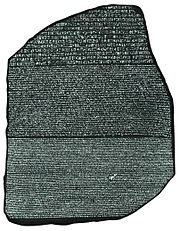
As we contemplate off-label uses, we might also celebrate the happier fall-out of military maneuvers, as it was on this date in 1799 (or close; scholars agree that it was “mid-July” but disagree on the precise day) that a French soldier in Napoleon’s Egyptian Campaign discovered a black basalt slab inscribed with ancient writing near the town of Rosetta, about 35 miles north of Alexandria.
The stone contained fragments of passages written in three different scripts inscribed by priests of Ptolemy V in the second century B.C.– Greek, Egyptian hieroglyphics, and Egyptian demotic. The Greek passage proclaimed that the three scripts were all of identical meaning– so allowed French Egyptologist Jean Francois Champollion to decipher the hieroglyphics… and opened the language of ancient Egypt, a written language that had been “dead” for nearly two millennia.
You must be logged in to post a comment.