Posts Tagged ‘Marcus Aurelius’
From A to B…

Dutch designer Ruben van der Vleuten wondered what happened to the packages he sent between the time he shipped them and their arrival.
What happens when you send something by mail? What happens in between you sending it off and someone else receiving it? What people and processes are involved and how many steps does it take?
Those all were questions I was dealing with and wanted to find out. So instead of sitting back I started a simple project to actually see it myself. I put a small camera in a box, build a timer circuit using Arduino and shipped it.
That’s as simple as it is. The timer circuit was set to make a 3 sec video every minute and make longer videos while the box was moving: to not miss on the ‘interesting’ parts.
See the resulting video, “From A to B”.
[TotH to Flowing Data]
###
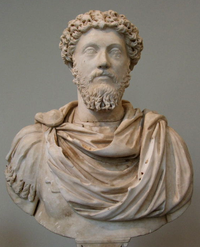
As we add some extra bubble wrap, we might send stoic birthday greetings to Marcus Aurelius Antoninus Augustus; he was born on this date in 121 CE. The last the “five good emperors” of Rome, Marcus Aurelius is considered one of the most important Stoic philosophers. His Meditations, written in Greek while on campaign during the Marcomannic Wars between 170 and 180, and describing how to follow nature to find and preserve equanimity in the midst of turmoil, is considered by many to be the urtext of the philosophy of service and duty.
Look beneath the surface; let not the several quality of a thing nor its worth escape thee.
– Meditations, Book VI, 3

You ain’t got a thing if you ain’t got that swing…

The identification of scientific laws has historically been a painfully long– and innately human– process of pattern recognition. It took observers centuries to distill the laws of mechanics, for instance. Now, as Science reports, researchers at Cornell have take a stab at using computing power to automate the process… and have some astoundingly-encouraging results:
For centuries, scientists have attempted to identify and document analytical laws that underlie physical phenomena in nature. Despite the prevalence of computing power, the process of finding natural laws and their corresponding equations has resisted automation. A key challenge to finding analytic relations automatically is defining algorithmically what makes a correlation in observed data important and insightful. We propose a principle for the identification of nontriviality. We demonstrated this approach by automatically searching motion-tracking data captured from various physical systems, ranging from simple harmonic oscillators to chaotic double-pendula. Without any prior knowledge about physics, kinematics, or geometry, the algorithm discovered Hamiltonians, Lagrangians, and other laws of geometric and momentum conservation. The discovery rate accelerated as laws found for simpler systems were used to bootstrap explanations for more complex systems, gradually uncovering the “alphabet” used to describe those systems.
Read the full-text of the article here.
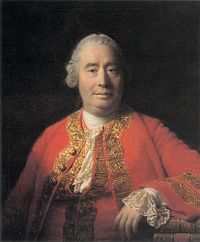
As we reconsider the beauties of brute force, we might send a cheery greeting to David Hume, the Scottish Positivist philosopher; he was born on this date in 1711. Bishop Berkeley may have wondered if, when a tree falls in the forest and no one is around, it makes a sound. For Hume, the question was whether the tree was beautiful (“Beauty in things exists in the mind which contemplates them. “)
But then, it’s also the birthday of the (somewhat more “practical”) Roman Emperor and Stoic Marcus Aurelius, born on this date in 121. “Why should a man have any apprehension about the change and dissolution of all the elements?” Why indeed?
You must be logged in to post a comment.