Posts Tagged ‘logic’
“If it was so, it might be; and if it were so, it would be; but as it isn’t, it ain’t. That’s logic.”*…
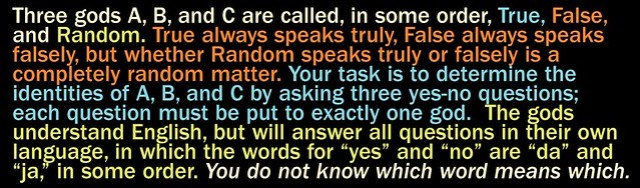
Your correspondent is headed into the chilly wilds for the Thanksgiving holiday, so this will be the last post until after the passing of the tryptophan haze. By way of keeping readers amused in the meantime, the puzzle above…
Find a step-by-step guide to its answer at “How to Solve the Hardest Logic Puzzle Ever.”
* Tweedledee, in Lewis Caroll’s Through the Looking-Glass, and What Alice Found There
###
As we muddle in the excluded middle, we might recall that it was on this date in 1915 that Albert Einstein presented the Einstein Field Equations to the Prussian Academy of Sciences. Einstein developed what was elaborated into a set of 10 equations to account for gravitation in the curved spacetime described in his General Theory of Relativity; they are used to determine spacetime geometry.
(German mathematician David Hilbert reached the same conclusion, and actually published the equation before Einstein– though Hilbert, who was a correspondent of Einstein’s, never suggested that Einstein’s credit was inappropriate.)

On the right side of the equal sign, the distribution of matter and energy in space; on the left, the geometry of the space, the so-called metric, a prescription for how to compute the distance between two points.
“Use what language you will, you can never say anything but what you are”*…

Lars Yenken‘s “The Great Language Game” is an interactive game, being played worldwide, that challenges users to distinguish among (currently) 87 languages based on their sound alone. As Lars explains,
There are perhaps six or seven thousand languages in the world. Even so-called hyperpolyglots, people who learn to speak six or more fluently, barely scratch the surface. You and I will never be able to communicate in all these languages without machine aids, but learning to identify what’s being spoken near us, that’s within our reach…
Besides, it’s fun!
[TotH to reddit]
* Ralph Waldo Emerson
###
As we prick up our ears, we might send thoughtful birthday greetings to Alfred North Whitehead; he was born on this date in 1861. Whitehead began his career as a mathematician and logician, perhaps most famously co-authoring (with his former student, Bertrand Russell), the three-volume Principia Mathematica (1910–13), one of the twentieth century’s most important works in mathematical logic.
But in the late teens and early 20s, Whitehead shifted his focus to philosophy, the central result of which was a new field called process philosophy, which has found application in a wide variety of disciplines (e.g., ecology, theology, education, physics, biology, economics, and psychology).
“There is urgency in coming to see the world as a web of interrelated processes of which we are integral parts, so that all of our choices and actions have consequences for the world around us.”

Time travel…

Chino Otsuka, 1980 and 2009, Nagayama, Japan
In the photo series “Imagine Finding Me,” photographer Chino Otsuka revisits her childhood by digitally inserting herself in old photos of her as a child. Otsuka likens her double self-portraits to a kind of time travel:
“The digital process becomes a tool, almost like a time machine, as I’m embarking on the journey to where I once belonged and at the same time becoming a tourist in my own history…”

Chino Otsuka, 1975 and 2005, Spain
See (and read) more at Laughing Squid and at AGO.
###
As we revisit Memory Lane, we might spare a thought for Kurt Friedrich Gödel; he died on this date in 1978. Considered (with Aristotle and Frege) one of the most important logicians in history, Gödel published the work for which he is probably most widely remembered– his two incompleteness theorems— in 1931 when he was 25 years old, one year after finishing his doctorate at the University of Vienna. He demonstrated that:
- If a system is consistent, it cannot be complete.
- The consistency of a systems axioms cannot be proven within the system.
Gödel’s theorems ended a half-century of attempts, beginning with the work of Frege and culminating in Russell and Whitehead’s Principia Mathematica and Hilbert’s formalism, to find a set of axioms sufficient for all mathematics.
As the Anschluss swept Austria, Gödel fled to the U.S., landing at Princeton, where he joined Albert Einstein at the Institute for Advanced Studies. In 1951, as a 70th birthday present for Einstein, Gödel demonstrated the existence of paradoxical solutions to Einstein’s field equations in general relativity (they became known as the Gödel metric)– which allowed for “rotating universes” and time travel… and which caused Einstein to have doubts about his own theory.

“One of the most learned monstrosities of all times”…

More than 170 years before Jean-François Champollion had the first real success in translating Egyptian hieroglyphs, the 17th century Jesuit scholar Athanasius Kircher was convinced he had cracked it. He was very wrong. Daniel Stolzenberg looks at Kircher’s Egyptian Oedipus, a book that has been called “one of the most learned monstrosities of all times” in Public Domain Review.
###
As we take care not to jump to conclusions, we might send thoughtful birthday greetings to Bertrand Arthur William Russell, 3rd Earl Russell; he was born on this date in 1872.
A philosopher, logician, mathematician, historian, and social critic, Russell is probably best remembered for Principia Mathematica (co-authored with Alfred North Whitehead), which attempted to ground mathematics in logic (though his essay “On Denoting” has also been celebrated as a “paradigm of philosophy.” He won the 1950 Nobel Prize in Literature “in recognition of his varied and significant writings in which he champions humanitarian ideals and freedom of thought.”

For tonight’s debate…
Logical Fallacy Bingo

Definitions of each flavor of fallacy, and clean copies of the board at Lifesnow.com.
###
As we overcome our wistfulness on remembering that this is Oscar Wilde’s birthday, we might recall that it was on this date in 1793, nine months after her husband, the former King Louis XVI of France, was beheaded, that Marie Antoinette followed him to the guillotine. (Readers who are parents– or collectors– can find commemorative dolls here.)

You must be logged in to post a comment.