Posts Tagged ‘information’
“Share your knowledge. It is a way to achieve immortality.”*…

As of earlier this week, the English-language Wikipedia contains 4,985,975 articles. If these were printed and bound into books — each 25cm tall by 5cm thick, like Britannica — there would be 2,207 volumes, each containing 1,600,000 words…
All of this content is, of course, user-submitted. It is also user-policed: the site requires constant maintenance from a massive pool of unpaid editors, who do things like fix typos, remove instances of vandalism (like de-categorizing George W. Bush as a “sexually-transmitted disease”), and improving the breadth and accuracy of each and every page.
Of Wikipedia’s 26 million registered users, roughly 125,000 (less that 0.5%) are “active” editors. Of these 125,000, only some 12,000 have made more than 50 edits over the past six month. And of these selfless few, one man is king of the domain.
Since joining Wikipedia a decade ago, 32-year-old Justin Anthony Knapp (username “koavf”) has established himself as the the site’s most active contributor of all time. He has made an astonishing 1,485,342 edits (an average of 385 per day), ranging in topic from Taylor Swift to the history of blacksmithing.
What’s life like as Wikipedia’s most prolific editor? And what has compelled this man to dedicate thousands of hours of his time, knowledge, and energy to an online encyclopedia for absolutely no compensation?…
Find out at “The Most Prolific Editor on Wikipedia.”
* Dalai Lama XIV
###
As we contribute to the commonweal, we might recall that it was on this date in 1760 that Denis Diderot, Enlightenment paragon and co-founder, chief editor, and contributor to the Encyclopédie, wrote to his friend Sophie Volland of the very phenomenon that koavf has devoted so much of his life to avoiding…
Diderot transcribed the words of Galiani, who seized the occasion to shine before his audience: “My friends, I recall a fable. Listen to it.” The story tells of a contest between two birds of different species, the cuckoo (supposed to be the representative of method) and the nightingale (the spokesman of genius). Which voice is more beautiful? The dispute is submitted to the ass for judgment. He is lazy and, without investigating the case or listening to the litigants, declares the cuckoo the winner. The story came from an Italian work, the burlesque epic Ricciardetto (1738), by Niccolò Fortiguerri (1674–1735), which Diderot also knew, having recently read it and found cause in it “to weep alternatively from pain and from pleasure.” The ass’s iniquitous judgment in favor of the cuckoo is a perfect example of resorting to antiphrasis: the good response, in a case of this sort, is obviously the contrary of the one given by a bad judge, that is, a judge who does not listen…

Diderot
“Where is the knowledge we have lost in information?”*…
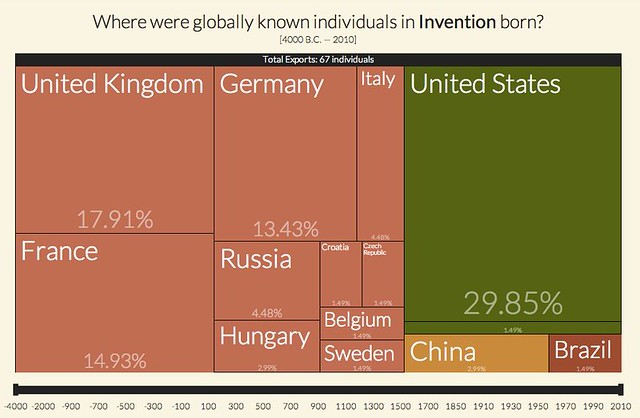
The MIT Media Lab’s Pantheon Project aims to restore some of that knowledge…
You were not born with the ability to fly, cure disease or communicate at long distances, but you were born in a society that endows you with these capacities. These capacities are the result of information that has been generated by humans and that humans have been able to embed in tangible and digital objects.
This information is all around you. It is the way in which the atoms in an airplane are arranged or the way in which your cell-phone whispers dance instructions to electromagnetic waves.
Pantheon is a project celebrating the cultural information that endows our species with these fantastic capacities. To celebrate our global cultural heritage we are compiling, analyzing and visualizing datasets that can help us understand the process of global cultural development. Dive in, visualize, and enjoy…
Readers can lose themselves in Pantheon, exploring the relative cultural output of different regions in specific domains, like innovation:
… or the cultural output across all domains of a particular nation:

… even the overall rankings of individual contributors to culture over time:

There are, as Pantheon’s keepers freely acknowledge, biases built into the methodology; they continue to work to overcome them. Still, it is a fascinating– and altogether absorbing– resource. Check out the rankings engine here; the visualization engine here; and these videos, by way of background:
* T.S.Eliot
###
As we consult the league tables, we might recall that it was on this date in 2010 that the overdue fines on two books checked out but never returned by George Washington from the New York Society Library (the city’s only lender of books at the time of Washington’s presidency) reached $300,000.
The library’s ledgers show that Washington took out the books on October 5, 1789, some five months into his presidency at a time when New York was still the capital. They were an essay on international affairs called Law of Nations and the twelfth volume of a 14-volume collection of debates from the English House of Commons.
“We’re not actively pursuing the overdue fines,” the head librarian Mark Bartlett said at the time. “But we would be very happy if we were able to get the books back.”

The Library’s ledger: the bottom-most entries, ascribed to “President,” show show the withdrawal date, but no return. A search of the holdings confirms that the volumes are still missing.
You must be logged in to post a comment.