Posts Tagged ‘George Orwell’
“Imagination, like certain wild animals, will not breed in captivity”*…

Some essays are letters into the future. “The Prevention of Literature” is one such essay, and today I’d like to respond to it from 2018.
Orwell argues that totalitarianism makes literature impossible. By literature, he means all kinds of writing in prose, from imaginative fiction to political journalism; he suggests that verse might slip through the cracks. He writes, too, that there is such a thing as “groups of people who have adopted a totalitarian outlook”—single-truth communities of sorts, not just totalitarian regimes or entire countries. These are deadly to literature as well.
Orwell was writing in 1946, five or seven years before scholarly works by Hannah Arendt, on the one hand, and Karl Friedrich, on the other, provided the definitions of totalitarianism that are still in use today. Orwell’s own “Nineteen Eighty-Four,” which provides the visceral understanding of totalitarianism that we still conjure up today, was a couple of years away. Orwell was in the process of imagining totalitarianism—he had, of course, never lived in a totalitarian society.
He imagined two major traits of totalitarian societies: one is lying, and the other is what he called schizophrenia. He wrote, “The organized lying practiced by totalitarian states is not, as it is sometimes claimed, a temporary expedient of the same nature as military deception. It is something integral to totalitarianism, something that would still continue even if concentration camps and secret police forces had ceased to be necessary.” The lying entailed constantly rewriting the past to accommodate the present. “This kind of thing happens everywhere,” he wrote, “but is clearly likelier to lead to outright falsification in societies where only one opinion is permissible at any given moment. Totalitarianism demands, in fact, the continuous alteration of the past, and in the long run probably demands a disbelief in the very existence of objective truth.”
He goes on to imagine that “a totalitarian society which succeeded in perpetuating itself would probably set up a schizophrenic system of thought, in which the laws of common sense held good in everyday life and in certain exact sciences, but could be disregarded by the politician, the historian, and the sociologist.”
Orwell was right. The totalitarian regime rests on lies because they are lies. The subject of the totalitarian regime must accept them not as truth—must not, in fact, believe them—but accept them both as lies and as the only available reality. She must believe nothing. Just as Orwell predicted, over time the totalitarian regime destroys the very concept, the very possibility of truth. Hannah Arendt identified this as one of the effects of totalitarian propaganda: it makes everything conceivable because “nothing is true.”
As for what he called “schizophrenia,” this, too, has been borne out. In 1989, as the longest-running totalitarian experiment in the world, the U.S.S.R., neared what then appeared to have been its demise, a great sociologist named Yuri Levada and his team undertook a large study of Soviet society. He concluded that the Soviet person’s very self-concept depended on a constant negotiation of mutually exclusive perceptions: the Soviet person identified strongly with the great Soviet state and its grand experiment, and yet felt himself to be insignificant; he worshipped at the altar of modernity and progress, and yet lived in conditions of enforced poverty, often deprived of modern conveniences that even the poor in the West had come to take for granted; he believed in egalitarianism and resented evident inequality, yet accepted the extreme hierarchical order and rigid class structure of Soviet society. To live in his world—simply to function day to day, balancing between contradictory perceptions—the Soviet person had to engage in constant negotiations. In “Nineteen Eighty-Four,” Orwell predicted this negotiation, and named it doublethink. You will recall that “even to understand the word doublethink involved the use of doublethink.” Doublethink destroyed the mind and crushed the soul, and yet it was essential for survival. It killed as it saved, and that, too, is doublethink.
But perhaps Orwell’s most valuable observation in this essay concerns instability. “What is new in totalitarianism,” he wrote, “is that its doctrines are not only unchallengeable but also unstable. They have to be accepted on the pain of damnation, but on the other hand, they are always liable to be altered on a moment’s notice.” Orwell had observed the disfavor and disappearance of prominent Bolsheviks and the resulting adjustments to the official narratives of the Revolution—the endlessly changing and vanishing commissars. Arendt argued that the instability was, in fact, the point and purpose of the purges: the power of the regime depended not so much on eliminating particular men at particular moments but on the ability to eliminate any man at any moment. Survival depended on one’s sensitivity to the ever-changing stories and one’s ability to mold oneself to them.
But why, exactly, did Orwell think all this was so destructive to literature?…
The marvelous Masha Gessen explains in her important essay (adapted from a lecture delivered in Barcelona at the Centre de Cultura Contemporània de Barcelona on June 6, 2018, in honor of Orwell Day), “George Orwell predicted the challenge of writing today.”
C.f. also Cass Sunstein’s piece in the current issue of The New York Review of Books, “It Can Happen Here.”
* George Orwell
###
As we say no to non-sense, we might recall that it was on this date in 1885 that “Liberty Enlightening the World”– a symbol of anti-totalitarian democracy and a token of friendship from the French to the U.S. that is better known these day as the “Statue of Liberty”– entered New York Harbor. Encased in more than 200 crates, the statue was reassembled, placed on its pedestal on (what was then known as) Bedloe’s Island, then dedicated by President Grover Cleveland in October, 1886.

“The lust for power can be just as completely satisfied by suggesting people into loving their servitude as by flogging and kicking them into obedience”*…

In 1949, George Orwell received a curious letter from his former high school French teacher.
Orwell had just published his groundbreaking book Nineteen Eighty-Four, which received glowing reviews from just about every corner of the English-speaking world. His French teacher, as it happens, was none other than Aldous Huxley who taught at Eton for a spell before writing Brave New World (1931), the other great 20th century dystopian novel.
Huxley starts off the letter praising the book, describing it as “profoundly important.” He continues, “The philosophy of the ruling minority in Nineteen Eighty-Four is a sadism which has been carried to its logical conclusion by going beyond sex and denying it.”
Then Huxley switches gears and criticizes the book, writing, “Whether in actual fact the policy of the boot-on-the-face can go on indefinitely seems doubtful. My own belief is that the ruling oligarchy will find less arduous and wasteful ways of governing and of satisfying its lust for power, and these ways will resemble those which I described in Brave New World.”…
Read the letter in full at “Huxley to Orwell: My Hellish Vision of the Future is Better Than Yours.”
See also Neil Postman’s and Alan Moore’s agreement.
* Aldous Huxley, in his letter to George Orwell
###
As we question authority, we might recall that it was on this date in 1966, the date that LSD was declared illegal, that The Love Pageant Rally was held in the Panhandle of Golden Gate Park in San Francisco. The first big free concert of it’s sort in the park, it was organized by Allen Cohen and artist Michael Bowen, the creators of the San Francisco Oracle, which first hit the streets in September 1966, to mark the banning of the drug– which effectively created a neighborhood of outlaws in the Haight, where acid was a staple of community culture. Music was provided by the Grateful Dead and by Big Brother and the Holding Company; Ken Kesey and the Merry Pranksters were on hand.

Brave New 1984…
Readers may well have seen this photo, which has been making its way across the web:

If the irony seems too perfect, it’s because it is… It is a crop of this photo:

… one of Steve Ullathorne‘s “Restyles of the Dead and Famous,” a collection of subtly– and pointedly– altered photos.
So, if the image isn’t, after all, an “actual” evocation of Orwell’s Oceania, it is a pretty powerful portrait of “Big Brother”…
Still, it may be that Orwell’s worries, while all-too-prescient, were less valent than Huxley’s– that our challenge isn’t so much the fear-infected world of 1984 as it is the soma-laced, desire-driven future of Brave New World:
Orwell was almost exactly wrong in a strange way. He thought the world would end with Big Brother watching us, but it ended with us watching Big Brother.
As we practice our newspeak, we might recall that it was on this date in 1943 that the “White Rose,” a student protest group, painted “Freedom” and “Down with Hitler” on the walls of the University of Munich. The leaders of the group were arrested two days later, and beheaded on February 22.
 Hans Scholl, his sister Sophie Scholl, and Christoph Probst- leaders of the White Rose (source)
“First Impressions”…
… was the tentative title with which Jane Austen worked before she settled on Pride and Prejudice.

George Orwell’s publisher convinced him that “The Last Man in Europe” simply wasn’t going to send copies flying off booksellers’ shelves, convincing Orwell to switch to his back-up title, 1984.

Discover more literary “might-have-beens,” featuring F. Scott Fitzgerald, Ernest Hemingway, Joseph Heller, Bram Stoker, and others– at Mentalfloss.
As we think again about our vanity plate orders, we might recall that it was on this date in 1943 that then-26-year-old poet Robert Lowell, scion of an old Boston family that had included a President of Harvard, an ambassador to the Court of St. James, and the ecclesiastic who founded St. Marks School, was sentenced to jail for a year for evading the draft. An ardent pacifist, Lowell refused his service in objection to saturation bombing in Europe. He served his time in New York’s West Street jail.
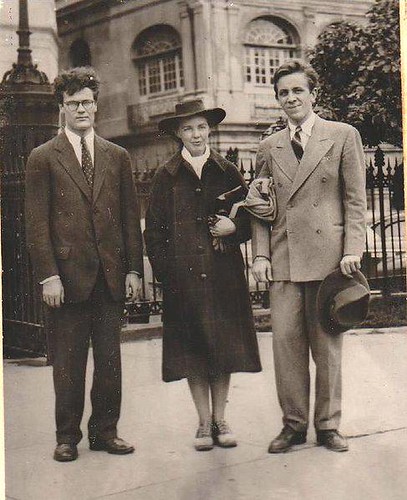 Lowell (left) in 1941, with (his then wife) novelist Jean Stafford, and their friend, novelist and short-story writer Peter Taylor, at Kenyon College, where they studied with John Crowe Ranson (source)
Nouvelle Vague for the New Millennium…
Click here to download Jean-Luc Godard’s latest (and last?) film, Film Socialisme, in its entirety (and entirely legally). Quoth novelist James Greer (repeating Howard Rodman), it’s “kind of like David Foster Wallace’s cruise ship essay, but in French, and with a lot of quotations thrown in. Win/win/win!”
As we try to remember which one is Jim, and which one Jules, we might recall that it was on this date in 1949 that George Orwell published his masterpiece of dystopian literature, Nineteen Eighty-Four, and introduced terms like “Big Brother,” “doublethink,” “thoughtcrime,” “Newspeak,” and “Memory hole” into the vernacular.

You must be logged in to post a comment.