Posts Tagged ‘film history’
Deja vu all over again…

Movie: Inception
Actor: Joseph Gordon-Levitt
Location: Paris, France
Photographer: Jazz Gabriel
How does one combine one’s loves of movies and travel? Allen Fuqua created Movie Mimic.

Movie: Vicky Cristina Barcelona
Actress: Rebecca Hall
Location: National Art Museum of Catalonia, Barcelona, Spain (Museu Nacional d’Art de Catalunya, Barcelona, Espanya)
With: Juan Sánchez
Photographer: Felipe ?
More, at Movie Mimic.
***
As we position ourselves carefully, we might send terpsichorean birthday greetings to Frederick Austerlitz; he was born in Omaha, Nebraska on this date in 1899. Despite a producer’s verdict on an early audition– “Can’t act, can’t sing, balding. Can dance a little.”– Fred Astaire, as he was better known, prospered. In a career that spanned 76 years, the film and Broadway stage dancer, choreographer, singer, and actor starred in 31 musicals– and has been named the fifth Greatest Male Star of All Time by the American Film Institute.
Gene Kelly, another major innovator in filmed dance, said that “the history of dance on film begins with Astaire.” And beyond film and television, many classical dancers and choreographers in other forms– Rudolf Nureyev, Sammy Davis, Jr., Michael Jackson, Gregory Hines, Mikhail Baryshnikov, George Balanchine, and Jerome Robbins among them– also acknowledged Astaire’s importance and influence.
As for Ginger Rogers, with whom he co-starred in 10 films, her admiration was qualified: “I don’t know why everyone makes such a fuss about Fred Astaire’s dancing. I did all the same steps, only backwards. And in heels!”

A good scare…

HW: Do you find that audiences are frightened by different things now from the things that frightened them when you started, what, 30 years ago… 35 years ago, making films?
AH: No, I wouldn’t say so, because after all they were frightened as children. You have to remember this is all based on “Red Riding Hood,” you see? Nothing has changed since “Red Riding Hood.”
In 1964, Huw Weldon (later, Director General of the BBC) interviewed Alfred Hitchcock for the BBC series Monitor…
Part Two here
HW: Have you ever been tempted to make what is nowadays called a horror film, which is different from a Hitchcock film?
AH: No, because it’s too easy… I believe in putting the horror in the mind of the audience and not necessarily on the screen.
[TotH to Brain Pickings]
***
As we reach for our security blankets, we might recall that, though accounts of an unusual aquatic beast living in Scotland’s Loch Ness date back 1,500 years, the modern legend of the Loch Ness Monster was born when a sighting made local news on this date in 1933. The Inverness Courier ran the account of a local couple who claimed to have seen “an enormous animal rolling and plunging on the surface.” The story of the “monster” (a label chosen by the Courier editor) became a media sensation: London papers sent correspondents to Scotland and a circus offered a 20,000 pound reward for capture of the beast.
 Photo “taken” in 1934, later proved a hoax (source)
The passing of the passion pit…
 The Pike, Montgomery, PA
Connecticut photographer Carl Weese uses oversize “banquet cameras” to document that quintessentially-American institution, the drive-in movie. While the first drive-in appeared (in New Jersey) in the early 1930s, their heyday was the golden age of suburbs, the 1950s and 60s. First pitched as a place to bring the whole family (“no matter how noisy the kids are”), drive-ins fell victim to proliferating “hard tops” (as Variety calls indoor theaters); Daylight Savings Time (which shaved an hour out of the evening’s viewing time); the growing availability of feature films on vcr, then cable and dvd (which made for an even more convenient family film night); and rising land prices (which made many “soft tops” comparatively uneconomical to operate). For many teens in the 50s and 60s, the drive-in provided an intimate privacy unavailable elsewhere. That too changed, as TV sets proliferated throughout the rooms of most households… There were over 4,000 drive-ins in operation in the 60s; today, there are under 400.
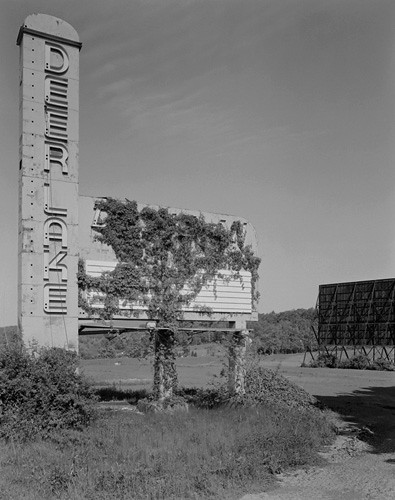 Deer Lake Drive-In, Deer Lake, PA
[TotH to Co.Design for the photos]
As we learn to pop our own corn, we might note that this date marked the end of one American political thinker’s life, and the beginning of another’s:
Author, printer, political theorist, politician, postmaster, scientist, musician, inventor, satirist, civic activist, statesman, and diplomat Benjamin Franklin died on this date in 1790.
 They who can give up essential liberty to obtain a little temporary safety, deserve neither liberty nor safety (source)
And on this date in 1854, Benjamin Ricketson Tucker, the champion of “unterrified Jeffersonianism” (AKA American individualist anarchism) was born. Tucker founded and published Liberty, a magazine that featured everything from the social economic ideas of Herbert Spencer and Lysander Spooner to articles on Free Love; it carried George Bernard Shaw’s first article to appear in the U.S. and the first American translations of Friedrich Nietzsche.
 Liberty, Equality, Fraternity, these three; but the greatest of these is Liberty. Formerly the price of Liberty was eternal vigilance, but now it can be had for fifty cents a year. (source)
In Praise of “Other”: The Librarian as Film Star…

Is it any wonder that older friends and relatives abroad still ask, when learning that one is from the Western U.S.: do you know any cowboys? Anyone with a sense of America formed from the movies that have been this nation’s leading cultural ambassador for most of the last century might well assume that we are a nation of wranglers, gangsters, reporters, and lawyers.
The invaluable Moira Finnie, blogger for TCM, moderator of the online forum Silver Screen Oasis and proprietor of the blog Skeins of Thought, strikes a blow for the unsung, singling out the librarian:
This rumination on work in the movies began while I was reading the new memoir, Quiet Please, (Da Capo Press). The author offers a look at the experiences of a young, male, very contemporary librarian named Scott Douglas from the other side of the reference desk… One amusing section of the book concerned the fact that Douglas felt that there was a serious dearth of librarians as role models in the movies. Sure, to the average person, “Marian the Librarian” in The Music Man (1964) may be the quintessential movie librarian. You know the type, frosty on the outside, potentially a molten hottie and closet romantic on the inside, all the while that “Prof. Harold Hill” is hoping she’s really that “sadder but wiser girl” he’s hoping to find in the hinterlands of Iowa during his travels…
Except for Noah Wyle’s three made-for-tv excursions as…(dramatic pause)…the nebbishy but dashing “Flynn Carsen” in The Librarian movies, there do seem to be paltry few positive images of librarians in the movies, especially for males…
So begins a delightful survey of librarians on screen: “One of the Invisible Professions.”

Library Science teacher Ann Robinson pausing for a reflective smoke with Gene Barry before the destruction of the human race proceeds in The War of the Worlds (1953).
As we refrain from unnecessary noises, we might recall that it was on this date in 1271 that Kublai Khan renamed his empire “Yuan,” officially marking the end of the Song Dynasty (though Southern Song wasn’t fully conquered until 1276) and the start of the Yuan Dynasty of (Mongolia and) China. The Yuan Dynasty was a period of consolidation and centralization, and encouragement of science, technology, and trade, creating the China that Marco Polo found at the end of the Silk Road. It was also the period during which China developed drama and the novel, and saw a marked increased in the use of the written vernacular.
 Kublai Khan (source)
Get (Sur)real…
 click here for video
From Alex Pasternack on Motherboard:
Before he was Kermit, Jim Henson was Brunel.
With apologies to Man Ray and Busby Berkley and many others, I submit that argument and this hypothesis: the amount of time you spent as a child watching Sesame Street and the Muppets is directly proportional to your taste for the comic, the avant-garde, the absurd and the surreal. Jim Henson, the lead instructor of this viewers-like-you-fueled education, would have turned seventy-five this week had he not died in 1990, sucking away a collective head trip that was, ultimately, firmly planted in a felt flowerbed of weirdness.
Pasternack offers plentiful– and delightful– evidence, including this remarkable 1974 appearance on Johnny Carson’s Tonight Show:
… and this “collaboration” with Orson Welles:
Many more mesmerizing examples at “Jim Henson Was America’s Greatest Surrealist.”
Special Minimalist Bonus!:
As we proclaim Henson the (Du)champ, we might wish a stony-faced Happy Birthday to “the greatest actor-director in the history of the movies” (quoth Roger Ebert); Joseph Frank “Buster” Keaton was born on this date in 1895.
As a young vaudevillian, Keaton met silent star Fatty Arbuckle. Keaton borrowed Arbuckle’s crew’s camera, took it back to his boarding house, disassembled and reassembled it, then returned to ask for a job. He was hired as co-star and gag man on “The Butcher Boy”– and soon became Arbuckle’s “second director” and his entire gag department. Keaton soon earned his own unit, and began churning out two-reelers. Leo McCarthy (director of Charlie Chase, Laurel and Hardy, the Marx Brothers, Mae West, and others) recalled, “All of us tried to steal each other’s gagmen. But we had no luck with Keaton, because he thought up his best gags himself and we couldn’t steal him!”
From 1920 through 1929, Keaton made Our Hospitality, The Navigator, Sherlock Jr., Seven Chances, Steamboat Bill Jr., The Cameraman, and The General— gems all. Indeed, Henson collaborator Orson Welles considered The General to be, “the greatest comedy ever made, the greatest Civil War film ever made, and perhaps the greatest film ever made.”
With the advent of sound, Keaton’s career took a sideways turn. While he appeared in a number of feature films, guested on many television series, and even served as an advisor to Lucille Ball on I Love Lucy, he was never again the monster star that he had been on the silent screen… which adds to the power– and the poignancy– of his penultimate role: the lead in the only movie written by Samuel Beckett, the (nearly) silent Film.

Your correspondent is bound for the City of Dreaming Spires. The time-zone differential being what it is, regular service will be interrupted until October 10 or so. While there may be an occasional missive in the meantime, readers can trustworthily amuse themselves with the films of Buster Keaton, streaming (for free) on the wonderful Archive.org.
You must be logged in to post a comment.