Posts Tagged ‘computers’
“The most fruitful and natural exercise for our minds is, in my opinion, conversation”*…

In this age of Alexa and Siri, it’s worth recalling the (long) history of human-machine conversation. At MIT in 1966 an experiment with an early form of artificial intelligence anticipated just how close we might grow with our machines…
Client: Men are all alike.
ELIZA (a computer): In what way
Client: They’re always bugging us about something or other.
ELIZA: Can you think of a specific example
Client: Well, my boyfriend made me come here.
ELIZA: Your boyfriend made you come here
Client: He says I’m depressed much of the time.
ELIZA: I am sorry to hear you are depressed
Client: It’s true. I am unhappy.
ELIZA: Do you think coming here will help you not to be unhappy
Client: I need some help, that much seems certain.
– Joseph Weizenbaum, from a transcription of “Computational Linguistics.”
Named after George Bernard Shaw’s ingénue in Pygmalion, the ELIZA program operated on the Project MAC computer system at MIT and made natural language exchange possible between man and machine. ELIZA identified key words and phrases and responded with rote answers that simulated a conversation.
“Talking Cure,” via Lapham’s Quarterly.
* Michel de Montaigne, The Essays
###
As we lie back on the couch, we might note that it was on this date in 1928 that the Enigma Machine encoded its first message.
A simple German machine the size of a portable typewriter, ENIGMA allowed for security in communications by a process in which typed letters were replaced by a cipher text displayed on illuminated lamps. The cipher was symmetrical so entering the cipher text into another ENIGMA reproduced the original message. Security was provided by a set of rotor wheels and a series of patch cables whose arrangement was agreed upon previously.
ENIGMA was used extensively by the German military during World War II to transmit battle plans and other secret information. By December of 1941, however, British codebreakers managed to decipher the code, allowing them to routinely read most ENIGMA traffic.
[source- Computer History Museum]

Phreaking out…

Cover of the Spring 2012 issue of 2600
In preparation for “treat-ing” tonight’s parade of freaks, one might pause to pay respects to 2600: The Hacker Quarterly, an American publication that specializes in publishing technical information on a variety of subjects including telephone switching systems, Internet protocols and services, as well as general news concerning the computer underground. The magazine’s moniker comes from the “phreaker” discovery (by John “Cap’n Crunch” Draper and friends in the 1960s) that the transmission of a 2600 hertz tone (which could be produced perfectly with a plastic toy whistle given away free with Cap’n Crunch cereal) over a long-distance trunk connection gained access to “operator mode” and allowed the user to explore aspects of the telephone system that were not otherwise accessible… like free long distance calls. (The seed money for Apple was in part raised by the two Steves’ sale of “phreaking boxes” designed to do just this.)
2600 has become a journal-of-record for “Grey Hat” hackers– tech explorers concerned to push past the limits inherent to the design of a given technological device or application (as opposed to White Hats, who are ideologically motivated to do good, or Black Hats, who pursue selfish– often illegal– gain). So its current editorial focus is largely on the web and its devices, increasingly on mobile implementations and application.
But 2600 honors its roots, among other ways, by maintaining a gallery of photos of payphones around the world; for example…

Peshlawar, Pakistan

Moscow, Russia (The payphones only accept one ruble coins, an obsolete denomination)
###
As we wax nostalgic, we might send illuminating birthday greetings to Narinder Singh Kapany; he was born on this date in 1926. While growing up in Dehradun in northern India, a teacher informed him that light only traveled in a straight line. He took this as a challenge and made the study of light his life work, initially at Imperial College, London. In January 1954, Nature published his report of successfully transmitting images through fiber bundles– and Dr. Kapany became the father of fiber optics (a name he coined). Dr. Kapany ultimately migrated to the U.S., where he continued to invent (he holds over 100 patents), taught, started successful companies, and became a philanthropist. Fortune named him one of seven ‘Unsung Heroes’ in their “Businessmen of the Century” issue (November 22, 1999). It was, of course, the implementation of Dr. Kapany’s work that rendered “phreaking” moot.

Happy Halloween!
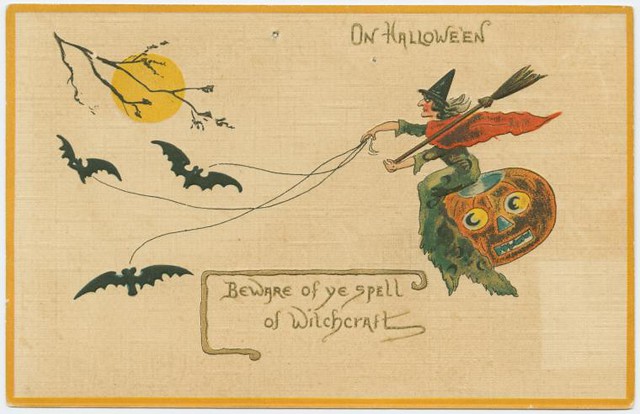 from the NY Public Library’s Flickr set of Halloween cards…
Geek Humor…

Readers who have wondered about the utility of Quora can discover at least one example here…
- yo momma’s so mean, she has no standard deviation.
- A infectious disease walks into a bar. The bartender says “We don’t serve infectious diseases.” The infectious disease says “Well, you’re not a very good host.”
- A neutrino walks into a bar. The bartender says “We don’t serve neutrinos in this bar.” The neutrino says “Hey, I was just passing through.”
- A wife asks her husband, a software engineer: “Could you please go shopping for me and buy one carton of milk, and if they have eggs, get 6!” A short time later the husband comes back with 6 cartons of milk. The wife asks him, “Why the hell did you buy 6 cartons of milk?” He replied, “They had eggs.”
- The Higgs boson walks into a church. The priest says “We don’t allow Higgs boson in here. The Higgs boson says, “But without me how can you have mass?”
- Two men walk into a bar and the first one says, ” I would like some H20.” Then the second man says, “That sounds good I will have H20 too.” Then the second man died.
Many more at “What are some funny nerd jokes?”
###
As we titter technologically, we might recall that it was on this date in 1988 that the first “computer worm” was unleashed. The phrase was coined in in John Brunner’s 1975 novel, The Shockwave Rider; but the first worm was written and released thirteen years later by Robert Tappan Morris, a Cornell University computer science graduate student. Morris also has the distinction of being the first person tried and convicted under the 1986 federal Computer Fraud and Abuse Act.

You must be logged in to post a comment.