Posts Tagged ‘cartoons’
“I like physics, but I love cartoons”*…


On December 15, 2016, internet cartoonist Branson Reese made a pact to release a new comic every day at midnight, no matter what. One year later, he has done that, which is pretty cool. The only catch is his art is really freaking strange and I mean that in the best way possible…
Joey Cosco on why you should follow Branson Reese.
* Stephen Hawking
###
As we look forward to our daily dose, we might recall that it was on this date in 1942 that Jack Mercer and his wife Margie voiced Popeye and Olive Oyl in the new Popeye cartoon, “Kickin” the Conga.

“Oo ee oo ah ah ting tang walla walla bing bang”*…
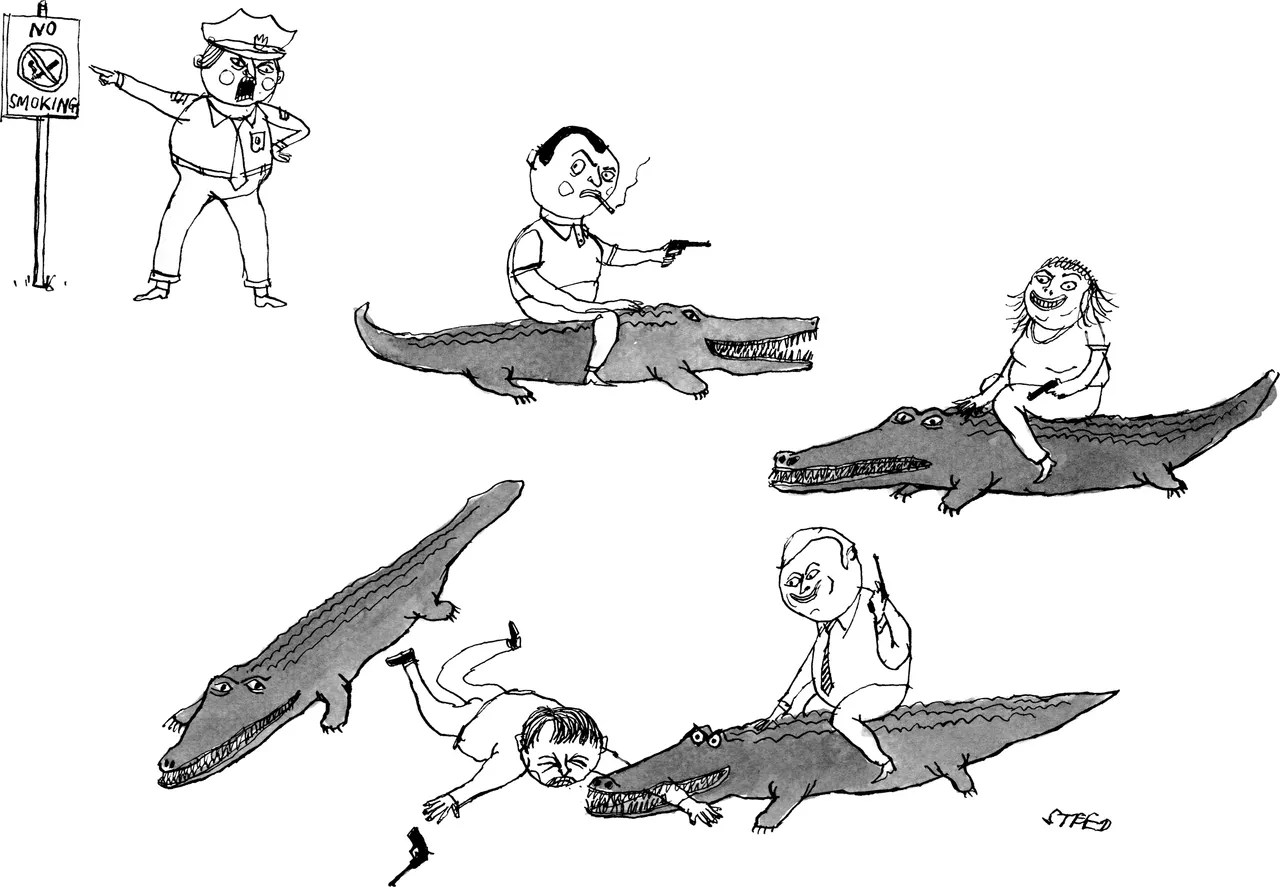
On this most bizarre of days, an alternative: hours of fun at The New Yorker‘s “Cartoons at Random.”
* “The Witch Doctor”
###
As we fight the urge to bury our heads, we might spare a thought for John Ruskin; he died on this date in 1900. Best remembered as the leading English art critic of the Victorian era, he was also an art patron, draughtsman, watercolourist, a prominent social thinker, and a philanthropist. He wrote on subjects as varied as geology, architecture, myth, ornithology, literature, education, botany, and political economy, and in styles and literary forms equally varied: Ruskin penned essays and treatises, poetry and lectures, travel guides and manuals, letters and even a fairy tale.
Ruskin was hugely influential in the latter half of the 19th century, and up to the First World War. After a period of relative decline, his reputation has steadily improved since the 1960s with the publication of numerous academic studies of his work. Today, his ideas and concerns are widely recognized as having anticipated interest in environmentalism, sustainability, and craft.
You may either win your peace, or buy it:—win it, by resistance to evil;—buy it, by compromise with evil.
– Ruskin, The Work of Iron, in Nature, Art, and Policy. Lecture at Tunbridge Wells, February 16, 1858

“If you do not know the words, you can hardly know the thing”*…

… one of hundreds of evocative entries in Greg Borenstein‘s wonderful Dictionary of Fantastic Vocabulary.
###
As we contemplate coinage, we might spare a thought for George Joseph Herriman; he died on this date in 1944. A cartoonist best remembered for Krazy Kat, which ran from 1913 until his death, he was never a commercial success; his strip survived via the admiration (and support) of his publisher, William Randolph Hearst. But Herriman was enormously influential, a primary influence on cartoonists like Will Eisner, Charles M. Schulz, Robert Crumb, Art Spiegelman, Bill Watterson, and Chris Ware… and no mean wrangler of language himself.

1922 self-portrait
“In America the President reigns for four years, and Journalism governs forever and ever”*…

Hand-wringing over the state of journalism– especially the state of print journalism– is a feature of our times. As Will Mari reminds us, the profession has been here before…
In the late 1950s, TV news was on the rise, as more and more Americans (nearly 90 percent of them, in fact) were buying sets. As broadcasters competed with print journalists for breaking news, writers for newspapers and magazines were rethinking their role as storytellers and interpreters.
Sigma Delta Chi, later known as the Society of Professional Journalists, recognized this. The Quill, its magazine for reporters and editors, confronted the occupation’s many challenges. From embracing discussions of technological change, to discussing journalistic failings (like how to handle the next Sen. Joe McCarthy) and encouraging its members to mentor younger journalists, the organization and others like it played a big part in the professionalization of the field.
Cartoons in The Quill poked fun at newsroom life. Occupational humor, often of the gallows variety, was (and remains) a critical way for journalists to think about their profession. Cartoons also appeared in abundance in other trade publications, such as in the American Newspaper Guild’s Guild Reporter and Editor & Publisher. The former championed labor, and the latter presented publishers’ point of view.
The Quill walked a middle path. Its cartoons, some unsigned and others bylined, depict the inhabitants of the newsroom going about their daily business. The humor had a light, earnestly innocent feel. Sigma Delta Chi’s members also included broadcast journalists, but the cartoons were drawn mostly from the perspective of print reporters…

* Oscar Wilde
###
As we parse the new(s) paradigms, we might recall that it was on this date in 2005, in Woody Creek, Colorado, that the ashes of Hunter S. Thompson were “blasted into the sky over his farm [there], carried by red, blue and silver fireworks in front of a 153-foot monument that Mr. Thompson, the writer and avatar of “gonzo” journalism, designed himself almost 30 years ago.”
email readers click here for video
“The older I get, the more individuality I find in animals and the less I find in humans”*…

Long-time readers will know of your correspondent’s deep affection and respect for Chuck Jones, who once observed that “the name ‘Chuck Jones,’ according to my uncle, limited my choice of profession to second baseman or cartoonist.” Happily for the world, he chose the pen over the bat.
The (wonderfully appropriately user-named) Every Frame a Painting has done us all a tremendous service:
email readers click here for video
If you grew up watching Looney Tunes, then you know Chuck Jones, one of all-time masters of visual comedy. Normally I would talk about his ingenious framing and timing, but not today. Instead, I’d like to explore the evolution of his sensibilities as an artist. To see the names of the films, press the CC button and select “Movie Titles.”
* Charles Martin “Chuck” Jones
###
As we agree that this is in fact “what’s up, Doc,” we might send send beautifully-collaged birthday greetings to another animation giant, Evelyn Lambart; she was born on this date in 1914. Lambart joined the National Film Board of Canada in 1942– their first female animator; one of the few women in the world working even as a co-director in any form of cinema during the 1940s and ’50s, she made beautiful films– and animation history– both as a co-director with the great Norman McLaren and on her own.
Read more of her story, and see several of her works here.

You must be logged in to post a comment.