Posts Tagged ‘Blackboard’
“It is still an unending source of surprise for me how a few scribbles on a blackboard or on a piece of paper can change the course of human affairs”*…
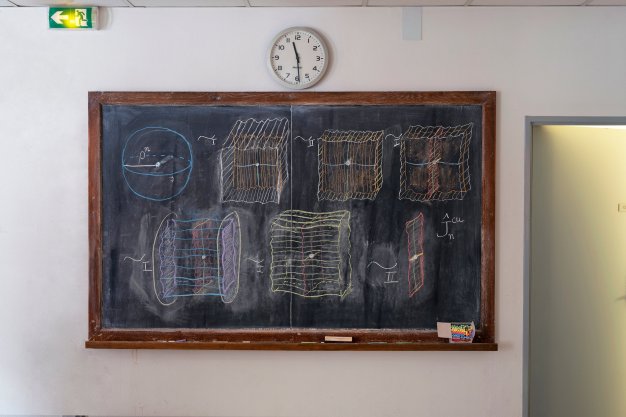
For the last year, Jessica Wynne, a photographer and professor at the Fashion Institute of Technology in New York, has been photographing mathematicians’ blackboards, finding art in the swirling gangs of symbols sketched in the heat of imagination, argument and speculation. “Do Not Erase,” a collection of these images, will be published by Princeton University Press in the fall of 2020…
This is what thought looks like.
Ideas, and ideas about ideas. Suppositions and suspicions about relationships among abstract notions — shape, number, geometry, space — emerging through a fog of chalk dust, preferably of the silky Hagoromo chalk, originally from Japan, now made in South Korea.
In these diagrams, mysteries are being born and solved…

More (and larger) examples from this photo survey of the blackboards of mathematicians at “Where Theory Meets Chalk, Dust Flies.”
###
As we scribble “do not erase,” we might spare a thought for Herbert Aaron Hauptman; he died on this date in 2011. A mathematician, he pioneered and developed a mathematical method that has changed the whole field of chemistry and opened a new era in research in determination of molecular structures of crystallized materials. Today, Hauptman’s “direct methods,” which he continued to improve and refine, are routinely used to solve complicated structures… work for which he shared the the 1985 Nobel Prize in Chemistry.

“A few scribbles on a blackboard… can change the course of human affairs”*…

What’s the most transformative piece of technology in U.S. classrooms? Smart boards? Laptops? In a 2000 paper on computers in education, Steven D. Krause argues that it’s one that’s been around for nearly two centuries: the blackboard. And he suggests that if we want to understand how teachers adopt technology, we might want to study its history.
To understand the impact of blackboards, Krause writes, we need to consider what schools were like before them. Around 1800, most U.S. schools were one-room log buildings with a fireplace at one end and a single window at the other. “Writing lessons” generally meant students working on their own, whittling goose-quill pens and copying out texts.
When the idea of chalkboards first arrived in the early nineteenth century, they came as a revelation to teachers and education experts. In 1841, one educator declared that the blackboard’s unknown inventor “deserves to be ranked among the best contributors to learning and science, if not among the greatest benefactors of mankind.” Around the same time, another writer praised blackboards for “reflecting the workings, character and quality of the individual mind.”
It’s important to remember that school budgets and student-teacher ratios in the early nineteenth century would seem ludicrous to a modern school district. One teacher might be responsible for hundreds of students, with very little funding for supplies.
Krause writes that one prominent way of using the blackboard to improve education under these circumstances was known as the Lancasterian method, after British educator John Lancaster. Lancaster prescribed particular ways of physically arranging the classroom so that a teacher could work with a large group all at once…
The whole dusty story at “How blackboards transformed American education.” Read Krause’s paper, “‘Among the Greatest Benefactors of Mankind’: What the Success of Chalkboards Tells Us about the Future of Computers in the Classroom,” here.
* Stanislaw Ulam
###
As we clean the erasers, we might send repetitive-but-instructive birthday greetings to Edwin Ray Guthrie; he was born on this date in 1886. A philosopher and mathematician by training, he became a leading behavioral psychologist, specializing in the psychology of learning and more specifically, in the role association plays in acquiring skills. He’s probably best remembered for his belief that all learning is based on a stimulus- response association, instantiated in his Law of Contiguity, which held that “a combination of stimuli which has accompanied a movement, will on its recurrence tend to be followed by that movement.” Movements are, he argued, small stimulus- response combinations; these movements make up an act. Thus, a learned behavior– an act that is consolidated by the learner so that it can be repeated– is, at its root, a series of movements. Guthrie believed that what is learned are the movements (of which the behaviors are simply a result).

D’oh!…
Now in it’s 21st season, The Simpsons has consistently been one of the best-written shows on television. Among it’s many gleaming facets, as readers will know, is the opening sequence– in which, to the accompaniment of Danny Elfman’s theme, three elements change from episode to episode: the things that Bart writes on the school chalkboard, the solos that Lisa plays on her saxophone, and the sight gags by which the family enter their living room to end up on the couch.
Now the archival site Bart’s Blackboard allows readers to wander at will back through young master Simpson’s scrawls.
 “Sometimes it’s funny, sometimes it’s not. Sometimes the reference is obvious, sometimes it’s not. After 20 years, the writers of The Simpsons can still surprise and delight viewers with Bart’s punishment, and this site’s purpose is to capture them all for posterity.”
As we blow away the chalk dust, we might celebrate a different but resonant brand of resourcefulness: the paper boat. In the mid-Nineteenth Century, a flourishing business grew near Troy, NY, manufacturing boats with hulls of paper. Founded and run by the appropriately-named Elisha Waters, Waters & Sons (later Waters & Balch) was credited as the “largest boat manufacturer in America” by the New York Daily Graphic. The firm made a variety of boats, but was best known for their lighter craft– in particular, their canoe and their racing shell, the hulls of which were fashioned from manila paper (which was in those days actually made from manila hemp, often in the form of recycled sails and ropes)– and the patent for the manufacturing process of which was granted on this date in 1843.

You must be logged in to post a comment.