Posts Tagged ‘BBC’
What’s Bad is Good for You, Part 13…
 source: Babble.com
Uttering expletives when you hurt yourself is a sensible policy, according to scientists who have shown swearing can help reduce pain.
A study by Keele University researchers found volunteers who cursed at will could endure pain nearly 50% longer than civil-tongued peers.
They believe swearing helps us downplay being hurt in favour of a more pain-tolerant machismo.
The work by Dr Richard Stephens’ team appears in the journal NeuroReport.
Dr Stephens, from Keele’s school of psychology, came up with the idea for the study after swearing when he accidentally hit his thumb with a hammer as he built a garden shed.
<snip…>
Read the entire d*mned BBC report here.
As we savor alternative anaesthetics, we might think loving thoughts of “Laura” as her dedicated poet, Francesco Petrarca– Petrarch– was born on this date in 1304. Considered by many to have been “the Father of Humanism,” and reputed to have coined the term “Renaissance,” Petrarch was famous for his paeans to his idealized lover “Laura” (modeled, many scholars believe, on the wife of Hugues de Sade whom he met in Avignon in 1327, and who died in 1348). But Petrarch’s more fundamental and lasting contribution to culture came via Pietro Bembo who created the model for the modern Italian language in the 16th century largely based on the works of Petrarch (and to a lesser degree, those of Dante and Boccaccio).

![Reblog this post [with Zemanta]](https://i0.wp.com/img.zemanta.com/reblog_e.png?w=700)
Take me to your leader…
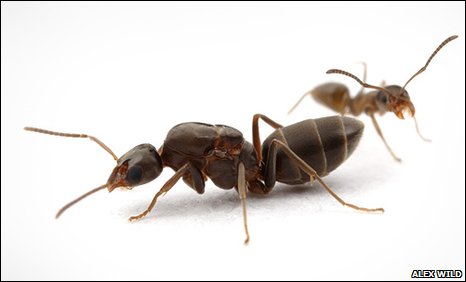
Just as one begins to feel self-satisfied about the dominance of humanity on earth, and the degree of interconnectedness afforded by Facebook, Twitter, and the like, this from the BBC:
A single mega-colony of ants has colonised much of the world, scientists have discovered.
Argentine ants living in vast numbers across Europe, the US and Japan belong to the same inter-related colony, and will refuse to fight one another. The colony may be the largest of its type ever known for any insect species, and could rival humans in the scale of its world domination.
…
While ants are usually highly territorial, those living within each super-colony are tolerant of one another, even if they live tens or hundreds of kilometres apart. Each super-colony, however, was thought to be quite distinct.
But it now appears that billions of Argentine ants around the world all actually belong to one single global mega-colony.
…
Read the entire story here.
As we contemplate connection (and redouble our efforts to emulate E.M. Forster), we might recall that it was on this date in 1957 that young Paul McCartny attended a church picnic at which a newly-formed band, the Quarrymen, were playing between sets, McCartney played a couple of tunes on the guitar for the group and its leader, John Lennon, who invited McCartney to join. McCartney did, but was slow to serious commitment (Paul missed his first gig, as he had a scout outing to attend).
Still, the group gained a following, changed its name to Johnny and the Moondogs, and recruited McCartney’s friend George Harrison. After bassist Stu Sutcliffe joined, they changed the name again, to the Silver Beetles, then finally to the Beatles. Tommy Moore joined the band as drummer and was replaced by Pete Best in 1960. After a tour to Germany in 1961, Sutcliffe left the band to become a painter (a scant year before he died of a brain hemorrhage), and the band returned to Liverpool. In 1962, five years after Lennon and Mccartney found each other, they found Ringo; Best left the band; the Fab Four–McCartney, Lennon, Harrison, and Starr–recorded “Love Me Do”… and the rest is history.
 McCartney and Lennon in the Quarrymen (source: Dull Neon/Random Notes)
Collect all seven!…
The Shadow asked, “Who knows what evil lurks in the hearts of men?” Well, as it happens, Thomas Vought and a team of geographers from Kansas State University do, at least in the U.S. Vought and his team first mapped transgression in the state of Nevada– “The Spatial Distribution of the Seven Deadly Sins Within Nevada”— then expanded their survey (at a county-specific level) nationwide…

Click here to see how one’s home stacks up in the other six dimensions of damnation.
As we reach for our rosaries, we might ruminate on the ways in which standards change: it was on this date in 1970 that Ray Davies of the Kinks travelled round-trip New York-London-New York– literally on this date, in 24 hours– to change a single word in his immortal “Lola” (“Coca Cola” became “cherry cola”) to satisfy a ban on commercial reference by the BBC. How quaint.
I can’t see a thing in the video
I can’t hear a sound on the radio
In stereo in the Static Age— “The Static Age,” Green Day, 21st Century Breakdown

A taxonomy of turns…
From our friends at The Infrastructurist, “A Field Guide to Freeway Interchanges” (Part Two, here)…
Never again need we be confused by the difference between a “Spooey” (Single Point Urban Interchange, or “SPUI”):

…and a “Clovermill” (partial cloverleaf with turbine-style flyover [or, elevated] ramps):

Collect all 31 here (and here).
As we activate our turn indicators, we might recall with gratitude that it was on this date in 1969 that the BBC ordered the first 13 episodes of a new comedy sketch show improbably titled Monty Python’s Flying Circus (which premiered on October 5 of that year).
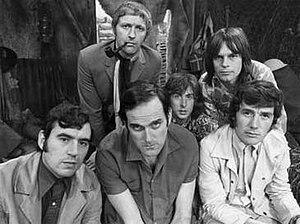
Hours of amusement on the MPFC YouTube channel, here…
You must be logged in to post a comment.