Posts Tagged ‘anesthetic’
“Small irritations can lead to exaggerated reactions”*…

From the annals of abnormal behavior…
In the late 19th century, a rare and highly unusual neuropsychiatric condition was observed among a group of French-Canadian lumberjacks living in the Moosehead Lake region of northern Maine. Those affected exhibited an extreme and exaggerated startle reflex. When startled by a sudden movement or loud noise, they reacted with dramatic involuntary responses, such as leaping into the air, screaming, repeating words, or instantly obeying shouted commands. It was reported that the “jumpers” were primarily of French descent, born in Canada, and worked as lumbermen in the Maine woods.
The mystery of the Jumping Frenchmen of Maine first drew the attention of the scientific community in 1878, when prominent American neurologist George Miller Beard informed members of the American Neurological Association at its annual meeting that he had heard accounts of these lumberjacks and their unusual nervous condition. Two years later, Beard himself travelled to the Moosehead Lake region to see first-hand if the accounts were true. He wasn’t disappointed…
I found two of the Jumpers employed about the hotel. With one of them, a young man twenty-seven years of age, I made the following experiments:
1. While sitting in a chair, with a knife in his hand, with which he was about to cut his tobacco, he was struck sharply on the shoulder, and told to “throw it.” Almost as quick as the explosion of a pistol, he threw the knife, and it stuck in a beam opposite; at the same time he repeated the order “throw it” with a certain cry as of terror or alarm.
2. A moment after, while filling his pipe with tobacco, he was again slapped on the shoulder and told to “throw it.” He threw the tobacco and the pipe on the grass, at least a rod away, with the same cry and the same suddenness and explosiveness of movement…
After observing and examining many jumpers, Beard concluded that jumping was a type of nervous disorder. In a paper published in 1881, Beard wrote:
Jumping is a psychical or mental form of nervous disease, and is of a functional character. Its best analogue is psychical or mental hysteria, the so-called ‘servant-girl hysteria,’ as known to us in modern days, and as very widely known during the epidemics of the middle ages.
Beard surmised that the syndrome of jumping might be tied to tickling:
This disease was probably an evolution of tickling. Some, if not all, of the Jumpers, are ticklish—exceedingly so—and are easily irritated by touching them in sensitive parts of the body. It would appear that in the evenings, in the woods, after the day’s toil, in lieu of most other sources of amusement, the lumbermen have teased each other, by tickling, and playing, and startling timid ones, until there has developed this jumping, which, by mental contagion, and by practice, and by inheritance, has ripened into the full stage of the malady as it appears at the present hour.
Jumping was also found to be strongly tied to families indicating a genetic condition…
[There follow a series of accounts of “jumpers” in other locations (almost all timber-adjacent) and of the evolving explantions offered by experts, concluding…]
… In 1965, Reuben Rabinovitch, an assistant professor of neurology at McGill University, wrote a letter to the editor of the Canadian Medical Association Journal , where he described a children’s game he had witnessed in the Laurentian Mountains, north of Montreal. In this game, a child would secretly follow another, jab them in the ribs, and imitate the sound of a kicking horse. The “victim” was expected to respond by mimicking the sound, leaping into the air, and flinging their arms outward. This form of horseplay, he noted, often continued into adulthood, particularly in isolated villages or lumber camps where recreational outlets were scarce.
Rabinovitch concluded that the Jumping Frenchman syndrome was not a neurological disorder per se, but rather a conditioned reflex that developed out of the monotony and social isolation of life in lumber camps. According to this interpretation, the behaviour became institutionalized within a close-knit community as a form of interaction and entertainment. When the traditional logging camps gradually disappeared, so too did the jumping behaviour.
Further support for this view came in 1986, when two Canadian neurologists and a psychologist studied eight individuals in Quebec who exhibited jumping behaviours. The researchers found that all of the men had developed the condition during adolescence, shortly after beginning work in lumber camps. They reported being teased and provoked by other workers until the jumping behaviour became ingrained.
Based on this evidence, some scholars have argued that the Jumping Frenchman syndrome is not a medical condition or a case of collective hysteria, but a classic case of operant conditioning —a learned behaviour reinforced by social stimuli—that developed in a closed community.
The long and the short of it is that the Jumping Frenchmen of Maine may have more to do with human nature than with neurology. In the rough, close-knit world of lumber camps, where entertainment was scarce, a peculiar habit took hold, that slowly developed into a cultural quirk, or even a very strange joke that went too far. As the lifestyle that nurtured it faded, so did the jumping.
Nothing conclusive has yet been established. The National Organization for Rare Disorders (NORD) still lists Jumping as “an extremely rare disorder” with “no specific therapy”. While it acknowledges the theory of operant conditioning, NORD notes that some researchers believe that jumping Frenchmen of Maine may be a somatic neurological disorder, caused by a gene mutation that occurs after fertilization and is not inherited from the parents or passed on to children.
The organization concludes that further research is needed to understand the exact causes and underlying mechanisms of the Jumping Frenchmen of Maine, as well as other culturally-specific startle disorders…
“The Jumping Frenchmen of Maine,” from @AmusingPlanet.
###
As we query curious comportment, we might send birthday greetings of uncertain provenance to Charles Thomas Jackson; he was born on this date in 1805. A physician and scientist, he was active in medicine, chemistry, mineralogy, and geology, in that lattermost of which he was particularly distinguished.
That said, he is probably best remembered for a series of spectacular claims he made to the work of others: the discovery of guncotton (Christian Friedrich Schönbein), the telegraph (Samuel F. B. Morse), the digestive action of the stomach (William Beaumont), and the anesthetic effects of ether (William T. G. Morton). These claims continued until, in 1873, he was hospitalized at McLean Hospital. It was widely believed at the time that the reason was mental illness, either through a seizure or having a manic episode upon seeing Morton’s tombstone.
In fact, Jackson had suffered a left brain stroke that affected his language area. While he never regained his speech, he was cooperative and did not exhibit “inappropriate behavior of insanity.” By unanimous vote of the McLean Asylum Trustees, Jackson was hosted as a guest at the hospital at no charge for the entire duration of his stay as a recognition of his [very real] past contributions.

“Psychedelic experiences are notoriously hard to render in words”*…

… to categorize them, even harder. But Josie Kins (@Josikinz) and her colleagues at Effect Index are putting in the work…
The Subjective Effect Index is a set of articles designed to serve as a comprehensive catalogue and reference for the range of subjective effects that may occur under the influence of psychoactive substances and other psychonautic techniques.
The effects listed here are accompanied by detailed descriptions on the subjective experiences of them. They are written in a consistent and formal writing style that avoids the use of flowery metaphors or analogy; instead, they strive to use simple and accessible language. This is done with the hope that they will eventually serve as a universal terminology set that enables people to better communicate and share experiences that are, by nature, difficult to convey.
The Index is separated into 233 effects, which are organised into categories based on the senses they affect and their behavior. Many of these are further broken down into leveling systems, subcomponents, and style variations that may occur across different substances. Detailed image, video, and audio replications [like the one above] have been included wherever possible to supplement text-based descriptions…
Stanislav Grof, M.D has argued that “LSD is a catalyst or amplifier of mental processes. If properly used it could become something like the microscope or telescope of psychiatry.” Effects Index is attempting to build a database to help that process along.
* Michael Pollan
###
As we tackle the taxonomy of trips, we might recall that it was on this date in 1842 that (modern) anesthesia was used for the first time in an operation– by Dr. Crawford Long. Long, a physician and a pharmacist, used diethyl ether in the removal of a tumor from the neck of James Venable in Jefferson, GA; given success with Venable, Long then used ether in other surgeries and in childbirths. He published the results of these trials in 1848 in The Southern Medical and Surgical Journal (an original copy of which is held in the U.S. National Library of Medicine).
It’s cool that Long is the subject of one of the two statues representing Georgia in the crypt of the U.S. Capitol. It’s cooler that Long was the cousin of Doc Holliday.

Crawford Long (source)
A, B, C, D, E, F, G…
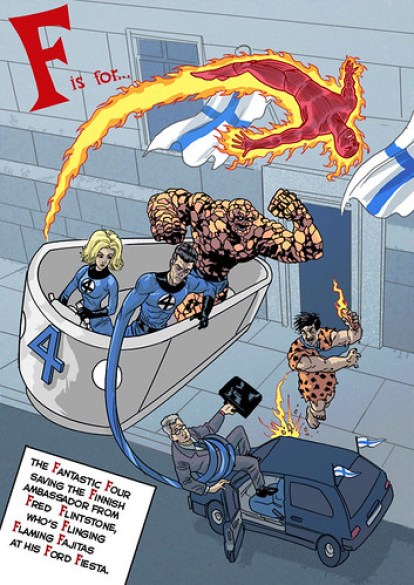
From artist and illustrator Neill Cameron, a celebration of superheroes, celebrities, comic characters– and the allure of alliteration: “The A – Z of Awesomeness.”
As we parse our pleasures, then pause to ponder pain, we might recall that it was on this date in 1842 that anaesthesia was used for the first time in an operation– by Dr. Crawford Long. Long, a physician and a pharmacist, used diethyl ether in the removal of a tumor from the neck of James Venable in Jefferson, GA; given success with Venable, Long then used ether in other surgeries and in childbirths. He published the results of these trials in 1848 in The Southern Medical and Surgical Journal (an original copy of which is held in the U.S. National Library of Medicine).
It’s cool that Long is the subject of one of the two statues representing Georgia in the crypt of the U.S. Capitol. It’s cooler that Long was the the cousin of Doc Holliday.

You must be logged in to post a comment.