Posts Tagged ‘American history’
History repeats itself, first as tragedy, second as farce*…
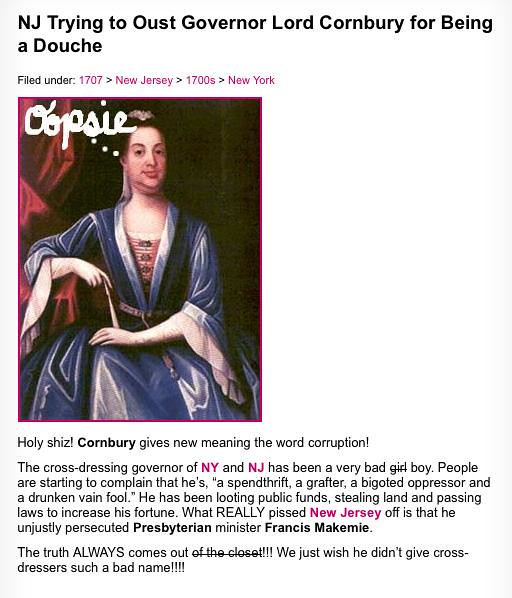
Ladies and Gentlemen… Perez Hamilton:
Imagine if Perez Hilton was around during the founding of America…
That’s us, bitches!!!!!!!
Perez Hamilton delivers the HOTTEST gossip from the New World, as it happens. We mean drama SO steamy that everyone will be talking about it — for centuries.


*Karl Marx
***
As we rethink Revisionism, we might recall that it was on this date in 1782 that (after six years of debate– some things never change) Congress formally adopted the Great Seal of the United States of America.


WTF?!?!?
Diacritical Diagrams…

The curious art of diagramming sentences was invented 165 years ago by S.W. Clark, a schoolmaster in Homer, N.Y. His book, published in 1847, was called A Practical Grammar: In which Words, Phrases, and Sentences Are Classified According to Their Offices and Their Various Relations to One Another. His goal was to simplify the teaching of English grammar. It was more than 300 pages long, contained information on such things as unipersonal verbs and “rhetorico-grammatical figures,” and provided a long section on Prosody, which he defined as “that part of the Science of Language which treats of utterance.”
It may have been unwieldy, but this formidable tome was also quite revolutionary: out of the general murk of its tiny print, incessant repetitions, maze of definitions and uplifting examples emerged the profoundly innovative, dazzlingly ingenious and rather whimsical idea of analyzing sentences by turning them into pictures…
The full story– and lots of nifty diagrams– at Kitty Burns Florey’s “A Picture of Language” in the New York Times‘ Opinionator blog…
***
As we map our mumblings, we might pause to think some celebratory thoughts: today is Juneteenth.
Though the Emancipation Proclamation was issued on September 22, 1862 (effective January 1, 1863), word was slow to spread. On June 19, 1865, Union General Gordon Granger, who’d arrived in Galveston, Texas, with 2,000 federal troops to take possession of the state and enforce the emancipation of its slaves, read “General Order No. 3” from a local balcony:
The people of Texas are informed that, in accordance with a proclamation from the Executive of the United States, all slaves are free. This involves an absolute equality of personal rights and rights of property between former masters and slaves, and the connection heretofore existing between them becomes that between employer and hired labor. The freedmen are advised to remain quietly at their present homes and work for wages. They are informed that they will not be allowed to collect at military posts and that they will not be supported in idleness either there or elsewhere.
Former slaves in Galveston celebrated in the streets; Juneteenth observances began across Texas the following year– and are now recognized as State Holidays by 41 states.
 Ashton Villa in Glaveston, from whose front balcony the Emancipation Proclamation was read on June 19, 1865 (source)
 Juneteenth celebration in Austin, c.1900 (source)
From the Department of Stuff-I-Didn’t-Know…

The horseshoe crab plays a vital, if little-known, role in the life of anyone who has received an injectable medication. An extract of the horseshoe crab’s blood is used by the pharmaceutical and medical device industries to ensure that their products, e.g., intravenous drugs, vaccines, and medical devices, are free of bacterial contamination…
More at The Horseshoe Crab.
[Thanks to friend Erik Speckman]
***
As we watch where we wade, we might recall that it was on this date in 1959 that Governor Earl Long of Louisiana (the brother of former Governor Huey “The Kingfish” Long, and self-described “last of the red-hot poppas” of politics) was committed to the state mental hospital in Mandeville for erratic behavior (that included a very public dalliance with ecdysiast Blaze Starr). Long and his staff discovered that Louisiana law allowed him to continue to govern even in confinement, so he worked the phones to keep his machine rolling. Long had Jesse Bankston, the head of the state hospital system fired, and appointed a new director, who declared him sane.
Illustrating the time-honored principle that “it takes one to know one,” The Kingfish averred (in explaining why he was supporting a rival candidate in a gubernatorial election), “Earl is my brother but he’s crooked. If you live long enough he’ll double cross you.”

Earl Kemp Long, Governor of Louisiana for three non-consecutive terms
To the day…

Barker’s Illustrated Almanac (1912)
Monthly calendar and almanac with various testimonials for Barker’s horse, cattle, and poultry powders.
Almanacs are books published annually that can contain a host of useful information including a calendar of holy days, holidays, farmer’s planting dates, weather forecasts, astronomical data and various statistics. The times of the sunrise and sunset as well as tide charts can also be included. Almanacs, in various forms, have been in existence for hundreds of years. It has been stated in the Encyclopedia of Ephemera that the first printed almanac was published in Vienna in 1457 and the Almanack Calculated for New England – the first American almanac was published in 1639 in Cambridge Massachusetts. The Old Farmer’s Almanac has been published since 1792, making it the oldest continuously published periodical in North America
According to ABC for Book Collectors (an invaluable source for any book lover) an almanac is: “[c]alendar[s], usually in pocket-book (more rarely sheet) form, augmented with Saints’ days, fair-dates and astronomical and meteorological data; a bestseller from the start and protected by jealously guarded patents, the different titles [were especially] hot rivals in the 17th century….”
More data on day books on the ever-illuminating Abe Books blog.
[TotH to reader MK]
***
As we page through the year, we might recall that President Abraham Lincoln wasn’t the only person to die in Ford’s Theater: it was on this date in 1893 that three interior floors of the building collapsed. Following Lincoln’s assassination, the United States Government appropriated the theatre, (Congress payed Ford $100,000 in compensation), and an order was issued forever prohibiting its use as a place of public amusement. In 1866, the theatre was taken over by the U.S. military… then in 1893, the front of the building gave way, killing 22 military clerks and injuring another 68… which led some to conclude that the former Church-turned-theater was cursed. (A restored Ford’s Theater opened in 1968.)

Bodies being removed from Ford’s Theatre following the building’s collapse
“Here’s to alcohol: the cause of, and solution to, all of life’s problems.”*…

“It is well to remember that there are five reasons for drinking: the arrival of a friend, one’s present or future thirst, the excellence of the wine, or any other reason.”
– Latin proverb
The BBC reports:
At high-end bars in the United States and United Kingdom, bartenders are crafting cocktails with ingredients like crickets, tarantulas, scorpions and even giant ants.
The Artesian bar at the Langham hotel in London has been serving up their Langham Tea Punch for just over a year. The ingredients include Courvoisier cognac, Japanese sencha tea and an oven-baked tarantula and scorpion [pictured above]. Just last month, the bar upped the ante by introducing their Vieux Carre cocktail, which pairs cognac and rye whiskey with a side of toasted Colombian giant ants and Mopani worms. Both cocktails cost £16.50
“The drinks are a great talking point since insects aren’t a typical source of nutrition in the UK,” said Artesian head barman Alex Kratena, who noted the cocktails are usually ordered in groups. “Some insects get toasted, which brings the drink extra flavour and some are used for decorative purposes. Most are rather tasty!”
Stateside, White and Church in New York City serves up a trio of insect cocktails, including a cinnamon-flavoured rum paired with honeybees, a margarita-like drink with Mexican spicy worms, and a Batida de Cocco drink with heavy cream and dried grasshoppers. The drinks ring up at $13 each.
Brave enough to drink up and chow down? A single bug can provide 10 to 20 grams of protein, offering a nice nutritional boost in addition to the more usual buzz.
*Homer Simpson
As we order a round for the house, we might send reverent birthday wishes to athlete and evangelist William Ashley “Billy” Sunday; he was born on this date in 1862. After a successful career as an outfielder with the Chicago White Stockings, then the Philadelphia Phillies, Sunday hit the “kerosene circuit” as a preacher, ultimately becoming the most celebrated and influential American evangelist of the first two decades of the 20th century (e.g., playing a significant role in the passage of the 18th Amendment– Prohibition). Historians estimate that, over the course of his pre-broadcast-era career, Sunday preached face-to-face to more than one hundred million people– to the great majority, without electronic amplification.

You must be logged in to post a comment.