Posts Tagged ‘horror films’
“All that we see or seem is but a dream within a dream”*…
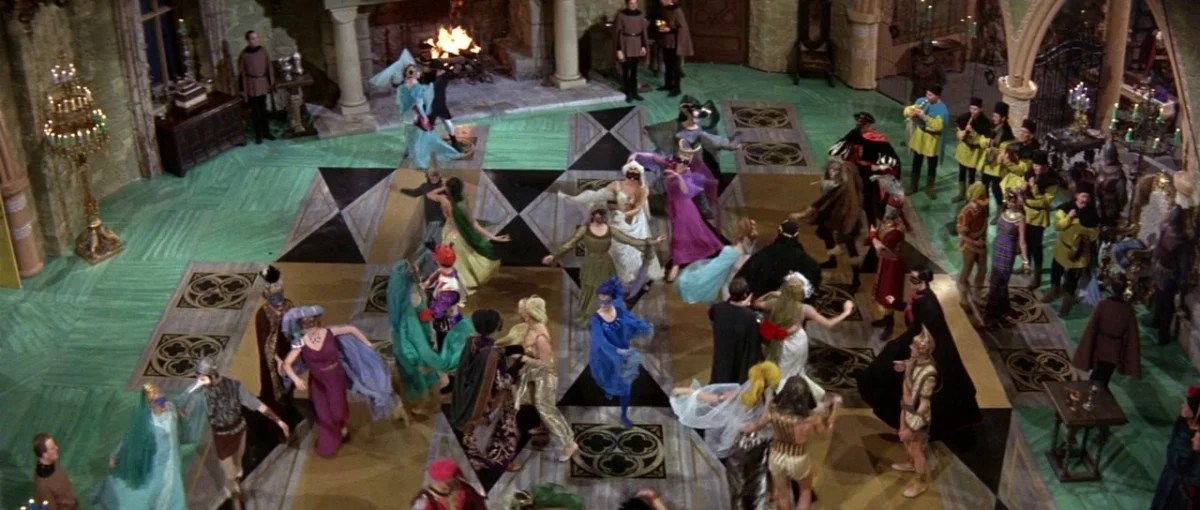
As All Saint’s Eve approaches, Karina Wilson weighs in (on her lovely blog, Horror Film History) on the remarkable series of films created by Roger Corman from the works of seasonal “hero” Edgar Allan Poe…
Corman was fond of literary adaptations, especially if the original was in the public domain. He mined Edgar Allan Poe’s short stories for some of his most memorable work between 1960 and 1964…
… In 1960 AIP execs Arkoff and Nicholson asked Roger Corman to make yet another pair of low-budget black and white horror films. He told them he had a better idea, a movie adaptation of Edgar Allan Poe’s The Fall of the House of Usher. Nicholson and Arkoff initially balked at the concept, which differed wildly from their then-staple trade in monster B-pics aimed at drive-in adolescent audiences. “Where’s the monster?” asked Arkoff.
Corman reassured them the house was the monster (“The house lives. The house breathes”). He was becoming more and more interested in Freudian theory and wanted the adaptation to reference psychoanalytic theory. To Corman, the dark corridors and gaping portals of the decaying mansion were unmistakably female spaces. He was fascinated by the concept that buildings (or at least movie sets) can reflect the ego and the id. Daily activities happen as normal in the sunlit upper rooms of a mansion while shapeless terrors ooze within the gloom of the basement .
If a yonicentric set wasn’t enough to draw the crowds (at least subconsciously), Corman insisted Poe stories had built-in teen appeal thanks to the efforts of English Literature teachers everywhere (“He’s read in every high school”). Corman wanted to tap into widespread familiarity with the tales and the ongoing love affair with gothic horror fuelled by television reruns of Universal movies from the 1930s. He also wanted to make more lavish movies instead of perpetually budgeting on a shoestring. Always mindful of the market, he believed a classic literary adaptation could give AIP productions more mainstream (and adult) appeal and compete with the technicolor horror films being produced by Hammer in the United Kingdom and as part of the nascent Giallo movement in Italy. Arkoff and Nicholson, fully aware of Corman’s proven ability to deliver low budget quality in a timely fashion, agreed to the experiment.
For House of Usher (1960), Corman teamed up with actor Vincent Price, whose sonorous cod-Shakespearean vowels became synonymous with the storybook theater narration that would become emblematic of this cycle. Price had supposedly sworn off making horror movies after The Fly (1958) because he claimed he couldn’t keep a straight face on set. Corman lured him back to the genre with the prospect of playing Roderick Usher, a meaty, actorly role – and the rest is history. Corman tapped screenwriter Richard Matheson, (who was doggedly building his reputation as a master of the genre) for the script, which stuck quite closely to the original, adding a romance between Philip and Madeline. House of Usher was Corman’s first foray into color movies and cost a luxurious $270,000 ($50,000 of which reportedly went to Price). The production schedule was still tight (15 days) and Corman made the most of his expensive star by framing him against production designer Daniel Haller’s skilfully scavenged yet sumptuous looking sets. The result was a commercial and critical hit, grossing $2 million that summer and elevating American International Pictures’ aesthetic beyond Poverty Row. Arkoff and Nicholson, naturally, wanted more of the same.
Between the House of Usher (1960) and The Tomb of Ligeia (1964), Corman made seven Poe-related movies for AIP. Premature Burial in 1962 featured Ray Milland in the lead role but all the others starred Vincent Price (who would go on to make The Oblong Box in 1969, for AIP but without Corman). Matheson supplied scripts for The Pit and the Pendulum (1961), Tales of Terror (1962), The Raven (1963), while his friend Charles Beaumont wrote The Premature Burial, The Haunted Palace (1963), and The Masque of the Red Death (1964). Future Academy Award winner Robert Towne (Chinatown) penned the final entry, Tomb of Ligeia.
While he relied heavily on tried-and-trusted AIP personnel, Corman tried to switch things around tonally with each movie. This ensured a different experience for the audience each time rather than simply replicating what had gone before. Tales of Terror is quite cynical, even humorous in tone and The Raven is outright comedy-horror [and noteworthy as a rung on Jack Nicholson’s climb to stardom]. The Haunted Palace isn’t even based on a Poe story – it’s actually an adaptation of H. P. Lovecraft’s The Case of Charles Dexter Ward. AIP wanted to market it as part of the cycle, so they gave it the title of one of Poe’s poems, and bookended the action with narrated lines…
Read on… “Roger Corman’s Poe Cycle (1960-1964)” from @karinalw.bsky.social.
* Edgar Allan Poe, “A Dream Within a Dream“
###
As we scream, we might recall that it was on this date in 1988 that Lair of the White Worm was released in the U.S. A “supernatural comedy horror film” loosely based on the 1911 Bram Stoker novel of the same name, it was written, produced, and directed by the remarkable Ken Russell, and starred Amanda Donohoe, Hugh Grant, Catherine Oxenberg, and Peter Capaldi; it follows the residents in and around a rural English manor that are tormented by an ancient priestess after the skull of a serpent that she worships is unearthed by an archaeologist.

You must be logged in to post a comment.