Posts Tagged ‘William Logan’
“Soft as the earth is mankind and both need to be altered”…
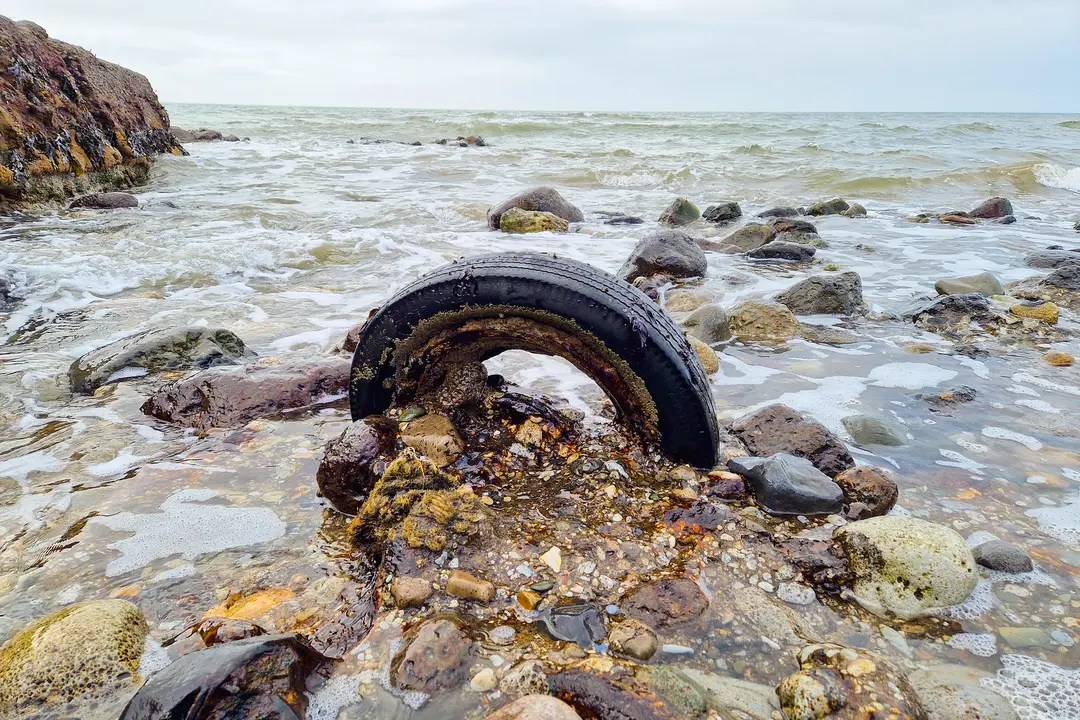
Indeed, especially over the last 150 years or so, both have been. And as a consequence, John MacDonald reports, the Anthropocene is presenting a challenge to geologists:
I’m standing on a beach at Workington, on the western edge of the Lake District in England [pictured above and throughout the article linked below]. Here I find myself contemplating a very unnatural object, while pondering a pretty fundamental question: what, exactly, is a rock? For a geologist like me, this should be easy to answer, but what I’m looking at has made me think otherwise.
At Workington, all seems natural – the sounds of the waves lapping the shore, the call of seabirds, the smell of the ocean, the sight of the stony beach and high cliffs. At first glance, the beach is made largely of a rock platform, which is not a particularly unusual phenomenon – many coastal areas are ‘rock coasts’ made of sandstone, basalt or granite. These rocks are ancient in human years – often millions or even billions of years old – and have been sculpted into their current cliff or platform shapes over hundreds to thousands of years.
Yet among the waves is an object that shouldn’t be there: a wheel and tyre, embedded in the rock that makes up the shore. It’s not stuck in a crevice – the rock has actually formed around it. How can this have happened? The wheel and tyre are of a mid-20th century style, but rocks are ancient, often millions of years old. Aren’t they?
Closer inspection of this hard rock platform shows it is what geologists call conglomerate: a sedimentary rock made of rounded pebbles and cobbles deposited on the Earth surface. Over thousands to millions of years, this material is buried and heated causing minerals to form and fill in the gaps between the pebbles and cobbles, fusing them together into a hard rock mass. At Workington though, this can’t have happened: as well as the tyre, my colleagues and I found several other human-made objects, under 100 years old. The pebbles and cobbles in the conglomerate aren’t natural either: they are all made of slag, a solid by-product of the iron- and steel-making process.
As a geologist, I have studied various types of natural rocks, but recently I have become interested in ‘anthropogenic geomaterials’ – things like industrial slag – and how they become entwined in geological and environmental processes. I came to Workington originally to look at the slag, because I was interested in its potential to scrub-capture carbon dioxide out of the atmosphere. However, when encountering the rock platform with the wheel in it, I was drawn by its incongruity. After studying the geomaterials of Workington more closely with my colleagues Amanda Owen and David Brown, we believe that this little-known section of the English coastline represents a tangible and potentially long-lasting signature of the impact humans are having on the planet.
Unlike many industrial landscapes, nature here has mostly returned, so it would be easy to miss that the beach is composed of human materials. Here a process that normally takes millennia or aeons has happened in a matter of decades. And it’s not the only example: new forms of anthropogenic geology are emerging around the world. These new materials are blurring the borderline between the natural and unnatural. They are also raising a rather fundamental question for geology: what actually is a rock?…
And what becomes of geology as its tasks come to resemble archaeology and anthropogy? Read on for the backstory and the answers.
Not natural, not quite unnatural, the strange new rocks of the Anthropocene stretch the boundaries of geology: “What is this rock?” from @aeon.co.
* W. H. Auden, “In Praise of Limestone“
###
As we ruminate on rocks, we might spare a thought for William Logan; he died on this date in 1875. Born in Montreal in 1798, he was sent to Edinburgh for an education, after which, he lingered in Britain to work in Wales at his uncle’s coal and copper-smelting business. Logan made geologic maps of coal fields in Wales, in attempt to understand the sources of coal and ores. He noted the relationship between the underlying clay layers and fossil tree roots with local coal beds– which helped substantiate the theory that coal beds are formed in place.
On returning to Canada in 1842, he became the founding director of the Geological Survey of Canada. At the time, the country’s geology was virtually unknown; but as a product of two decades of his research, the CGS published the monumental Report on the Geology of Canada in 1863. Known as “the father of Canadian geology,” Logan was knighted by Queen Victoria; and after his death Mount Logan, Canada’s highest mountain, was named in his honor.

You must be logged in to post a comment.