Posts Tagged ‘Pentagon Papers’
“If all else fails, there’s always print or web zines”*…

Gabriela Riccardi, with a history of– and an homage to– the zine…
After Martin Luther furiously (supposedly) hammered his 95 Theses to a local church door in the 16th century, chroniclers of history saw his act as plenty of things: a righteous rally against Catholic excess, a call to arms for renewed values, a firing shot for one ripper of a Reformation.
Others, though, saw it as the world’s first zine.
The zine — that unruly riff on the glossy magazine, often handmade and always self-published — has long been associated with revolution. DIY dabblers and political thought guerrillas, superfan scenesters and couriers of counterculture have all found a home in the humble zine.
Maybe that’s because a zine’s proposition — permission self-granted, gates unkept — is a boon companion to those who operate outside of the mainstream. Or maybe it’s just because they’re a lot of fun to make.
In any case, these exuberant little publications have something big to say: Small presses, indeed, can turn over heavy pages of history….
An appreciation of handcrafted publishing: “Zines: Scan and release,” from @griccardi_ in @qz.
See also: “Zines, the Punks of Print Media: A Creative Rebellion in Branding and Design” (source of the image above)
* Rudy Rucker
###
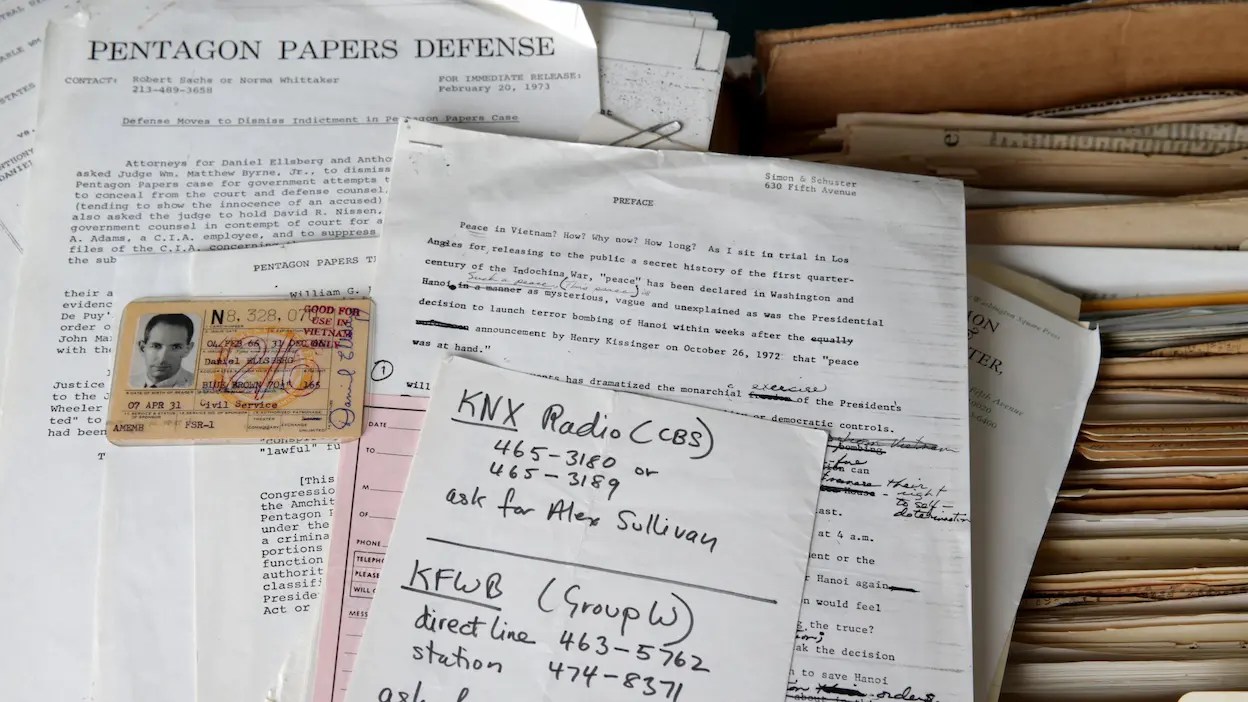
As we do it ourselves, we might recall that this date in 1972 was a milestone in (a different kind of) guerilla publishing: the New York Times begin publishing the “Pentagon Papers”…
… the 47-volume Pentagon analysis of how the U.S. commitment in Southeast Asia grew over a period of three decades. Daniel Ellsberg, a former Defense Department analyst who had become an antiwar activist, had stolen the documents. After unsuccessfully offering the documents to prominent opponents of the war in the U.S. Senate, Ellsberg gave them to the Times.
Officially called The History of the U.S. Decision Making Process on Vietnam, the “Pentagon Papers” disclosed closely guarded communiques, recommendations, and decisions concerning the U.S. military role in Vietnam during the Kennedy and Johnson administrations, along with the diplomatic phase in the Eisenhower years. The publication of the papers created a nationwide furor, with congressional and diplomatic reverberations as all branches of the government debated over what constituted “classified” material and how much should be made public.
The publication of the documents precipitated a crucial legal battle over “the people’s right to know,” and led to an extraordinary session of the U.S. Supreme Court to settle the issue. Although the documents were from the Kennedy and Johnson administrations, President Richard Nixon opposed their publication, both to protect the sources in highly classified appendices, and to prevent further erosion of public support for the war. On June 30, the Supreme Court ruled that the Times had the right to publish the material.
The publication of the “Pentagon Papers,” along with previous suspected disclosures of classified information to the press, led to the creation of a White House unit to plug information leaks to journalists. The illegal activities of the unit, known as the “Plumbers,” and their subsequent cover-up, became known collectively as the Watergate scandal, which resulted in President Nixon’s resignation in August 1974…
You must be logged in to post a comment.