Posts Tagged ‘Celine Dion’
“It’s not those who write the laws that have the greatest impact on society. It’s those who write the songs”*…
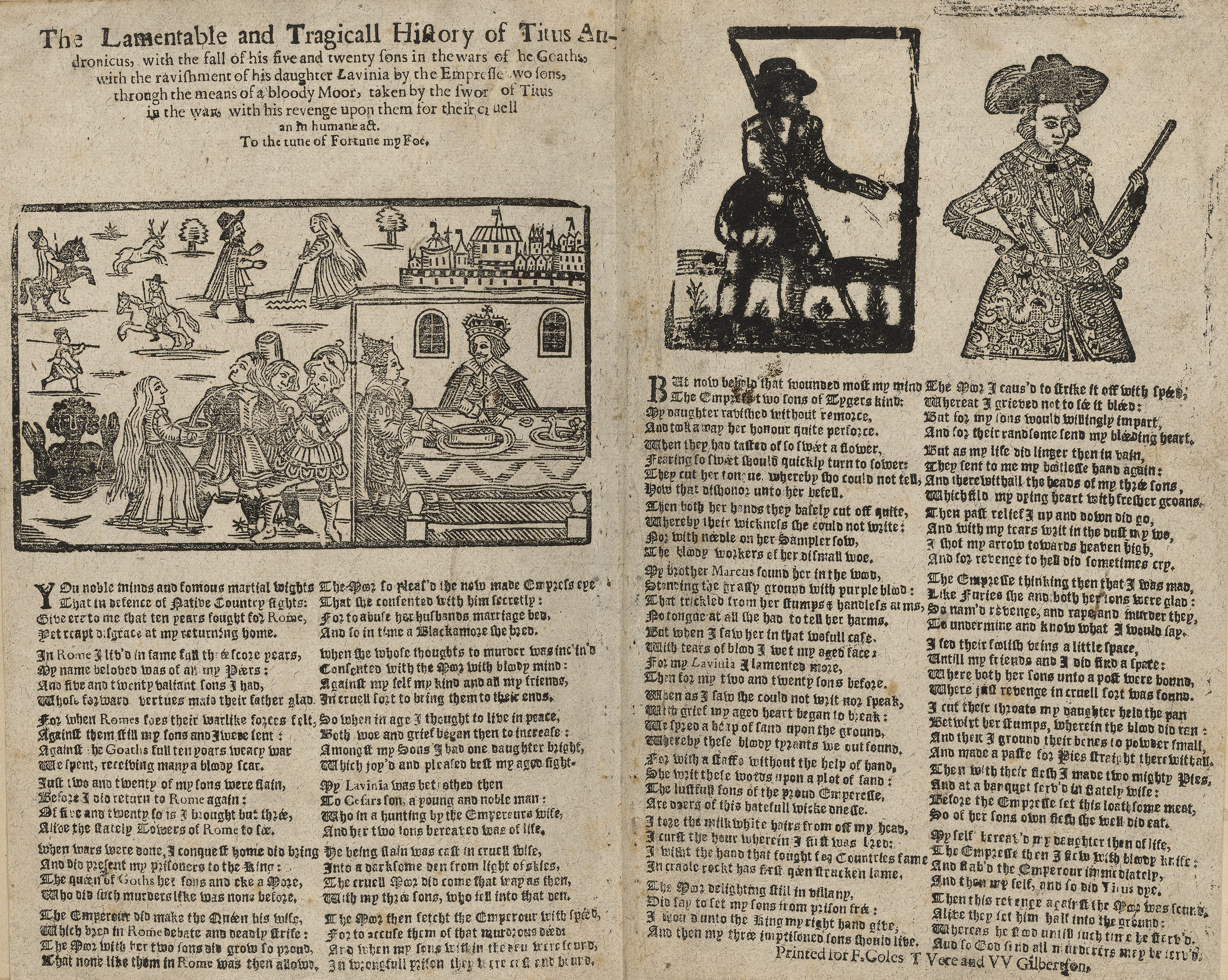
Broadside ballads were single-sheet songs that emerged with the spread of printing and sold for a penny a piece; the most popular of them were the 16th and 17th century equivalent of the Hit Parade. Christopher Marsh and Angela McShane have put together an extraordinary rich collection…
We here identify and present a body of the biggest hits from seventeenth-century England…
This website concentrates on over 100 resoundingly successful examples that you can investigate through recordings, images and a wealth of other materials. Whether you are interested in music, art, love, gender, tragedy, politics, family life, crime, history, humour or death, you will find something to engage you here…
For example, the ballad pictured above:
The Lamentable and Tragicall History of Titus Andronicus seems certain to have been written in c. 1594 as a spin-off from Shakespeare’s play about the fictional general whose final months in late-imperial Rome were even more bloody than the decades of military service that went before. Plays for the stage and songs for the street cross-fertilised throughout the early-modern period, and several of our hit songs reveal the relationship (see, for example, The Lamentation of Master Pages wife and An Excellent Ballad of George Barnwel).
The ballad, like the play, was highly successful. Of the two forms, it was perhaps the ballad that maintained its popularity more consistently after Titus’ first phase of marketability in the Elizabethan and Jacobean periods. There were numerous editions of the ballad in the seventeenth and eighteenth centuries. More occasionally, it was also included in printed song-collections such as Richard Johnson’s Golden garland of princely pleasures (1620).
…
To the tune of ‘Fortune my Foe’ (standard name)
‘Fortune my foe’ was so well known that notation appears in dozens of sources, both printed and manuscript. There are instrumental settings for lute, virginals, cittern and lyra viol, and several of the period’s most celebrated composers – John Dowland and William Byrd, for example – applied their talents to the tune. This was a remarkably solid melody, and renditions are striking in their consistency over time and space…
[Here it here]
99 other Tops of the Pops in the 17th century: “100 Ballads” @100ballads.
* Blaise Pascal
###
As we belt it out, we might recall that on this date in 1994, a different ballad was #1 on the pop charts: Celine Dion singing “The Power of Love”– a cover of its author Jennifer Rush‘s version, which had itself reached the top of the chart nine years earlier.
You must be logged in to post a comment.