Posts Tagged ‘hospitality’
“Some people can stay longer in an hour than others can in a week”*…
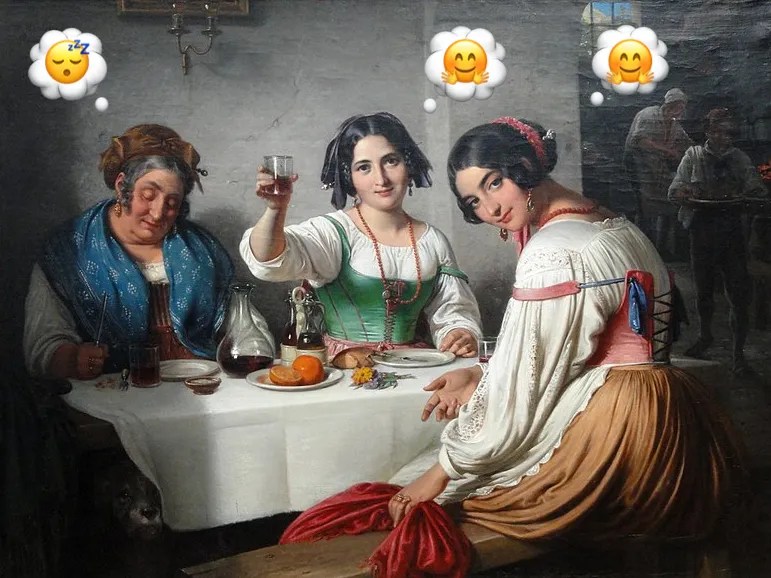
The ever-amusing Benjamin Errett on hospitality…
… The original word ghosti meant both guest and host specifically because of the deep connection between the two, “a mutual exchange relationship highly important to ancient Indo-European society.”…
That, as Beerbohm argues in his essay “Hosts and Guests,” is how we’ve evolved along with our words. There are natural hosts who keep a stocked drinks cart and jars of olives on hand. Obviously, it helps to have a generous olive budget. These people who arrange things just so are often bad guests.
A bad guest, Beerbohm writes, is either a parasite or a churl, the latter being someone like the freeloading poet Dante, who “received during his exile much hospitality from many hosts and repaid them by writing how bitter was the bread in their houses, and how steep the stairs were.” Poets!
To be perfectly positioned between parasitism and churlishness is to reciprocate the food and drink with good company, “radiating gratitude, but not too much of it; never intrusive, ever within call; full of dignity, yet all amenable; quiet, yet lively; never echoing, ever amplifying; never contradicting, but often lighting the way to truth; an ornament, an inspiration, anywhere.” If you’re particularly winning at this, you can save on room and board and no one will ever call you a mooch.
…
let’s reflect on how the who-would-you-invite-to-an-imaginary-dinner-party game is always less fun than it sounds. And yet the New York Times keeps asking authors in By the Book, despite the fact that Charlie Kaufman absolutely demolished the premise with this answer:
I see Oscar Wilde there, of course, Voltaire, Carol Saroyan Saroyan Matthau (wife of William Saroyan, William Saroyan, and Walter Matthau, and a writer in her own right), Hitler (not witty but quite a “get”), Edie Sitwell, Molière, Oscar Wilde (so witty I thought why not double him and place him on each end of the table so everyone could enjoy his witticisms?), Aristophanes, and Sir Kenneth Dover (to translate Aristophanes’ jokes for the other guests). That’s more than three, but one must assume there will be cancellations. Oh, and Jesus...
Be neither a parasite nor a churl- @benjaminerrett on hospitality: “The Wit’s Guide to Guests.”
* W. D. Howells
###
As we contemplate conviviality, we might consider the history of the visitor’s vehicle of choice, the automobile: it was on this date in 1903 that Ernest Pfennig, a Chicago dentist, became the first owner of a Ford automobile, a Model A. The two-(bench) seater weighed 1,240 lbs. and could reach a top speed of 28 mph. The Model A was the first car produced using pairs or trios of men working on each car; between 1903 and 1904, 1,750 cars were made.
Between 1903 and 1908, Ford produced the Models A, B, C, F, K, N, R, and S. Hundreds or a few thousand of most of these were sold per year. Then in 1908, Ford introduced the mass-produced Model T, which totaled millions sold over 18 years. While the Model T was famously available “in any color the customer wants, so long as it’s black,” the Model A was only sold in the color red.
(In 1927, Ford resurrected the “Model A” designation for the successor to its Model T; the revived Model A came in a variety of styles and colors…)

“Luxury lives in the finer details. It’s a cloth napkin at a dinner table.”*…
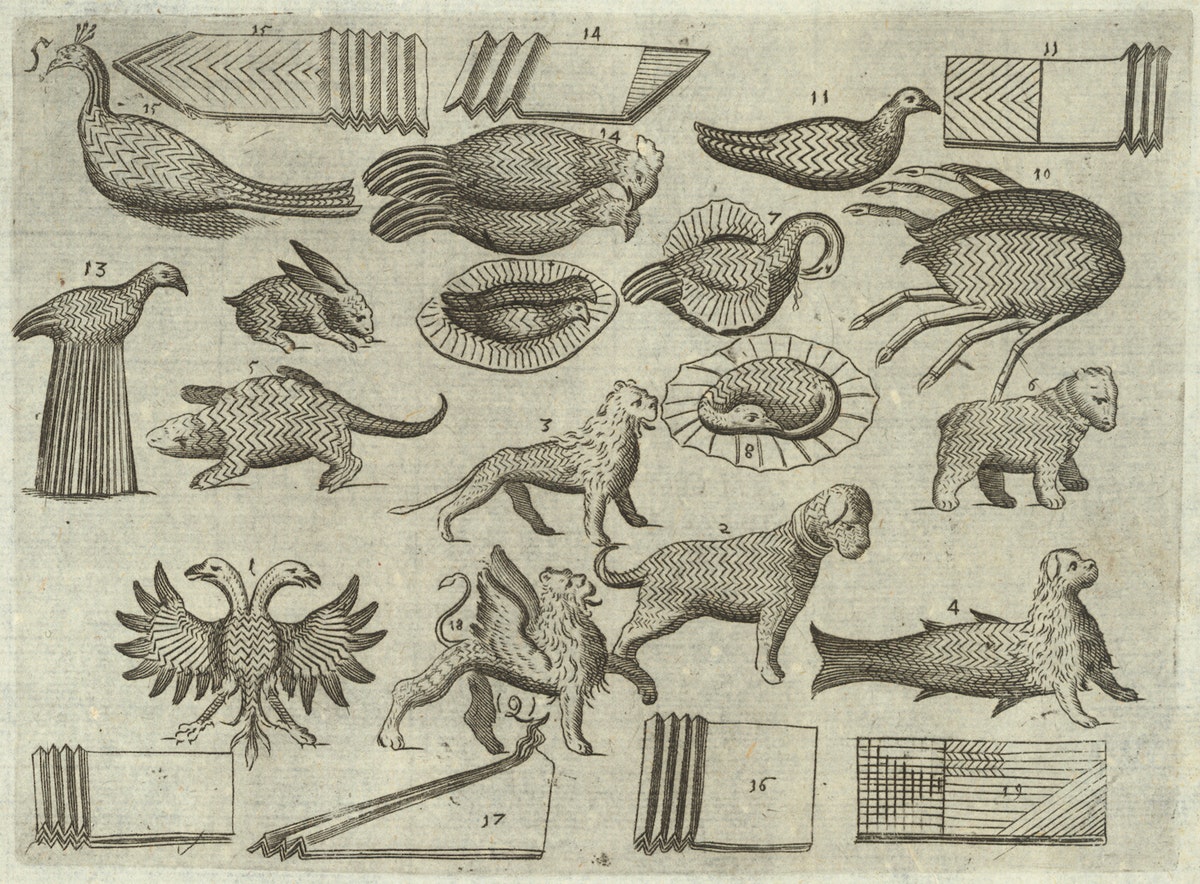
“There should always be a pretty centerpiece”, instructs Sarah Field Splint in The Art of Cooking and Serving, a Depression-era etiquette guide that greased the rails for Crisco shortening’s steady slide into the American home. During Margaret Atwood’s 2006 short story named after Splint’s book, her preteen protagonist weighs decoration against utility. “The charm of my centrepiece would not however cancel out the shabbiness of our paper napkins”. Mattia Giegher’s 1629 Trattato delle piegature (Treatise on folding) offers an elegant solution to the young girl’s quandary: nix the centerpiece and fold your napkins into finery worthy of display.
Giegher’s Trattato appeared as part of Li tre tratatti (1629), joining his earlier works on meat carving (Il trinciante) and stewardship (Lo scalco). While we crease modern napkins as an entrée to the main task — a lap dam for gravy, say, or neck-tucked against crustacean spray — Giegher’s creations were never meant for dabbing. These were starched objets d’art.
During the fifteenth century in northern Italy and southern Germany, technical knowledge of the mechanical arts (think: crafts, machinery, and culinary recipes) began to appear in vernacular writing. “Why around 1400 did artisans take up pen and paper with such gusto?” asks Pamela H. Smith about these early modern how-to guides. Her answer involves war technologies, state power, and urban, cultural exchange. Come the seventeenth century, with literacy on the rise in pockets of Europe, the proliferation of manuals on carving, table service, and, in Giegher’s case, napkin folding suggests a widening interest in knowledge once exclusive to the princely domain…
The history and cultural significance of a lost art (plus lots of nifty pictorial examples): “Serviette Sculptures: Mattia Giegher’s Treatise on Napkin Folding.”
* Iggy Azalea
###
As we practice pleating, we might send amusing birthday greetings to John Garnet Carter; he was born on this date in 1883. A hotelier who ran a lodge at Lookout Mountain, Tennessee/Rock City, Georgia, he built the first “Tom Thumb Golf” course to keep the children of his guests occupied– only to find that the attraction was a hit with adults.
Miniature golf dates back to the 19th century in the UK and the earlier 20th century in the U.S., when putting greens became attractions in their own right. But Carter’s patented “Tom Thumb” approach– which incorporated tile, sewer pipe, hollow logs, and other obstacles, along with fairyland statuary– earned him the honorific “Father of Miniature Golf.”

“You have to be insanely well prepared”*…

The service industry always has job openings. The rising number of chefs who are working on a freelance basis is becoming a great challenge for restaurant owners who are trying to keep their businesses going. Twenty-eight-year-old Dennis de Haan of De Haan restaurant, located in the Dutch city of Groningen, doesn’t have this problem. His restaurant seats sixteen, serves five courses, and features an open kitchen and wine bar. There’s just one hook: the whole place is run De Haan himself. Five days a week, de Haan is not only the chef, but also the server and the dishwasher. His business is thriving…
He’s the owner, cook, waiter, busboy, dishwasher, and sommelier– and he hasn’t gone crazy yet: “This Restaurant Only Has One Employee.”
Is it a trend? In Copenhagen, another one-employee restaurant has started up: “Meet the Man Who Does Every Single Job at ‘Denmark’s Smallest Restaurant’.”
* Thomas Pamperin, the Danish solo operator
###
As we sharpen our knives, we might recall that it was on this date in 2012 that the movie “The Hunger Games” premiered across the U.S.

You must be logged in to post a comment.