Posts Tagged ‘John Coltrane’
“The only truth is music”*…
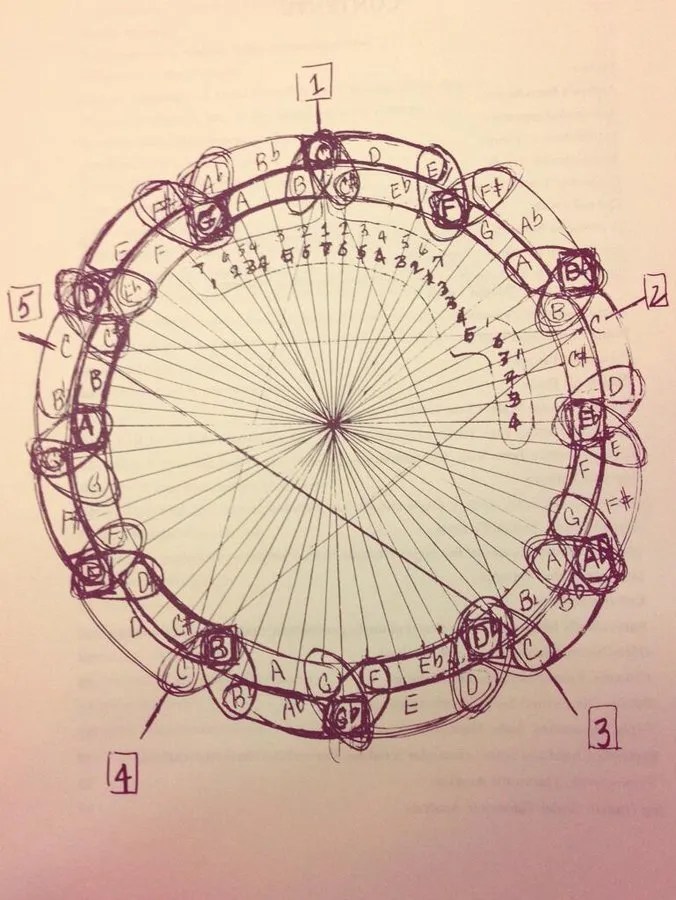
The pseudonymous Kerwin Fjøl on music theory and its origins…
A while back, I posted the above picture onto Elon Musk’s X, and it got fairly popular, which was nice. It’s a sketch that John Coltrane made, and I had no idea what it was meant to demonstrate. Apparently, he gave it to fellow jazz musician Yusef Lateef in 1967, the same year he died (although I heard elsewhere he actually drew it in 1961), and he would pretty regularly produce these sorts of sketches to help himself reason through his music. A small handful of people started wondering about its mystical or occult implications, while others connected it to the “my coworker be losing his mind” meme. But what surprised me about it was the amount of people who got annoyed and immediately started yammering about how it isn’t really mystical; it’s just a boring circle of fifths, as though the fact that anyone might find this picture interesting for spiritual reasons was offensive on its face. One guy in particular, an account with 10k followers and a furry avatar, used it as the basis of a thread in which he saw a dichotomy between the real music theorists, the serious guys who are simply working out their ideas visually, and the woo-woo mystics who have no idea what they’re talking about but desperately want to see magic things everywhere. I’d link the post, but X doesn’t allow me to go through view most of the quote-tweets for some reason. In any case, you can imagine the kind of person who made it: the classic fedora-wearing, Reddit-using atheist that has become a cliché by this point.
There are a few problems with this interpretation, though, that are worth discussing. First, the picture isn’t just a typical circle of fifths. A circle of fifths is usually drawn by laying out the notes of a major scale in one circle and its relative minor notes in another, whereas this picture demonstrates a chromatic scale distributed along two concentric circles, with each circle arranged by whole tones. The likely reason Coltrane drew the picture, as I think this YouTube video lecture convincingly argues, was to think through what you can do with tritones during improvisation. And although it’s unclear what the pentangle might be doing besides linking the C octaves, it’s not at all unreasonable to guess that Coltrane was interested in its esoteric significance and wanted to incorporate it into his music somehow. After all, people have discussed this exact sort of influence when interpreting how he devised his Coltrane changes, which use major third interval chord substitutions that form an equilateral triangle on the circle of fifths. And he was clearly into pan-religious mysticism, which should be obvious by the content of his late albums.
But the more important problem with this distinction between the “Real Music Theorists” and the “woo-woo mystics” is that music has always been grounded in woo-woo mysticism. Bizarre philosophical ideas and supernatural notions have always accompanied the formal development of music theory, and composers themselves have often embedded religious and theological ideas into their compositional approach. I’d like to spend a bit of time here discussing exactly that topic…
There follows a fascinating history and analysis of the Pythagorean origins of Western music theory: “Yes, Music Is Mystical (and woo-woo),” from @zermatist.
See also Ted Gioia‘s broader survey of much the same turf: “Music to Raise the Dead: The Secret Origins of Musicology” @tedgioia
* Jack Kerouac
###
As we contemplate the key to keys, we might recall that it was on this date in 1969 that David Bowie’s “Space Oddity” was released as a single in the U.K. The tale of a fictional astronaut, it was hurried out to precede the Apollo moon landing– and became Bowie’s first commercial hit, reaching the UK top five.

“All musicians are subconsciously mathematicians”*…

Physicist and saxophonist Stephon Alexander has argued in his many public lectures and his book The Jazz of Physics that Albert Einstein and John Coltrane had quite a lot in common. Alexander in particular draws our attention to the so-called “Coltrane circle,” which resembles what any musician will recognize as the “Circle of Fifths,” but incorporates Coltrane’s own innovations. Coltrane gave the drawing to saxophonist and professor Yusef Lateef in 1967, who included it in his seminal text, Repository of Scales and Melodic Patterns. Where Lateef, as he writes in his autobiography, sees Coltrane’s music as a “spiritual journey” that “embraced the concerns of a rich tradition of autophysiopsychic music,” Alexander sees “the same geometric principle that motivated Einstein’s” quantum theory…
Explore the connection at “John Coltrane Draws a Picture Illustrating the Mathematics of Music.”
* Thelonious Monk
###
As we square the circle, we might recall that it was on this date in 1786, at the Burgtheater in Vienna, that Mozart’s glorious Le nozze di Figaro— The Marriage of Figaro— premiered. Based on a stage comedy by Pierre Beaumarchais, La folle journée, ou le Mariage de Figaro (“The Mad Day, or The Marriage of Figaro”), which was first performed two years early, Mozart’s comedic masterpiece has become a staple of opera repertoire, appearing consistently among the top ten in the Operabase list of most frequently performed operas.

Early 19th-century engraving depicting Count Almaviva and Susanna in act 3
Going out gracefully…

Twenty-four more valedictions at Buzzfeed’s “The Last Words Of 25 Famous Dead Writers.” And many more parting shots– like Oscar Wilde’s “My wallpaper and I are fighting a duel to the death. One or the other of us has to go”– at Wikiquote’s Famous Last Words.
As we rehearse our final scenes, we might spare a tuneful thought for trumpeter, bandleader, and composer Miles Dewey Davis III; he died on this date in 1991. Davis was a pioneer of a number of jazz forms– bebop, cool jazz, hard bop, modal jazz, and jazz fusion, among others– but was perhaps even more influential for the musicians he launched in his bands (an extraordinary roster that includes Bill Evans, Gerry Mulligan, John Coltrane, Cannonball Adderley, Wayne Shorter, Herbie Hancock, Keith Jarrett, Chick Corea, Elvin Jones, and Jack DeJohnette) and for the bands and musicians he influenced (and equally amazing list that includes Lalo Schifrin, Tangerine Dream, King Crimson, Steely Dan, Frank Zappa, Duane Allman, Radiohead, The Flaming Lips, Lydia Lunch, Jerry Garcia, and Prince).

Hear that Coltrane comin’…

John Coltrane moved from be-bop through hard bop to free jazz, and delighted at every step. One has no trouble hearing his magical tenor sax; Coltrane recorded over 50 albums. But now one can hear– and see– his signature tune, “Giant Steps,” unfold on its transcription:
As we tap our toes, we might also click our heels three times, as (though she said “I was born at the age of 12 on a Metro-Goldwyn-Mayer lot”), Frances Ethel Gumm– later known as Judy Garland– was born in Grand Rapids, Michigan on this date in 1922.

You must be logged in to post a comment.