“There’s been most uncommon bad weather in them latitudes, there’s no denyin'”*…
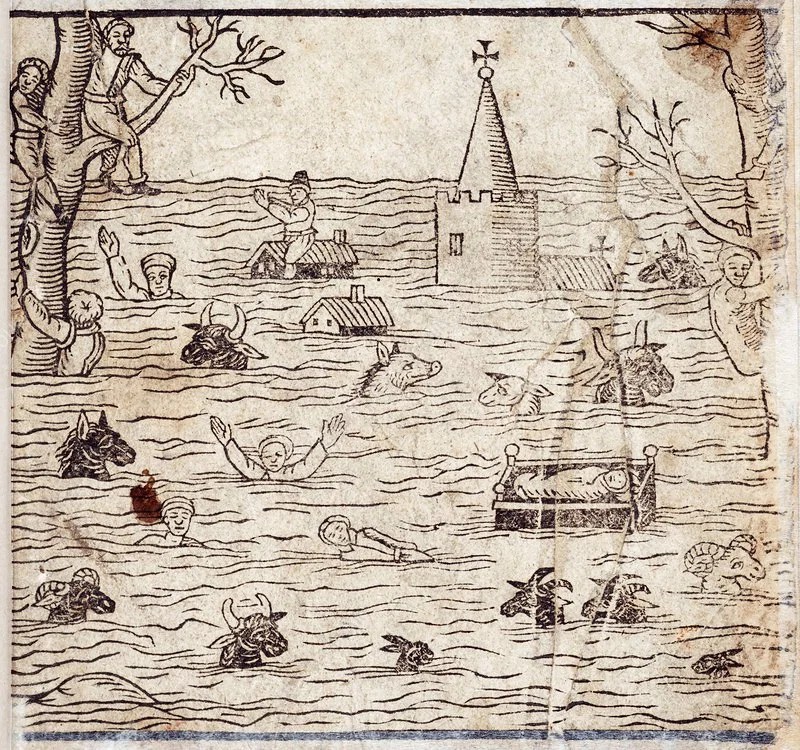
When the Bristol Channel flooded in 1607, it was not just one of the worst natural disasters in British history, it was also a sign, for many, that they had strayed from the path of God. Erik Crnkovich examines the overlap of miraculous weather and the early modern printing industry, which cultivated a thirst for all things occult, exotic, and odd…
When the Bristol Channel flooded on January 30, 1607, pamphlets describing it as God’s warning to a wayward people likewise flooded out of London’s booming presses. Rare weather events of all sorts are ironically commonplace in seventeenth-century news — a century otherwise tempestuous in its frequent, often literal, chopping and changing in church and state. In fact, the two are reflections of each other. True, British weather was consistently inconsistent during the Little Ice Age, a period of prolonged cold and wet that would not end for another two centuries. But the headlines reporting “prodigious” thunderstorms, “miraculous” apparitions, and “terrible” earthquakes were often followed by interpretations of them as moral weathervanes — divine providence, a sign to repent and return to the proverbial straight and narrow.
It is perhaps little surprise, then, that the pamphleteer William Jones rushed to the presses when a storm surge inundated 518 square kilometres surrounding the Bristol Channel. Present scholarship counts 2,000 recorded deaths, making it one of Britain’s worst natural disasters and, according to Jones, a judgement from God…
To date, recent responses to climate disasters have been notably devoid of “divine” interpretation; indeed, if anything, they’ve largely been written off as “just the weather being the weather.” As further extreme weather wreaks havoc and our online version of the “early modern printing” continues to unfold, could that change?
Floods and foreboding in 17th-Century Britain: “Wonderful Weather,” from @publicdomainrev.bsky.social.
* Charles Dickens, Dombey and Son
###
As we seek higher ground, we might recall that it was on this date in 1991 that the “Perfect Storm” formed…
On October 30, 1991, the so-called “perfect storm” formed in the North Atlantic, producing remarkably large waves along the New England and Canadian coasts. Over the next several days, the storm spread its fury over the ocean off the coast of Canada. The fishing boat Andrea Gail and its six-member crew were lost in the storm. The disaster spawned the bestselling book The Perfect Storm by Sebastian Junger and a blockbuster Hollywood movie of the same name.
On October 27, Hurricane Grace formed near Bermuda and moved toward the coast of the southeastern United States. Two days later, Grace continued to move north, where it encountered a massive low pressure system moving south from Canada. The clash of systems over the Atlantic Ocean caused 40-to-80-foot waves on October 30—unconfirmed reports put the waves at more than 100 feet in some locations. This massive surf caused extensive coastal flooding, particularly in Massachusetts; damage was also sustained as far south as Jamaica and as far north as Newfoundland… – source

You must be logged in to post a comment.