“It takes something more than intelligence to act intelligently”*…
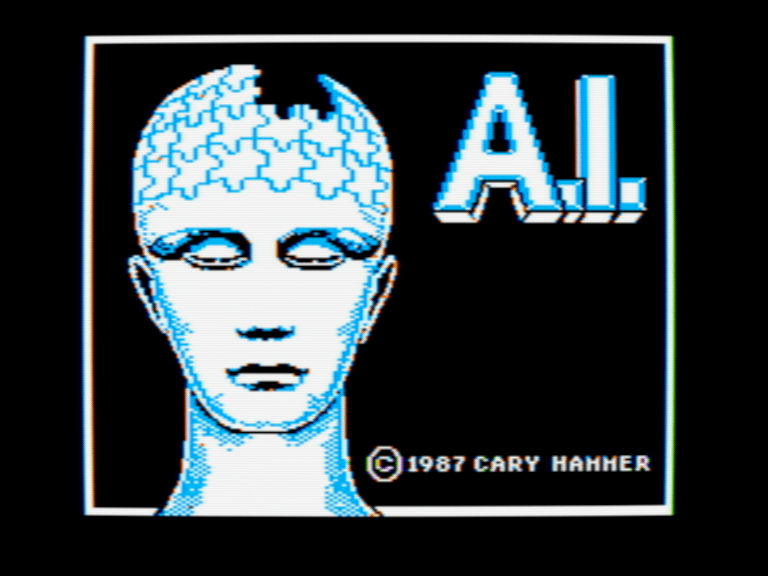
It can feel, as we’re awash in the wave of “news” and “dialogue” about AI that dominates discourse these days, as though artificial intelligence sprang onto the scene with more development up its sleeve but, Athena-like, essentially fully grown.
Writing on the Internet Archive’s blog, Jason Scott introduces a new collection at the Archive that reminds us that AI’s had a childhood (e.g., ELIZA) and an adolescence (e.g., work by and inspired by Seymour Papert), and that we can learn from it…
Long before the current kerfuffle about LLMs, Generative AI Artwork, and asking your tax preparation chatbot for a cookie recipe, the concept of artificial intelligence and synthetic life was a pervasive theme in creative and engineering works. We have the ground-breaking appearance of Rossum’s Universal Robots [and here] (or Tik-Tok, the Royal Army of Oz), through countless science-fiction properties and incredibly positive futurist home-making advertisements, and into the inevitable portrayal of dark and dystopian empires providing humans with nothing but a clear and present ending to their story arc. Artificial Intelligence has been riding along with humanity’s storytelling and expressiveness for many generations – and, one might argue, it is this ever-present influence and inspiration that has driven a lot of the modern phrasing and design in our most contemporary toys and tools wearing the vestments of consciousness.
The motivations are clear: our endless curiosity of the nature of our minds and humanity, the twists and turns that come when the synthetic mirror-images of people betray unintended consequences, and the fact that human beings look amazing when rendered in chrome.
But before we get swept up too much into the echoes of the past and see patterns of AI-like entities into the distant generations (golems, anyone?) let us instead zoom into a very specific family of projects and products that are presented at the Internet Archive for the research, education, and enjoyment of all: The newly-minted Vintage Artificial Intelligence collection.
Dating roughly from the 1970s through the 1990s, these emulated software packages have come from many sources, and with many motivations, but have been curated together for a very subtle and occasionally imperceptible theme: the adventure of experiencing a machine that thinks.
To be clear, and without taking too much time for a press conference announcing so or claiming such for a future IPO, none of the programs in this collection come within a solar system of thinking in any actual sense. They are, instead, portrayals on microcomputers and game consoles of the idea of thinking machines, the experience of creating autonomous or semi-autonomous virtual entities, and playing games with the illusion of a contemplative and improvisational opponent…
Eminently worth reading in full. The early days of AI: “Vintage Artificial Intelligence: Before It Got Awkward,” from @textfiles.com and @archive.org.
Given that the original users of/audiences for most those vintage programs presumably skewed young (in keeping with the demographics of recreational pc use), it’s fascinating to note, in the results of a recent Pew survey, that “for the first time, a majority of adults under 30 (55%) now say they’re more concerned than excited about AI,” a rate on par with adults 65+ and (for the time) higher than that level of concern adults 30-49 (51%) or adults 50-64 (47%). As to why…
Even in 2021, job loss was one of the top reasons behind Americans’ concern about AI. Today, Americans largely – and increasingly – think AI-related job loss is on the horizon.
In our new survey, 71% of adults think AI will lead to fewer jobs in the United States over the next two decades, up from 64% in 2024. Few (5%) say AI will lead to more jobs. One-in-ten say it won’t make much difference, and a slightly larger share are unsure…
… Adults under 30 are most likely to think AI will be bad for society – and for them. They largely think it will make connection and creativity harder to come by. And though most say they use chatbots, they’re just as likely to say these tools hurt their own creativity as help it… – source
* Fyodor Dostoevsky
###
As we reminisce, we might recall that it was on this date in 1833 that The Sun began publication in New York City. It was the first successful penny daily newspaper in the United States; and for a time, the most successful newspaper in the U.S.
[The Sun was] popular with the city’s less affluent, working classes. Its publisher, Benjamin H. Day, emphasized local events, police court reports, and sports in his four-page morning newspaper. Advertisements, notably help-wanted ads, were plentiful. By 1834, the Sun had the largest circulation in the United States. Its rising popularity was attributed to its readers’ passion for the Sun‘s sensational and sometimes fabricated stories [c.f., for example, here] and the paper’s exaggerated coverage of sundry scandals. Its success was also the result of the efforts of the city’s ubiquitous newsboys, who the innovative Day had hired to hawk the paper. The Sun added a Saturday edition in 1836. A number of weekly and semiweekly titles were also published, such as the Weekly Sun (1851-69), which shares the same masthead as the Sun with “Weekly” appearing in the title ornament.
The paper’s true glory days began in 1868 when Charles A. Dana, former managing editor of the New York Tribune, became part owner and editor. Dana endeavored to apply the art of literary craftsmanship to the news. Under him, the Sun became known as “the newspaperman’s newspaper,” featuring editorials, society news, and human-interest stories. A Sunday edition was added in 1875 and, later, a Saturday supplement appeared, offering book notices, essays, and fictional sketches by Bret Harte, Henry James, and other well-known writers. In the 1880s, the paper’s size increased to eight pages and in 1887 the Evening Sun hit the streets in two editions: Wall Street and Night
On September 21, 1897, in response to a letter from eight-year-old reader Virginia O’Hanlon (“Papa says ‘If you see it in The Sun it’s so.’ Please tell me the truth, is there a Santa Claus?”), the paper published “Yes, Virginia, there is a Santa Claus.” This opinion piece by veteran newspaperman Francis P. Church, insisting that Santa Claus “exists as certainly as love and generosity and devotion exist,” caused an immediate sensation. It became one of the most famous editorials in newspaper publishing history; the Sun would reprint this editorial annually until 1949… – source

You must be logged in to post a comment.