“I had always hoped that this land might become a safe and agreeable asylum to the virtuous and persecuted part of mankind, to whatever nation they might belong”*…
The founding fathers’ hopes notwithstanding, citizenship is under attack in the U.S.— and the intensity of the attack is increasing. On this 4th of July weekend, let us appreciate Kieran Healy‘s account of his path to citizenship…
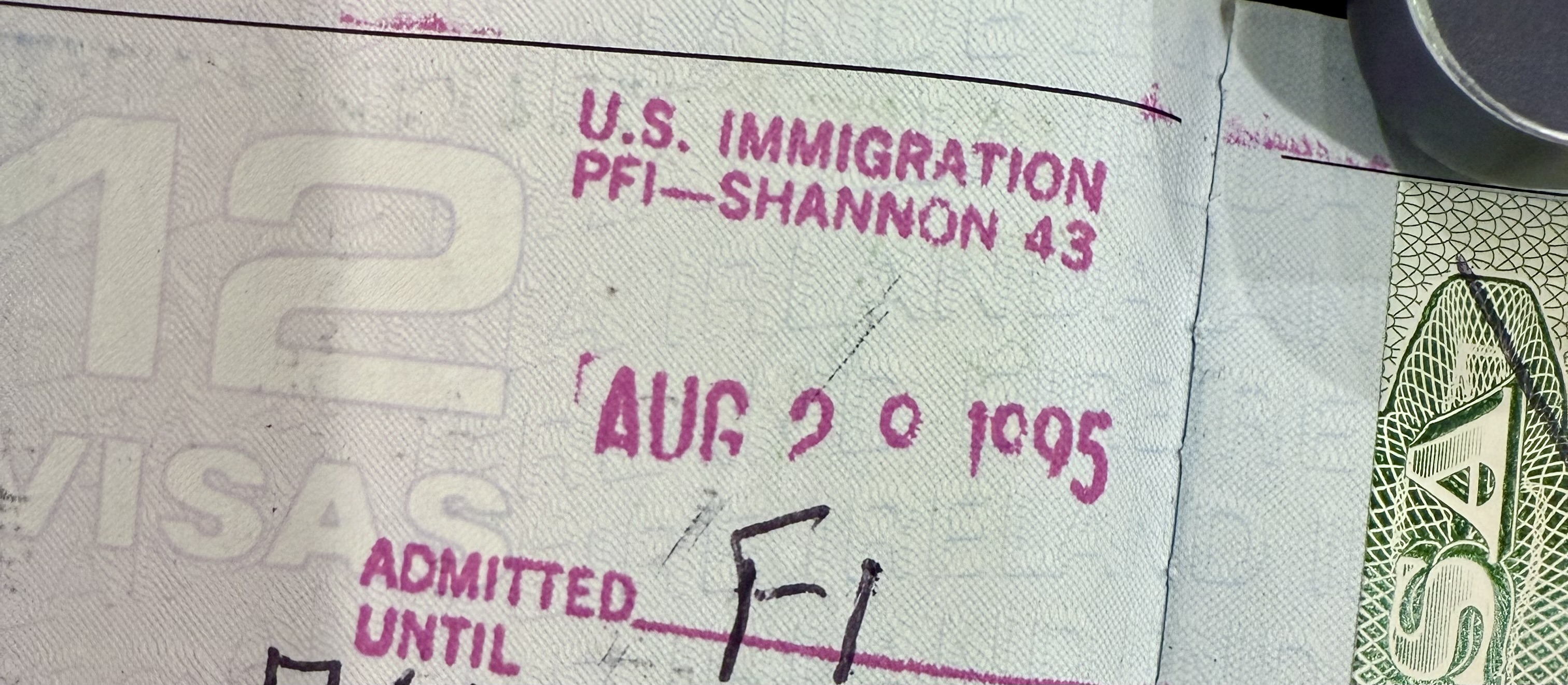
In 1995, at the beginning of the last week of August, on the afternoon of an inhumanly hot and intolerably humid day, I arrived at Newark Airport to live in the United States. I was twenty two years old and about to start as a graduate student at Princeton. I have been here more or less the whole time since. I spent six years on an F-1 Visa while getting my PhD. After that, I lived and worked in Tucson for seven years. My conception of what counts as an inhumanly hot day changed. During that time I was on an H1-B Visa sponsored by my employer, the University of Arizona. Subsequently, I was granted Permanent Residency—a Green Card—through marriage. In 2009 I moved to North Carolina. My conception of what counts as an intolerably humid day changed. I am an immigrant to this country. I have made my life here. My two children are Americans. And now, as of yesterday [June 27], so am I.
When I sat down to write something about becoming a citizen, I was immediately tangled up in a skein of questions about the character of citizenship, the politics of immigration, and the relationship of individuals to the state. These have all been in the news recently; perhaps you have heard about it. These questions ask how polities work, how they impose themselves upon us, how power is exercised. They are tied up with deep-rooted principles, claims and myths—as you please—about where authority comes from and how it is or whether it ever has been justly applied. These are not easy matters to understand in principle or resolve in practice. Nor can they simply be dismissed. But I am not writing this note because I want to take on these questions, even though I acknowledge them. I am writing this because I do not want to forget how I felt yesterday.
If you are a legal permanent resident of the United States, you apply to be naturalized as a citizen by filling out Form N-400. Part 1 of the form asks for information about your eligibility for becoming a citizen. Parts 2 and 3 ask about your name, address, country of birth, and also identifying information about you including your race and ethnicity. In Part 4 you list everywhere you have lived in the past five years. In Parts 5 and 6 you tell about your marital history and your children. Part 7 is your employment and schooling. In Part 8 you document all the times you have been outside the United States in the past five years even though, as a Lawful Permanent Resident, the state already knows this about you. Frankly, it already knows all the other stuff about you, too. Every time you enter the country you are photographed and fingerprinted.
Part 9 consists of thirty seven questions designed, in the main, to establish whether you are a person of good moral character and also whether you understand, assent to, and are willing to swear to each component of the Oath of Allegiance to the United States. After filling out the form you go to a biometrics appointment where your identity is once again confirmed and you are once again fingerprinted and photographed. Then your citizenship interview is scheduled. At the interview you are assessed by a USCIS Officer on several points, including whether you can speak, read, and write English at a basic level. They also check once again whether you understand and are willing to take the Oath of Allegiance that will make you a citizen. Finally, you must also pass the Civics Test.
The test has one hundred questions. At the interview you are asked up to ten of them at random and you must get six right. There is a Civics Booklet and Study Guide for the test. It is eighty five pages long. Its index is also a list of all one hundred questions and their acceptable answers. The test covers the Constitution, the branches of government, some elements of U.S. history and geography, the rights and responsibilities of U.S. citizens, and national symbols and holidays.
[The U.S. Citizenship and Immigration Services reports that over 95% of applicants pass the test. A 2018 survey found that only about 1/3 of American citizens at large would pass.]
The ceremony room was the kind of place, if you are an academic like me, you might expect to be named “Salon C” or “Wabash Room” or “Sequoia East” and be the site of a sparsely-attended conference talk. The two main differences were the words stenciled on the slightly dropped ceiling, and the fact that the room was full up and alive with nervous energy. At the front of the room there was a large-screen TV. The person leading the ceremony—who, coincidentally, was the USCIS Officer who had interviewed me a couple of months ago—introduced himself and welcomed everyone. All the staff were dignified and low-key delighted. The ceremony opened with a two-minute video that consisted of Ken Burns effect pans over still images and with W.G. Snuffy Walden music underneath. The Statue of Liberty. Ellis Island. Immigrants arriving in the nineteenth century at various locations. And then photographs of the modern equivalents of those people. I began to worry that I might have something in my eye.
The room filled up. It looked just as you might imagine. Some people looked like me, which is to say a middle-aged Irish guy in a standard-issue blazer and tie. There was a guy from Ghana in an immaculate suit. A couple from Algeria held their baby son. A family from the Republic of the Congo had their three young sons sit in the guest area. The boys all wore identical red-white-and-blue check. A German man looked dapper in a lavender shirt. An Indian woman had a green and gold sari. A Chinese family all in a row. A Romanian delightedly offering to take pictures of anyone in need of a photo. A Mexican man in cream-colored linen. A Peruvian woman’s bold floral dress. A family whose two children were wearing tiny plastic Stars and Stripes cowboy hats. It looked like America.
I know the nationalities of my fellow oath-takers because of the next stage of the ceremony. This was the Roll Call of Nations. I did not know this was going to happen. Every country of origin represented was announced in turn. As your country was named, you were asked to stand up, and remain standing. Afghanistan came first. Then Algeria. The last person to stand, immediately to my left, was from the United Kingdom. There were twenty seven countries in all, out of only fifty or so people. For me this part in particular was enormously, irresistibly moving. It perfectly expressed the principle, the claim, the myth—as you please—that America is an idea. That it does not matter where you are from. That, in fact, America will in this moment explicitly and proudly acknowledge the sheer variety of places you are all from. That built in to the heart of the United States is the republican ideal not just that anyone can become an American, but that this possibility is what makes the country what it is.
But isn’t it more complicated than that? You know as well as I do that it is. So much more complicated. So much more painful. So much more dangerous. So much more messed-up. I will think about and work on strands and threads of that impossible tangle tomorrow, just like I have thought about and worked on bits and pieces of it since I came here. But I will not forget this moment. I will not forget what it felt like.
Now all standing, we raised our hands and took the oath. Once we stopped speaking, we were citizens. We watched a two-minute congratulatory video from President Trump. Even though the video was short, you could see that, in his usual way, he was improvising and riffing around what was on his teleprompter. The result was that he said some odd-sounding things, like how we had U.S. citizenship “like no-one has ever had it before”. It did not matter. The video finished. We filed out of our seats in row order to get our certificate of citizenship. And that was the end.
Afterwards people milled about in the room, delighted, shaking hands, hugging one another. I hugged my daughter. I hugged my friends who had come down from New York at the last minute on an overnight bus to be there. I counted my blessings. There was a little staged area in the corner where people could pose for photographs against a backdrop. At the rear of the room, volunteers were set up and ready to register you to vote if you wanted. People were smiling and crying. Children were running around meeting one another. We were gently reminded that there was another ceremony due to start in twenty minutes.
A new line began to form outside…
“American,” from @kjhealy.co.
As Franklin D. Roosevelt enjoined us: “Remember, remember always, that all of us, and you and I especially, are descended from immigrants…”
* George Washington
###
As we remember our roots (and celebrate all that has– and can still- grow from them), we might recall that it was on this date in 1971 that the 26th Amendment to the Constitution, having been ratified by 38 states, was certified as adopted by the Administrator of General Services, Robert Kunzig. The amendment establised a nationally-standardized minimum age of 18 for participation in state and federal elections.

You must be logged in to post a comment.