Posts Tagged ‘urbanization’
Being dense…
The nifty site PerSquareMile.com points out that, if the entire world’s population lived in a single city with the density of New York, it would fit into the state of Texas. But if that “city” had the density of Houston, it would cover the entire Mid West (and then some)…
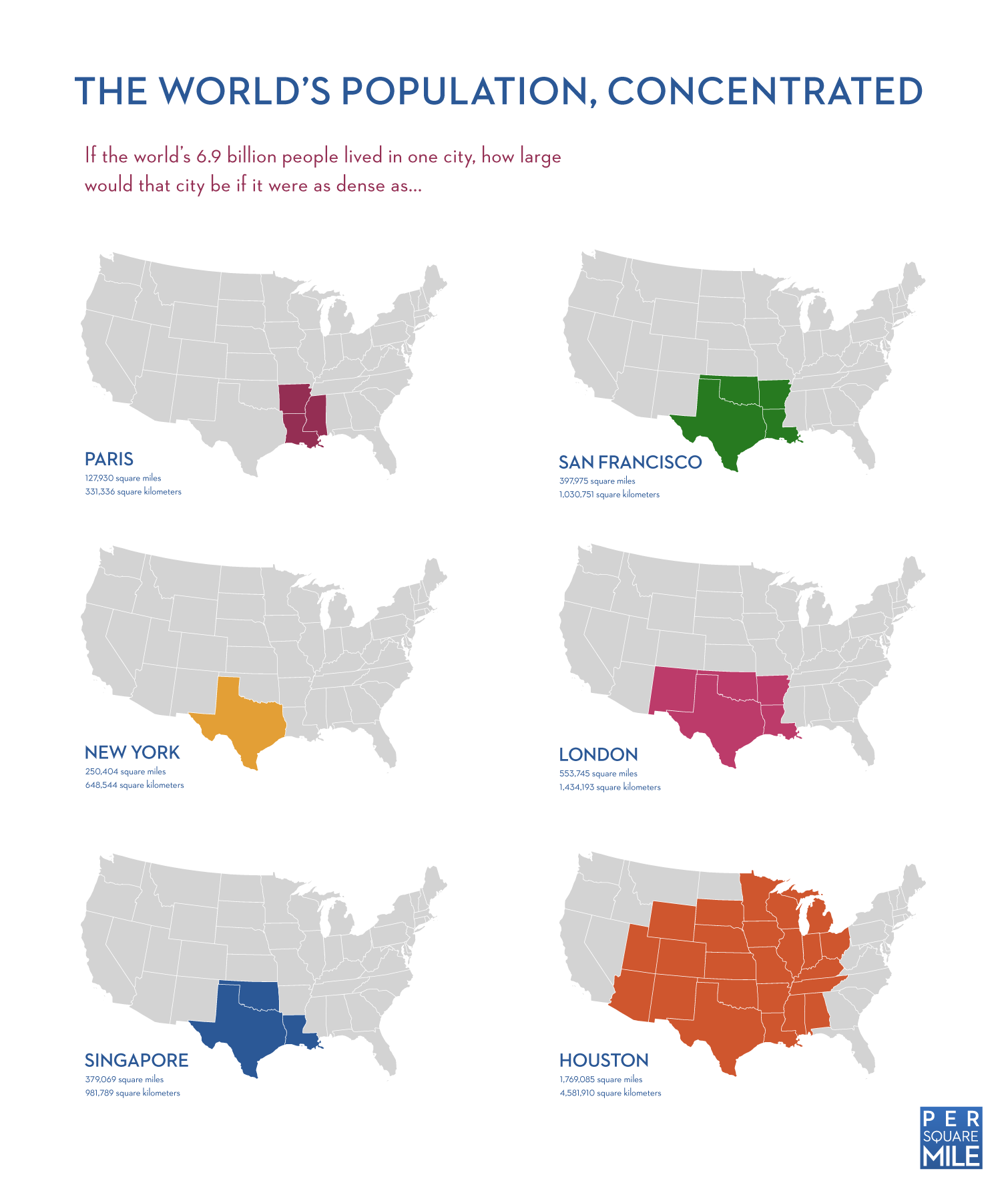 to enlarge, click the image above– or here— and again
[TotH to Flowing Data]
As we reconcile ourselves to looking even harder for parking, we might recall that it was on this date in 30 BCE that Mark Antony won a small victory over the invading forces of Octavian (AKA, Octavius– the future Augustus) in the Battle of Alexandria during the Final War of the Roman Republic. But Antony suffered significant desertion from his ranks; when Octavian attacked again the following day, Antony’s navy demurred. Antony committed suicide (followed several days later by his consort, Cleopatra)… and with Antony, the Republic died a final death: with his Triumverate partner dead, Octavian ( known as Augustus after 27 BC ) became uncontested ruler of Rome, accumulating all of Rome’s administrative, political, and military authority. When Augustus died in 14 AD, his political powers passed to his adopted son Tiberius; the Roman Principate had begun.
His legs bestrid the ocean: his rear’d arm
Crested the world: his voice was propertied
As all the tuned spheres, and that to friends;
But when he meant to quail and shake the orb,
He was as rattling thunder. For his bounty,
There was no winter in’t; an autumn ’twas
That grew the more by reaping: his delights
Were dolphin-like; they show’d his back above
The element they lived in: in his livery
Walk’d crowns and crownets; realms and islands were
As plates dropp’d from his pocket.Cleopatra
Antony and Cleopatra, Act 5, Scene 2; William Shakespeare
 Mark Antony (source)
Show me the money…
Throughout history, artists have tended to cluster around centers of power and wealth… which is simply to observe that they’ve honored Willie Sutton’s wisdom: “that’s where the money is”; they’ve set up their easels (or pianos or footlights or whatever) where they can find patrons and customers. But those centers of cultural gravity tend to be expensive places to live– increasingly, so expensive that aspiring artists can’t even afford a garret in which to starve. E.g., aspiring artists who want to join the community that migrated from Greenwich Village to Soho to Tribeca, then to Brooklyn, and on to Hoboken are beginning to find even that Jersey shore too pricey…
At the same time, new centers of wealth and power are emerging around the world, and with them, new communities of artists and performers. Indeed, as Richard Florida and others suggest, there’s a symbiotic relationship between the growth of a “Creative Class” in a community and that community’s ability to innovate and succeed commercially. A rich artistic and cultural life doesn’t assure a city’s commercial success, but its absence is a pretty good indicator of commercial mediocrity (or worse).
So one indicator of areas that are contenders to be “the next hot region” is the sprouting of the arts there. Consider, for example…

Brazil’s most creative neighborhood is far from the beaches of Rio, in loud and brash São Paulo, South America’s answer for New York City. And you can expect one thing from this loud, raw urban metropolis — a lot of really colorful, politically-charged street art. Large neon pieces of work show up everywhere from dilapidated buildings to enormous billboards, and in the ultimate nod to creativity, esteemed museum MuBE, the Brazilian Museum of Sculpture, hosted actual gallery space for some of São Paulo’s most well-known graffiti artists to promote their work. Unlike certain places, this is a city that fosters young talent.

If digital is your medium, you won’t find a better place to be right now than Jakarta. Indonesia has more Facebook users than Canada has people, and internet cafes are a daily visit. Investors from the West have their eye on mobile, broadcasting and start-ups, all growing trends across the country that make it easy for youngsters to take to their own businesses. Creative collectives like Askara, a bookstore where the hip commune, Serrum, a community for arts education, and Kampong Segart, a student art union, give the space and inspiration for this new wave of Indonesian trend makers.
Visit six other candidate cities– including two, Macao and Las Vegas, that are better known for shilling than selling– at Flavorwire’s “The Best Cities for Young Artists.”
As we get in touch with our inner expatriate, we might wish an elegantly-laid out and well-groomed Happy Birthday to Frederick Law Olmsted; he was born on this date in 1822. A journalist, social critic, public administrator, Olmsted is best remembered as the greatest American landscape architect of the 19th century. While the title “Father of American Landscape Architecture” probably belongs to Andrew Jackson Downing, Olmsted was unquestionably the primary agent of the discipline’s growth and adoption. Olmsted’s most famous commission was Central Park in New York; but he also designed city parks in St. Louis, Boston, and many other cities; the grounds around the Capitol in Washington, D.C.; the Niagra Reservation, one the countries first planned communities; the master plans for universities including UC-Berkley and Stanford (among other universities); and private estates like George Vanderbilt’s Biltmore House in Asheville.
 Olmsted at Biltmore House, by frequent house-guest John Singer Sargent (source)
How ya gonna keep ’em down on the farm?…
As the U.N. affirms, 3.5 billion people on earth– over half the world’s population– live in cities, and urbanization is growing. So it’s not surprising that there are, as io9 reports, some pretty strange pockets among the sprawl around the globe…
There are the novel, for instance…

Thames Town
This quaint English village, housing 10,000 people, is just 20 miles outside the center of Shanghai, and a new rail system puts it just 15 minutes from downtown, as part of a rapidly expanding Greater Shanghai. Thames Town was designed to look exactly like a bucolic English town, complete with red brick buildings, a sandstone church, a village green, a market square, and a pub. But it’s not a theme park – developers insist it’s a real residential community. As the Independent wrote:
Residents can sip their bitter in a traditional English pub, “The Thames Town”, as children scamper across the medieval market square to a bilingual school, while red-brick warehouses form a commercial area on the waterfront. Developers are targeting British companies such as Tesco and Sainsbury to add to the authentic high-street feel so the town’s…10,000 residents can shop in true British style. There are sporting facilities and everything a town of its size should have.
Watch a Youtube video of the place here.
And there are the horrifying…

Centralia, PA
In 1962, sanitation workers in this town began setting fire to some garbage, near a disused mine opening. The fire spread to a rich underground seam of coal, igniting a blaze that has been going for decades and could continue for up to 250 years according to some experts. The fire expanded and mutated like an amoeba. At first it was nice — the town’s residents no longer had to shovel snow off their sidewalks and tomatoes grew in the middle of winter. But then trees started dying and after a child nearly fell down a sinkhole full of carbon monoxide in 1981, the town was evacuated. Now, only a few stubborn residents remain despite efforts to evacuate them. (And rumor has it this town was the inspiration for the video game Silent Hill.)
More? Explore the “10 Weirdest Urban Ecosystems on Earth.”
As we remember that it’s “location, location, location,” we might recall that it was on this date in 1889, at noon, that The Land Run of 1889 began in what we now know as the State of Oklahoma. Within hours, both Oklahoma City and Guthrie were populated, each with over 10,000 residents. As William Willard Howard reported later that year in Harper’s Weekly:
Unlike Rome, the city of Guthrie was built in a day. To be strictly accurate in the matter, it might be said that it was built in an afternoon. At twelve o’clock on Monday, April 22d [sic], the resident population of Guthrie was nothing; before sundown it was at least ten thousand. In that time streets had been laid out, town lots staked off, and steps taken toward the formation of a municipal government.

You must be logged in to post a comment.