Posts Tagged ‘Sherlock Holmes’
First Impressions…

Via the always-rewarding Dangerous Minds, a simple– and simply wonderful– graduation film made by Jurjen Versteeg, who explains the idea behind his project:
Designed as a possible title sequence for a fictitious documentary, this film shows a history of the title sequence in a nutshell. The sequence includes all the names of title designers who had a revolutionary impact on the history and evolution of the title sequence. The names of the title designers all refer to specific characteristics of the revolutionary titles that they designed.
This film refers to elements such as the cut and shifted characters of Saul Bass’ Psycho title, the colored circles of Maurice Binder’s design for Dr. No and the contemporary designs of Kyle Cooper and Danny Yount.
This title sequence refers to the following designers and their titles: Georges Méliès – Un Voyage Dans La Lune, Saul Bass – Psycho, Maurice Binder – Dr. No, Stephen Frankfurt – To Kill A Mockingbird, Pablo Ferro – Dr. Strangelove, Richard Greenberg – Alien, Kyle Cooper – Seven, Danny Yount – Kiss Kiss Bang Bang / Sherlock Holmes.
As we remember to “tell ’em what we’re going to tell ’em,” we might recall that it was on this date in 1946 that the first Cannes Film Festival opened. It had originally been scheduled for September, 1939 as an “answer” to the Venice Film Fest, which had become a propaganda vehicle for Mussolini and Hitler; but the outbreak of World War II occasioned a delay.

Whether ’tis ignobler…
“The most exciting phrase to hear in science, the one that heralds new discoveries, is not ‘Eureka!’ but, ‘That’s funny…” —Isaac Asimov
“Once you eliminate the impossible, whatever remains, no matter how improbable, must be the truth.” —Sherlock Holmes
The good folks at Improbable Research have once again awarded the Ig Nobel Prizes. In keeping with IR’s goal…
to make people laugh, then make them think. We also hope to spur people’s curiosity, and to raise the question: How do you decide what’s important and what’s not, and what’s real and what’s not — in science and everywhere else?
… The Ig Nobel’s “honor” research that is, at the least, amusing… for instance, among this year’s winners:
VETERINARY MEDICINE PRIZE: Catherine Douglas and Peter Rowlinson of Newcastle University, Newcastle-Upon-Tyne, UK, for showing that cows who have names give more milk than cows that are nameless.
PEACE PRIZE: Stephan Bolliger, Steffen Ross, Lars Oesterhelweg, Michael Thali and Beat Kneubuehl of the University of Bern, Switzerland, for determining — by experiment — whether it is better to be smashed over the head with a full bottle of beer or with an empty bottle.
MEDICINE PRIZE: Donald L. Unger, of Thousand Oaks, California, USA, for investigating a possible cause of arthritis of the fingers, by diligently cracking the knuckles of his left hand — but never cracking the knuckles of his right hand — every day for more than sixty (60) years.
For the scholarly citations attaching to these accomplishments– and a full list of other winners– click here.
 At the 2009 ceremony, Public Health ig Nobel Prize winner Dr. Elena Bodnar demonstrates her invention — a brassiere that, in an emergency, can be quickly converted into a pair of protective face masks, one for the brassiere wearer and one to be given to some needy bystander. She is assisted by (real) Nobel laureates Wolfgang Ketterle (left), Orhan Pamuk, and Paul Krugman (right). PHOTO: Alexey Eliseev.
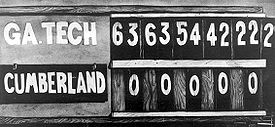
As our minds drift back toward campus, we might recall that, on this date in 1916, The Georgia Tech Yellow Jackets (playing under coach John Heisman, after whom The Trophy is named) set a still-unbroken football record, beating the Bulldogs of Cumberland College 222-0… of course, the game was in Atlanta, so the Jackets had home field advantage… Astoundingly, Tech wasn’t named National Champion for the first time until the following season.
 Everett Strupper, who scored eight TDs in the game
![Reblog this post [with Zemanta]](https://i0.wp.com/img.zemanta.com/reblog_e.png?w=700)
Seeing is… well, seeing…
Via Discover‘s Bad Astronomy blog, one of the more amazing optical illusions that your correspondent has ever seen:

Alternating red and green spirals, right? Actually, they are exactly the same color. As Bad Astronomy explains,
The reason they look different colors is because our brain judges the color of an object by comparing it to surrounding colors. In this case, the stripes are not continuous as they appear at first glance. The orange stripes don’t go through the “blue” spiral, and the magenta ones don’t go through the “green” one. Here’s a zoom to make this more clear:

The orange stripes go through the “green” spiral but not the “blue” one. So without us even knowing it, our brains compare that spiral to the orange stripes, forcing it to think the spiral is green. The magenta stripes make the other part of the spiral look blue, even though they are exactly the same color.
Read the full story in Bad Astronomy here. And for a treat, visit the site of the originator of the illusion, Japanese psychologist Akiyoshi Kitaoka here.
As we reconsider the evidence of our eyes, we might recall that it ’twas on this date in 1852 (according to the stories) that Sherlock Holmes’ sidekick, Dr. John H. Watson, was born… while Holmes did occasionally say “Elementary!” (e.g., in “The Crooked Man”), he never actually said “Elementary, my dear Watson” to Dr. Watson in any of the stories/novels by Sir Arthur Conan Doyle. The phrase was actually a kind of homage, offered by P.G. Wodehouse, who first used it in Psmith Journalist in 1915; it found more common currency as it made it’s way into the scripts of the Sherlock Holmes films, perhaps most notably on the pursed lips of Basil Rathbone… Ironically, it was on this date in 1930 that Arthur Conan Doyle, Holmes’ creator, died.
 Watson (left) as Holmes, as drawn by Doyle’s original illustrator, Sidney Padget
 Sir Arthur Conan Doyle (never actually seen in the room at the same time as Dr. Watson)
You must be logged in to post a comment.