Posts Tagged ‘right to repair’
“Make hay while the sun shines”*…
Hay, the foundation of the diet of grazing animals, is central to American agriculture. The USDA forecasts 2025 hay production at 123.5 million tons (grown on about 50 million acres countrywide), of which, about 3.24 tons are exported (generating over $1 Billion in revenue); the balance is consumed domestically.
Most of that hay is baled for storage and transport (in rectangular or round bales) using special (and increasingly expensive) equipment. But as Katie Hill reports, 115 years ago, before the advent of those motorized balers, a homegrown invention redefined stacking hay in the West. Some ranchers still see no reason to upgrade…
A scan of the horizon in Montana’s Big Hole Valley reveals plenty of examples of the land reclaiming what once belonged to it. Derelict jackleg fence. Log calving sheds with caving roofs. Rusting Chevrolets and spools of barbed wire. A giant compost pile of livestock carcasses, bones protruding from the mulch like seashells at low tide.
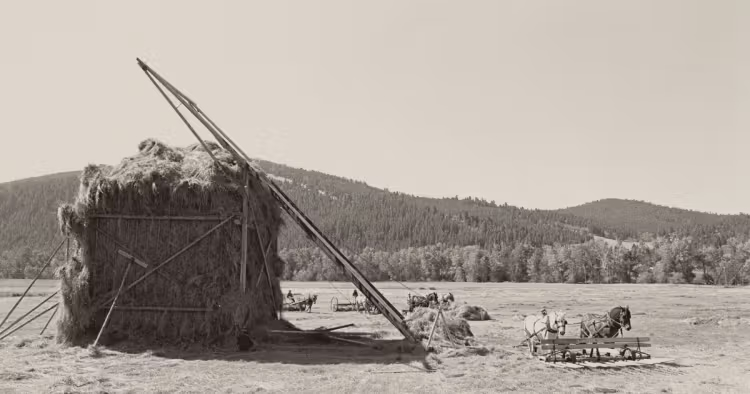
Then, every five miles or so, an old, spindly implement punctuates the scenery. It’s tall, maybe 30 feet, resembling a giant see-saw permanently out of balance. It’s not so much a stairway to heaven as it is a halted conveyor belt to nowhere; there’s no grain silo or corn crib nearby for a machine like this to fill up from above. Regardless, its efficacy in stacking giant piles of hay is clear from its construction. Grass grows tall around its base of rough-hewn lodgepoles, as if the earth might swallow it whole if it stayed put for another century.
This contraption [pictured at the top] is known as the beaverslide, patented in 1910 by Big Hole ranchers Herb Armitage and D.J. Stephens. The haystacking device consists of a wide, sliding fork at the base of a ramp and a cable pulley system rigged to the ramp’s underside. In practice, ranchers use a team of horses or a motorized vehicle with a winch to pull one of the cables perpendicular to the beaverslide, which in turn hoists the fork up the ramp, bringing a giant pile of hay up with it. (Ranchers rake cut hay onto the beaverslides with old buck rakes.) At the top of the ramp, the hay falls to the other side, forming three-story piles that can reach 25 tons in weight, depending on who you ask.
Details on the manufacturing and distribution of the beaverslide — named for its origins in Beaverhead County — are slim. The prevailing story is that ranchers often made their own, then made duplicates for neighboring ranches upon request, according to Big Hole rancher lore. Over the last few decades, the contraption has largely become a relic of a bygone era. But it’s not entirely obsolete, as some ranchers still use their old beaverslides today. With modern challenges like ballooning upgrade costs and the ever-present battle over a rancher’s right to repair their own equipment, the analog beaverslide makes more and more sense for those still using one with every passing hay season…
… he Kirkpatricks recall memories of neighbors being stuck in the middle of winter with broken-down bale processors and hungry cows. The closest repair shop in Jackson, an unincorporated community of roughly 20 people, is 42 miles south. The next closest shops or available technicians might be 53 miles away in Butte or 73 miles away in Dillon.
Many big-name mechanized implements run on trademarked chip technology that requires a trip to an authorized dealership for servicing. Even ranchers like Humbert who otherwise possess ample repair knowledge don’t have access to the diagnostic equipment necessary to solve problems on the fly. This might sound like sacrilege for an industry that lives and dies with rural, self-sufficient communities, but a bill calling for a rancher’s right to repair their own equipment died in the 2025 Montana legislature.
Score another point for the beaverslide…
Read on for more fascinating background: “Why Don’t You Beaverslide?” from @katiehillwriter.bsky.social
Watch the “technology” do it’s work here:
* A Tudor expression dating back to the mid-16th century, and used figuratively since 1673
###
As we honor old ways, we might recall that it was on this date in 1974 that Island Records released Country Life, the fourth studio album by Roxy Music.

“If You Can’t Fix It, You Don’t Own It”*…
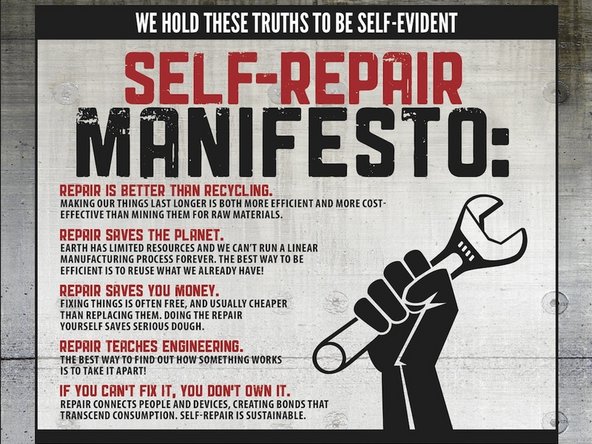
A just-issued report by the US Federal Trade Commission confirms that anti-repair actions by large companies are hurting small businesses, undermining your ownership rights, and hurting the planet. Of course, these are the very problems that we’ve been fighting for the past fifteen years—but it’s validating to see US government confirmation of the market imbalance.
The unanimous report, nearly two years in the making, follows public hearings and testimony from the FTC’s “Nixing the Fix” workshop in July 2019, and a demand from Congress in 2020 to report back. iFixit and other repair advocates told the Commission then how manufacturers design products that frustrate repair and force owners to use the manufacturers’ branded repair services, hurting consumers and stifling competition. Manufacturers claimed the market was working fine, and that opening up repair access would undermine the safety and security of their products. Today’s report is a rebuke to their arguments.
The FTC’s long-awaited report provides a thorough analysis of broad market failures, and recommendations for government action to address those failures. Some major findings included in the report:
– Warranties are being routinely voided, in violation of the Magnuson Moss Warranty Act. “The Commission takes these allegations seriously and will continue to address illegal practices in the marketplace.”
– “[T]he burden of repair restrictions may fall more heavily on communities of color and lower-income communities.”
– “The pandemic has exacerbated the effects of repair restrictions on consumers.”
…
The report summarizes the problems that consumers are facing from a variety of monopoly strategies. “Many manufacturers restrict independent repair and repair by consumers through:
– Product designs that complicate or prevent repair;
– Unavailability of parts and repair information;
– Designs that make independent repairs less safe;
– Policies or statements that steer consumers to manufacturer repair networks;
– Application of patent rights and enforcement of trademarks;
– Disparagement of non-OEM parts and independent repair;
– Software locks and firmware updates; or
– End User License Agreements.”
…
A rebuke of Apple, John Deere, and other manufacturers whose practices frustrate repair by “owners”: “FTC Report Finds Manufacturers’ Repair Restrictions Unwarranted.” Via @kwiens and @stewartbrand
###
As we resist rentiers, we might recall that it was on this date in 1893 that the U.S. Supreme court unanimously ruled that a tomato is a vegetable. In reaching their decision in Nix v. Hedden, a dispute over the appropriate duties to be levied pursuant to the Tarriff Act of 1883, the justices found that the “ordinary” understanding of a tomato as a vegetable should take precedence over the scientific fact that it is a fruit.

You must be logged in to post a comment.