Posts Tagged ‘Rax’
“Tell it like it is”*…
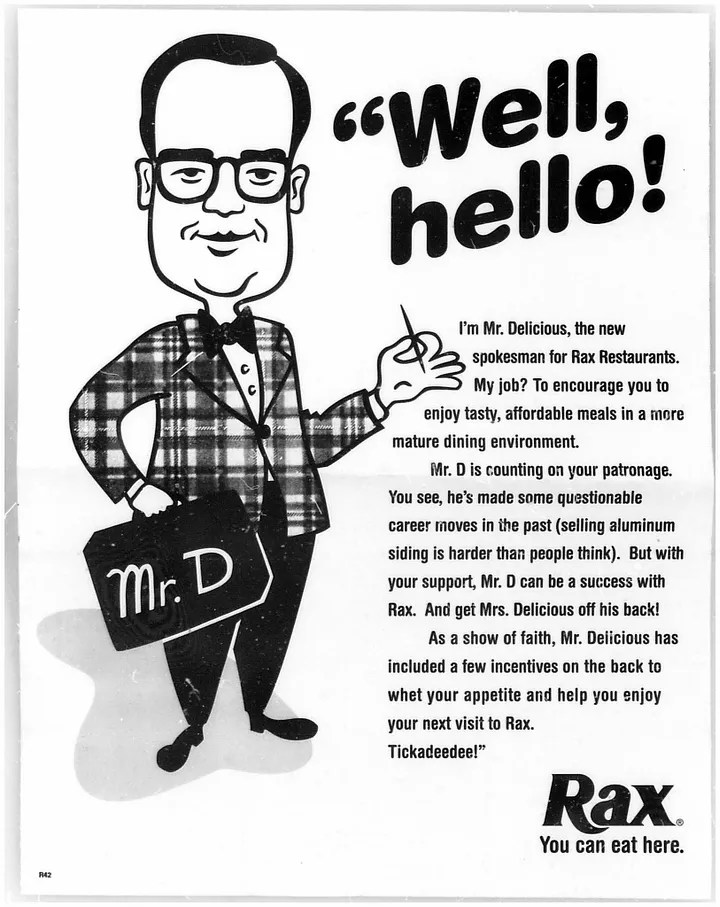
Most fast food chains court children. Mr. Delicious targeted depressed adults. Jake Rossen reports…
It’s not often that a mascot for a fast-food franchise will detail the discomfort prompted by hemorrhoid surgery in a national television advertisement. But Mr. Delicious rarely played by the rules.
Mr. Delicious was the cartoon spokesman for Rax, a chain of roast beef eateries that grew popular in the 1980s. But by 1992, sales were dwindling—so the company recruited “Mr. D” to liven up their brand identity. Middle-aged and burdened by a difficult marriage, the character was an anti-Ronald McDonald.
“Mr. Delicious just had some rather delicate surgery,” he announced in one spot for value meals priced in round numbers. “If there’s no change, he doesn’t have to squirm so much to put it back in his pocket, does he? He just grabs his combo and drives ever so slowly over the speed bump.”
In other spots, Mr. Delicious would refer to his aversion to children, a midlife crisis involving inappropriately aged women, and heading to Rax to nurse a hangover.
Rax thought the irreverent Mr. Delicious was a solution to their ailing sales numbers. They were greatly mistaken…
Read on for the instructive– and very amusing– tale, along with more arresting examples of the spots (including an account of his trip to Bora Bora with two female “friends”): “The Tortured Soul of Mr. Delicious, Fast Food’s Most Bizarre Mascot,” from @mental_floss.
And watch the promotional video that introduced Mr. Delicious:
More on Mr. D at “Mr. Delicious: The Fast Food Mascot Who Had A Mid-Life Crisis” (source of the image at the top).
* R&B singer Roy Milton in 1954 (canonizing a phrase in use since the 1940s in Black speech)
###
As we brood over branding, we might that it was on this date in 1879 that saccharin (AKA saccharine, benzosulfimide, or E954), an nutrition-free artificial sweetener, was discovered by Constantine Fahlberg and Ira Remsen at Johns Hopkins University. 500 times sweeter than sucrose, it can have a bitter or metallic aftertaste, especially at high concentrations.
Commercialized from soon after its discovery, saccharin took off during the sugar shortages of World War I. It was (and to some extent still is) used as a stand-alone sugar substitute (e.g., “Sweet’n Low), to sweeten products like drinks, candies, baked goods, tobacco products, excipients, and for masking the bitter taste of some medicines.
The FDA required warning labels from 1977 to 2000 on products using saccharin because it was a suspected carcinogen. After additional research, the FDA repealed the warning labels and declared saccharin safe for consumption.

You must be logged in to post a comment.