Posts Tagged ‘obituaries’
“There is nothing inherently gloomy about the newspaper obituary page. Done well, it should capture life rather than wallow in death.”*…
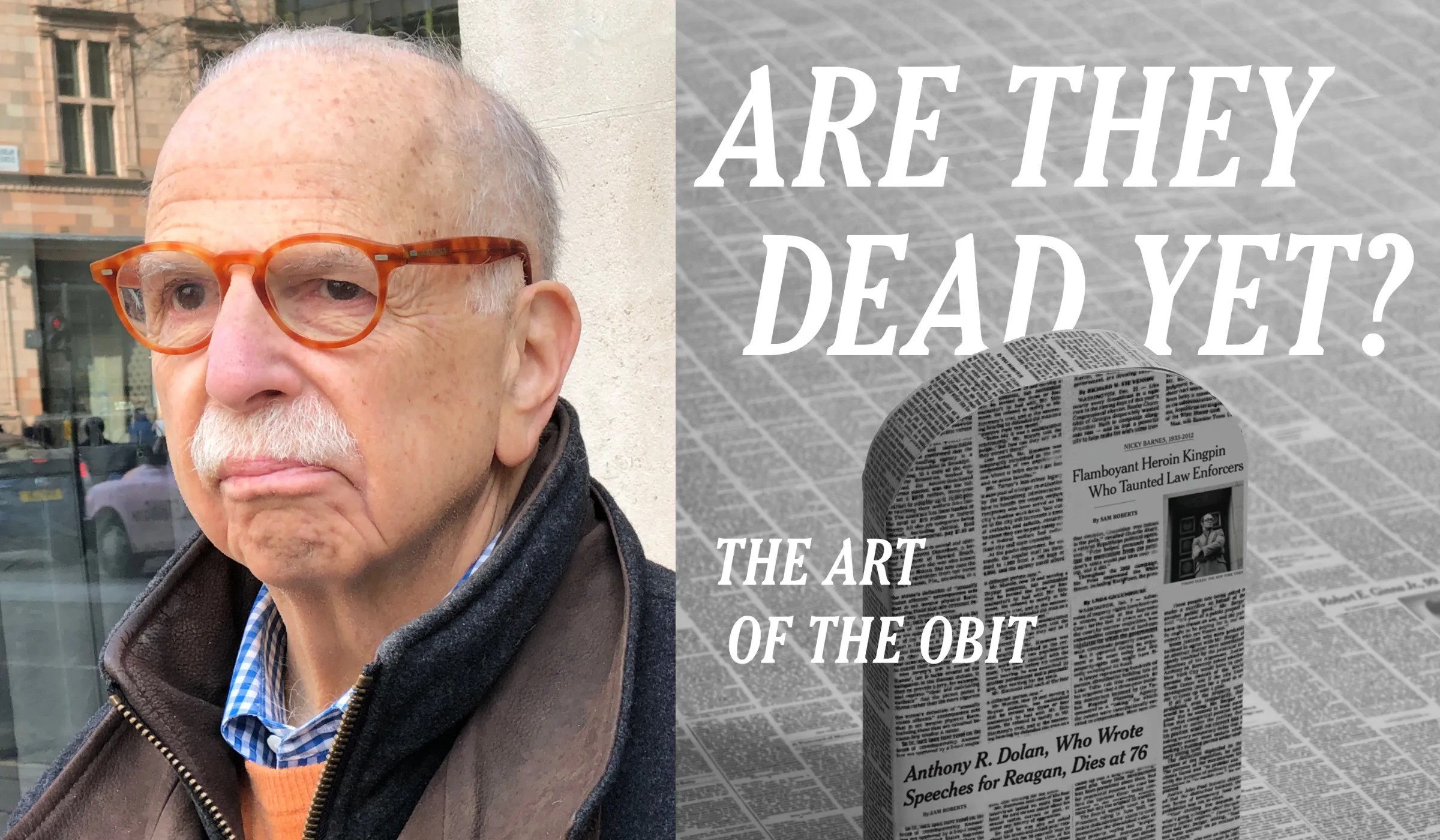
In an excerpt from his new book, veteran New York Times obituary writer Sam Roberts muses on the form and on how words give shape to legacies…
Tuck Everlasting is a cautionary tale about a family of the same surname who, by inadvertently discovering the proverbial Fountain of Youth, is forced to reconcile with eternity. When I was assigned to write the obituary of the book’s author, Natalie Babbitt, I wondered whether she had continued pondering immortality herself. It turned out she had. Not surprisingly, her own take on eternal life echoed that of the fictional family patriarch, Angus Tuck. “I think that living forever would be a terrible thing,” I quoted her as saying in her Times obituary. “It would be boring, sad and lonely.” Babbitt died when she was 84. But Tuck and her other novels endure as Babbitt’s legacy for readers. So does my obituary, which in 2016 revealed her motivation to become an author: She was inspired to write Tuck, she said, when her four-year-old daughter woke from a nap crying because she was scared of dying. Babbitt had intended to become an illustrator, not an author, but pivoted after taking one writing course in college. She had enrolled because her husband hoped to become a novelist and she wanted to understand the challenges he faced.
Back at the Daily News, obituaries weren’t the best way to achieve immortality. We mostly ran one-paragraph squibs for members of the paper’s family, of printers, pressmen, and their immediate relatives. Instead, like most tabloids, the News thrived on the reported details of murders, assassinations, and suicides. Few news stories generated more of a sensation than death in all its dimensions. No less an authority once defined “news” than the ancient newspaper deliverer—a beloved man known as Bo Gee, who was decades too old to be described as a newsboy—weaving up Second Avenue with a wire shopping cart brimming with Chinese-language newspapers, calling out the headlines as he delivered the papers to Chinese bars and restaurants on Manhattan’s East Side. He began his route in Chinatown, where the papers were printed. Subscribers on Manhattan’s Upper East Side were often a day or two behind the headlines because the last stop on his evening route depended largely on the number of drinks he had finagled from bartenders along the way before he was too wobbly to walk any farther. When a colleague of mine, the columnist Jimmy Breslin (who described him as “a small, thirsty man”), asked him which headlines sold the most papers, he responded unhesitatingly. He didn’t need a public opinion poll or a focus group of readers or a real-time digital analysis of clickbait: Two were surefire circulation boosters. One was war! The other: big guy dies!
Taken separately, obits constitute an individual’s legacy. In aggregate, they can capture the social and cultural currency of an era. Which people are worth remembering? Which values are worth celebrating? How do we measure success and failure, good and evil, achievement and defeat, social rank and professional standing? How many of the one hundred thousand people now immortalized in the periodically printed historical compilation Who Was Who were deemed worthy of obituaries at the time of their death? How many of the more than 33,000 contemporary notables included in the latest editions of Who’s Who will get obituaries when they die? (That the titles of those reference books don’t include question marks suggests that the listings themselves are indisputable, a questionable supposition when the price of inclusion by some publishers seems to be for the “whos” to buy at least one copy of the book. An entry for Michael Fowler Cullis, a former British diplomat, describes his recreation as “writing obituaries for friends.”)
People want to be remembered, and we want to remember them, or, at least, we do. “Obituaries commemorate a life at the point where it is completed by death. Yet the completion is also depletion, in the sense that the life is constructed as meaningful precisely at the point where it stops,” Professor Clare Brant, who teaches literature and culture at Kings College London, has written. “They act as the first version of a biography—sometimes the only one, although Wikipedia has closed the gap with each life story seemingly waiting for a death sentence.” But as valuable as Wikipedia can be, the New York Public Library notes, “Obituaries provide an important tool to researchers by offering biographical information on individuals that may not be readily available elsewhere. In many cases, the obituary supplies the only biographical data extant on a person.” Philip Sutton, a genealogy librarian at the library, told Legacy.com, the self-proclaimed world’s largest commercial provider of online memorials and guest books, that obituaries may reveal the married name of a daughter identified years earlier in the census only by her maiden name; that by identifying an immigrant’s specific birthplace, obituaries can also invigorate research on a family’s roots.
To me, obituaries evoke the heartrending backstories of the characters in Thornton Wilder’s play Our Town, the unfulfilled promise of Joe Crowell, who got a scholarship to the Massachusetts Institute of Technology and graduated first in his class: “Goin’ to be a great engineer, Joe was. But the war broke out and he died in France. All that education for nothing.” Emily is dead, too, but so consumed by nostalgia—before being persuaded that “live people don’t understand, do they?”—that she descends from the town’s cemetery and wants to return to her past life in Grover’s Corners, New Hampshire, until the Stage Manager reminds her, “You not only live it but you watch yourself living it. And as you watch it, you see the thing that they, down there, never know. You see the future. You know what’s going to happen afterwards.” “When I think of an obituary, it’s as objective as journalism can be, a story on someone’s life,” Holly Shreve Gilbert, a journalism instructor at Oakland University who was the interim president of the Funeral Consumers Information Society, told Molly Birnbaum of Atlas Obscura. But “hyper-local journalism is dying, and so is the obituary of the local person.” Gilbert added, “Now, if it’s on Legacy.com or Facebook or a blog, we’re basically whitewashing everyone’s lives. We’re all happy. Everyone is happy.”
Well, not everyone.
Obituaries are a reminder that when you die, someone else gets the last word on your legacy—or, at least, the first of the last words. And for all the beloved and respected and cherished and valued that punctuate paid obituaries, don’t forget that families can try to perpetuate irreverent descriptions unilaterally to settle scores when one is no longer in a position to retaliate or respond. In Shakespeare’s Macbeth, Malcolm declaims of the repentant Thane of Cawdor, who was executed for treason, “Nothing in his life became him like the leaving it.” If the Thane got the benefit of ambiguity, Florence Harrelson of Chelsea, Maine, had no such luck when she died in 2024 and her daughter, Christina Novak, placed a paid obituary in the Kennebec Journal. Wasting no words, the four-line obit read that the 65-year-old Henderson died “without family by her side due to burnt bridges and a wake of destruction left in her path.” It continued, “Florence did not want an obituary or anyone including family to know she died. That’s because even in death, she wanted those she terrorized to still be living in fear looking over their shoulders. So, this isn’t so much an obituary but more of a public service announcement.”…
Read on… The art of the obituary: “Speaking for the Dead,” from @longreads.com.
###
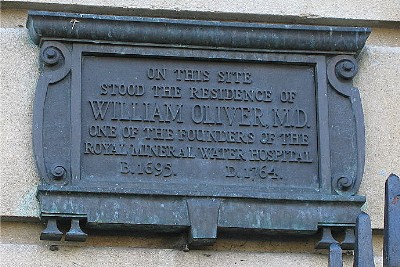
As we remember, we might send healthy birthday greetings to William Oliver; he was born on this date in 1695. A physician and philanthropist, he was a founder of the Royal Mineral Water Hospital in Bath, England, which opened in 1742 and continued to serve patients until 2019, often with treatments involving the geothermal springs at the Roman Baths.
But Oliver is better remembered for a culinary contribution. In a search for food that would suit his dyspeptic patients, he created the Bath bun. But as that proved too fattening for his rheumatic patients, he invented the “Bath Oliver” biscuit, a hard, dry cracker made simply from flour, butter, yeast and milk, and often eaten with cheese. Shortly before his death, Oliver confided the recipe to his coachman Atkins, giving him at the same time £100 in money and ten sacks of the finest wheat-flour. The fortunate recipient opened a shop in Green Street, and soon acquired a large fortune. The “Bath Oliver” is still a well-known type of cracker.

A Life Well Lived…
As the late Twentieth Century philosopher Jim Morrison noted, “nobody gets out of here alive”… the more important, then, to make that most of the time one has.
 Omer L. Baumgartner
AMES, Iowa – Noted Midwestern raconteur Omer L. Baumgartner passed away at this home in Ames, Iowa on Tuesday, Feb. 8, 2011. He was 90 years old. Mr. Baumgartner had lived a long and passionate life dedicated to rambunctious performances and dairy products.
Born on a dairy farm in Walnut, Ill., Baumgartner was prodigious with the movement of manure from an early age, and exercising these and other talents, earned recognition for his National 4-H Grand Champion Dairy Heifer, Clementine’s Ramona, in 1930 at the age of 10. After this debut, and as the Depression raged, Baumgartner cut his teeth in the livestock industry while attending hundreds of county and state fairs, showing and selling cattle, frying oysters, skinning rabbits, and drinking whiskey. While still a freshman at the University of Illinois, he successfully quelled the great dairy upraising of 1938, averting a desperate ice cream shortage in Chicago, and was immediately recruited, without finishing college, by the state’s Guernsey Breeders Association as a field agent.
Despite never learning to cook anything other than fried oysters, Baumgartner attained the rank of captain during World War II for running mess halls feeding over 5,000 in Tennessee and Alabama for the Army Air Corps. He was wildly popular with the troops for his mess hours bongo drum performances accompanied by dancing girls. Baumgartner notably worked for L.S. Heath and Company, running the dairy division and inventing Heath Bar ice cream in 1951. He also co-ran Wilkinson’s Office Supplies with his wife Jattie Wilkinson Baumgartner, serving one-third of the state of Illinois and parts of Iowa. Baumgartner disliked vegetables his whole life. Despite consuming more than 2,000 pounds of butter, he never suffered from any kind of heart disease. His last meal was ice cream.
[Galesburg.com, where readers will find the full obit; via Dangerous Minds]
As we commit to carpe each diem, we might recall that it was on this date in 1885 that Mark Twain’s Adventures of Huckleberry Finn was published in the U.S. Considered by many to be the Great American Novel, Huckleberry Finn has been controversial from it birth (e.g., here and here)– indeed, the controversy began before its birth: The UK and Canadian edition came out two months earlier; the U.S. version was delayed because one of the engravers added an obscenity to one of the illustrations: on p. 283, an illustration of Aunt Sally and Silas Phelps was augmented by the addition of a penis. Thirty thousand copies of the book had been printed before the unwanted addition was discovered. A new plate was made to correct the illustration and repair the existing copies; still, copies with the so-called “curved fly” plate remain valuable collectors items.
 Huck, as drawn by E. W. Kemble for the original edition of the book (source)
Before their time…

A number of "obituary templates" (like this one) were accidentally made public on CNN's website in August of 2003. Source: Snopes.com
In keeping with Prince’s declaration that “the Internet is completely over,” Wikipedia’s list of premature obituaries— the example above, and many, many more untimely announcements…
(TotH to GMSV)
As we recommit to double checking, we might recall that it was on this date in 1932 that King C. Gillette actually did die. An American businessman popularly known as the inventor of the safety razor (although several models were in existence prior to his design), Gillette’s true invention was an inexpensive, high margin stamped steel disposable blade– and the business model that later became known as freebie marketing: “give away the razor, sell the blades.”

You must be logged in to post a comment.