Paolo Veronese, The Adoration of the Magi, 1571 (source)
Attending to attentive canine figures in half a dozen paintings by Paolo Veronese, Thomas W. Laqueur explores the work of an artist whose love of dogs landed him in hot water with the Inquisition (and here)…
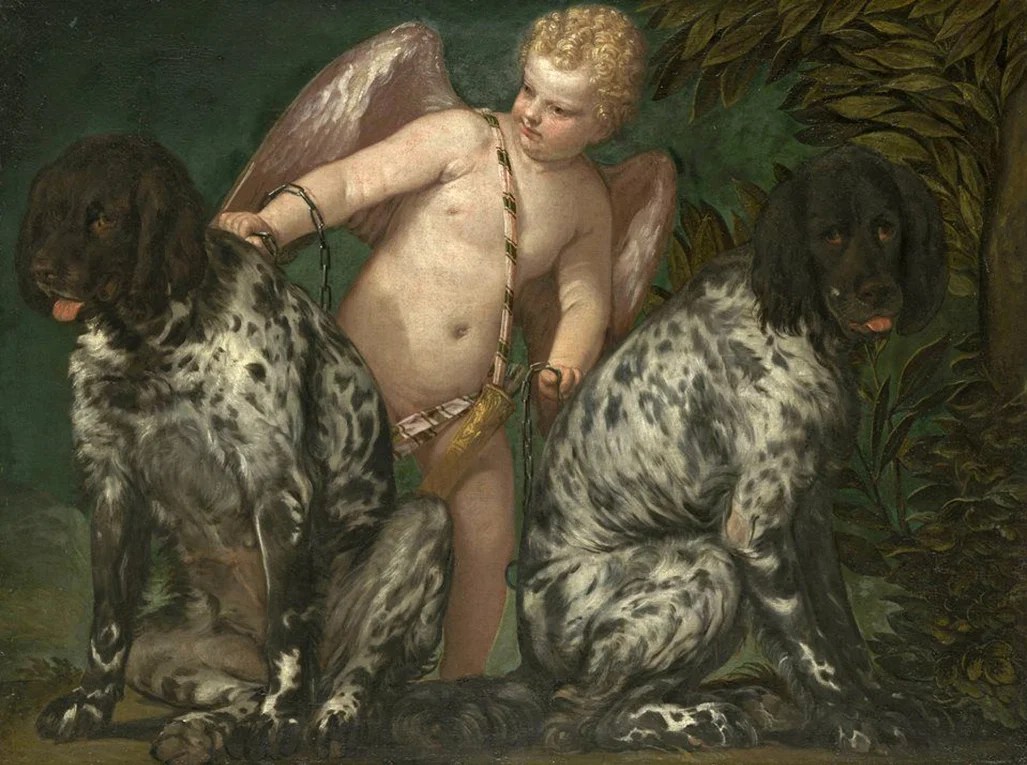
The art historian Kenneth Clark thought that Veronese was “the greatest dog lover of the Renaissance”. We have absolutely no biographical evidence to support this claim but we do have the evidence of numbers: there are a great many dogs in Veronese’s paintings. And Clark could have gotten support of a different kind from the great nineteenth-century critic John Ruskin. For Ruskin, Veronese’s dogs had a distinctive moral and social quality, which was especially prominent in one particular painting: Cupid with Two Dogs, a “great heroic poem”. Here, he wrote, two dogs are represented with the “highest, or spiritual view” of their nature: two magnificent mastiffs, “wildest of beasts perhaps they would have been by nature”. Between them is a beautiful boy, “golden quivered” — who represents, Ruskin thought, human love — holding the great beasts by a chain in his hands.
Paolo Veronese, Cupid with Two Dogs, 1580, a “great heroic poem” (source)
Love conquers savagery is how Ruskin interpreted the painting. But perhaps Cupid serves less as a stand-in for love (and its unpredictable nature) and more as a caretaker for these spectacular dogs, known for their steadfastness, who speak to a different kind of amorous union: one as faithful as dogs are to humans. The animals’ allegorical meaning, whatever it is, seems to me less important than the sweet intimacy with which the dogs are painted, grounded in their gaze and their sheer benign weightiness. The one on the right looks quizzically and seductively out at us; the other, the more relaxed one on the left, looks with Cupid toward the painter outside the frame. Perhaps contemporary viewers would have seen them as having been once the “wildest of beasts” but they seem very far from that now.
Visually they are the stars of the show in their almost psychedelically painted black-on-white spotted fur, their red tongues and glistening eyes like points of light. The curves of their backs frame the bathed, soft flesh of the Cupid figure; the leg of the dog on the left is intertwined with his leg — he is astride of it — and touches the left paw of the other dog. All this in a severely constrained space, a vignette, that stands at one end of a scale, with Veronese’s great theatrical scenes (and their dogs) at the other. This is a formally virtuosic painting, whatever else it is about or means, about dogs, doggishness, and the gaze. It would be a surprise, given his careful attention, if Veronese did not in fact love dogs…
[Laqueur considers other s of Veronese’s dogs…]
… We in fact have almost no documentary evidence why any painter, and Veronese in particular, was interested in thinking with dogs. But we do in his case have a tantalizing small hint because on July 18, 1573, he was called before the Inquisition to answer questions about one of his paintings, specifically about a dog that figures prominently, front and centre.
The Inquisitor asked if he had any idea why he had been summoned. Veronese replied that he did not although he speculated it might have been because the Inquisitors had summoned the Prior of San Giovani e Paulo who had commissioned a “Last Supper” from him as a replacement for a Titian on the same subject and “ordered him to have painted [in the picture] a Magdalen in place of a dog”. It had been more than three months since the painting had been finished; the dog was still there; no penitent prostitute had been added. Veronese confessed, that he had not done what they had ordered the Prior to order him to do. He told the Inquisitor that he would gladly do “everything necessary for my honour and for that of my painting”, but that he did “not understand how a figure of Magdalen would be suitable there.”
He had every reason not to understand. It is generally accepted that the painting in question was intended to be, as requested by the monastery, a Last Supper; we can identify it from all the detailed questions the Inquisitors asked and from its subsequent history. He might himself have caused some confusion by saying the painting was of the “Last Supper that Jesus Christ took with His Apostles in the House of Simon” when the Inquisitor asked what picture he was speaking about, although the Last Supper was neither at the house of Simon the Pharisee where the Magdalen story took place (Luke 7:36–50) nor of Simon the Leper (Mark 14:3–9) and Matthew 26:6–13) where Mary anointed Jesus. Veronese made no pretence in any of his feast scenes or other religious painting of faithfully illustrating a text. He was not unusual in this regard.
This was also not a Galileo moment: dogs in religious paintings did not threaten the teachings of the Church; there are plenty of them in paintings of The Last Supper. And they would be particularly appropriate in a commission from a Dominican monastery because of their well-known association with the order’s founder, St Dominic de Guzman. A black dog had announced to the saint’s mother “that she would bear in her womb a dog who, with a burning torch in his mouth and leaping from her womb, seemed to set the whole earth on fire”.6 She named her son after St Dominic of Silo, who had interceded on her behalf when she had failed to conceive. A dog with a torch in its mouth had already become in the late Middle Ages an iconographical sign for her son, the saint, in painting and sculpture for the order named after him and a logo until this day also for parishes named after the order’s founder. Everyone would know this. And, either in response to this story or independently much was made already in the Middle Ages of how the name of the order in Latin — Dominicanus — could easily be repurposed as Domini canis (“Dogs of the Lord”): dogs as the doppelgängers of the monks themselves, scurrying around corralling souls as in Andrea di Bonaiuto’s 1365 fresco Allegory of the Active and Triumphant Church.
But the problem was not, as Veronese first guessed, the presence of a dog instead of a Magdalen. In fact, he was not summoned in front of the Venetian Inquisition for heresy or even dubious iconography, although that charge was the ostensible subject of his trial. Veronese was collateral damage of local ecclesiastical politics, caught up in a struggle between Rome and Venice. The Inquisitor needed to prove himself to a new papal nuncio. In the context of the Counter-Reformation this painting could be construed as suspicious because of its indisputable theatrical extravagance; the Council of Trent had charged bishops with making sure that religious paintings were appropriately decorous and true to text.
Veronese’s only defence against this sort of attack — in addition to trying to claim he was no worse than Michelangelo in allowing his imagination full play — was a version of art for art’s sake: “We painters take the same licence the poets and the jesters take”. He filled the vast space of the canvas appropriately as his imagination dictated: his job was “to create the painting as I thought fit, it was large and could accommodate numerous figures”: “figures as ornaments, of my own invention”. The Inquisitor would have none of this. Everything in appropriate religious art, he was told, everything “befits the spiritual — there are no jesters, no dogs, no weapons, or any such silliness [as in yours]”. Veronese was ordered to “correct the painting” within three months.
In fact, all he did was put in a label where before there had been none. It read in the Latin of the Vulgate “Et fecit ei convivium magnum Levi in domo sua” (“Levi made the Lord a Great Feast”, Luke 5:29). A new name transformed Veronese’s Last Supper, in which soldiers and dogs and jesters might be regarded as sacrilegious and disrespectful, into a painting of a relatively obscure dinner with tax collectors and a great company of publicans at a rich man’s house to which Jesus had been invited. The Feast in the House of Levi, as the painting was now called, remained in the refectory of the priory for which it had been painted, watching over the monks as they ate, until it was moved to the Gallerie dell’Accademia in Venice in the nineteenth century.
Veronese, The Feast in the House of Levi (detail), 1573 (source)
* Martin Luther (speaking of his dog Tölpel [German for “klutz”]) in “Table Talk No. 2803” (1531), in Tischreden, vol. 3 (Weimar: Böhlaus Nachfolger, 1914) (author’s translation)



You must be logged in to post a comment.