Posts Tagged ‘Jane Austen’
“If it don’t cure them, it can’t more than kill them”*…

Your correspondent has been wrestling with a remarkably recalcitrant rhinovirus. Searching for solutions, he found this…
While the Civil War was raging back East, Samuel Clemens (who had recently begun using the pseudonym Mark Twain) lived in Virginia City, Nevada, where he came down with a serious cold and bronchitis that plagued him for the much of the summer in 1863. His ailments didn’t keep him from traveling, first to the home of his friend Adair Wilson near Lake Bigler (now Lake Tahoe) and then to Steamboat Springs. In a series of letters and reports to newspaper editors in Virginia City and San Francisco, Clemens detailed his adventures and the spirited (if half-hearted) attempts to attack his illness with various remedies…
More backstory, and Twain’s piece in in its short-but-glorious entirety, at “How to Cure a Cold.” (Your correspondent settled, as Twain did, on the remedy featured finally in the piece…)
* Mark Twain (from the story featured above)
###
As we reach for the tissues, we might send bounteous birthday greetings to the incomparable Jane Austen; she was born on this date in 1775. One of the most widely read writers in English literature. Her realism, biting irony, and sensible social commentary– along with her persuasive plots– have earned her a place of pride among readers and scholars/critics alike.
Check out Five Books on Jane Austen.

Portrait of Jane Austen, drawn by her sister Cassandra (c. 1810)
“The most inaccurate headline ever”?…

An article published in The Telegraph over a month ago remains on The Telegraph website with a headline that is so spectacularly incorrect that the BBC has reported that the article may set “a new record for the most inaccurate headline ever”.[*] According to The Telegraph headline there are “just 100 cod left in the North Sea”. Our first clue that this may be a case of wilful exaggeration lies in the subheading, which notes that The Telegraph are in fact attempting to report the number of adult cod, but as Tom Webb over at the SciLogs blog first pointed out this estimate is still “out by a cool factor of 210,000”. The Telegraph now admits (in a post script unapologetically added at the end of the article) that there are in fact over 21 million adult cod in the North Sea. It seems however; this fact is not significant enough to make The Telegraph change their headline – this in spite of the BBC reporting that a correct headline would have been “Just 436,900,000 cod left in the North Sea”, only about half a billion off from The Telegraph’s original estimate. The Sunday Times, The Atlantic Wire and of course the Daily Mail all also parroted the Telegraph’s claim, fine evidence that articles such as this, that are left to fester online result in the ongoing perpetuation of misinformation…
From Neurobonkers, a new addition to your correspondent’s blogroll that focuses “on issues of the mind, scientific controversies, and journalistic misrepresentation of science.”
* One infers that the British press never before had a “Dewey Defeats Truman!” moment?…
###
As we stock up on grains of salt, we might recall that it was on this date in 1811 that Sense and Sensibility, “by A Lady,” was published. For a variety of reasons– including the penetrating accuracy of her observations– that “Lady,” Jane Austen, went to great pains to hide her identity.

Last words…

Art is endless like a river flowing,
passing, yet remaining, a mirror to the same
inconstant Heraclitus, who is the same
and yet another, like the river flowing.– Jorge Luis Borges, from The Art of Poetry
To begin perfect happiness at the respective ages of twenty-six and eighteen is to do pretty well; and professing myself moreover convinced, that the General’s unjust interference, so far from being really injurious to their felicity, was perhaps rather conducive to it, by improving their knowledge of each other, and adding strength to their attachment, I leave it to be settled by whomsoever it may concern, whether the tendency of this work be altogether to recommend parental tyranny, or reward filial disobedience.
– Jane Austen, from Northanger Abbey
This game is seven-card stud.
– Tennessee Williams, from A Streetcar Named Desire
More final sentences from literary works of all sorts at “The Final Sentence.” (Even more here— from whence the end tile card, above.)
***
As we sum up, we might send carefully-composed birthday wishes to Alexandr Sergeyevich Pushkin; the Russian author was born on this date in 1799 (using the calendar then in effect in Russia). Pushkin was born into the nobility, an achieved literary acclaim early in his creer. But his free-thinking bought him trouble with the Tsar. Indeed, it was while he was under surveillance by the Imperial secret police that he wrote the work for which he’s probably best known, Boris Godunov.
(The people are silent with horror.)
– The stage direction that is the last line of Boris Godunov

Now you don’t; now you see it…

Though your correspondent is certain that it’s no problem for any of you, Dear Readers, it’s a sad fact that the craft of exploratory romantic communication– flirting– is, for many, fraught with the risk of misunderstanding, as it all-too-often-unsuccessfully tries to avoid the Scylla and Charibdys of misbehavior and missed opportunity.
Well, benighted bar-goers need fret no more: Dutch designers Studio Roosegaarde, in collaboration with V2_Lab and fashion designer Anouk Wipprecht, have come to the rescue with a line of dresses that telegraph a girl’s interest– or lack thereof. Co.Design reports:
So say you meet some guy who sends your heart aflutter. The dress responds to your elevated pulse by growing transparent around the (already plenty skimpy) plunging neckline. Conversely, if he’s such a snooze that you’re about two seconds away from flat-lining, the dress stays opaque, sending an instant “no, thanks!”
The line, “Intimacy 2.0,” is a series of sensor-enabled cocktail dresses that expose more (indeed, ultimately rather a lot of) skin the more excited the wearer becomes; a combination of embedded sensors and conductive “smart foils” (that become see-through conducting electricity) do the trick… as demonstrated in this– suitable for the club, if NSFW– video:
Readers may have a friend who would be interested to know that the dresses are, in fact, on sale.
As we ponder the impact of static electricity, we might recall that it was on this date in 1811 that a very different take on courtship emerged: a first novel entitled Sense and Sensibility was published. At the time, only a handful of folks knew the identity of its creator– who was presented to the reading public on the novel’s title page as “a Lady.” But as the author’s work caught on, she began to publish under her real name– Jane Austen– and later got credit for her inaugural effort.
 Title page from the first edition (source)
“First Impressions”…
… was the tentative title with which Jane Austen worked before she settled on Pride and Prejudice.

George Orwell’s publisher convinced him that “The Last Man in Europe” simply wasn’t going to send copies flying off booksellers’ shelves, convincing Orwell to switch to his back-up title, 1984.

Discover more literary “might-have-beens,” featuring F. Scott Fitzgerald, Ernest Hemingway, Joseph Heller, Bram Stoker, and others– at Mentalfloss.
As we think again about our vanity plate orders, we might recall that it was on this date in 1943 that then-26-year-old poet Robert Lowell, scion of an old Boston family that had included a President of Harvard, an ambassador to the Court of St. James, and the ecclesiastic who founded St. Marks School, was sentenced to jail for a year for evading the draft. An ardent pacifist, Lowell refused his service in objection to saturation bombing in Europe. He served his time in New York’s West Street jail.
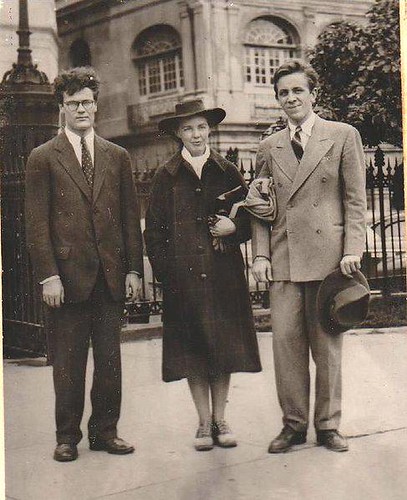 Lowell (left) in 1941, with (his then wife) novelist Jean Stafford, and their friend, novelist and short-story writer Peter Taylor, at Kenyon College, where they studied with John Crowe Ranson (source)
You must be logged in to post a comment.