Posts Tagged ‘fruit’
“Give me juicy autumnal fruit, ripe and red from the orchard”*…
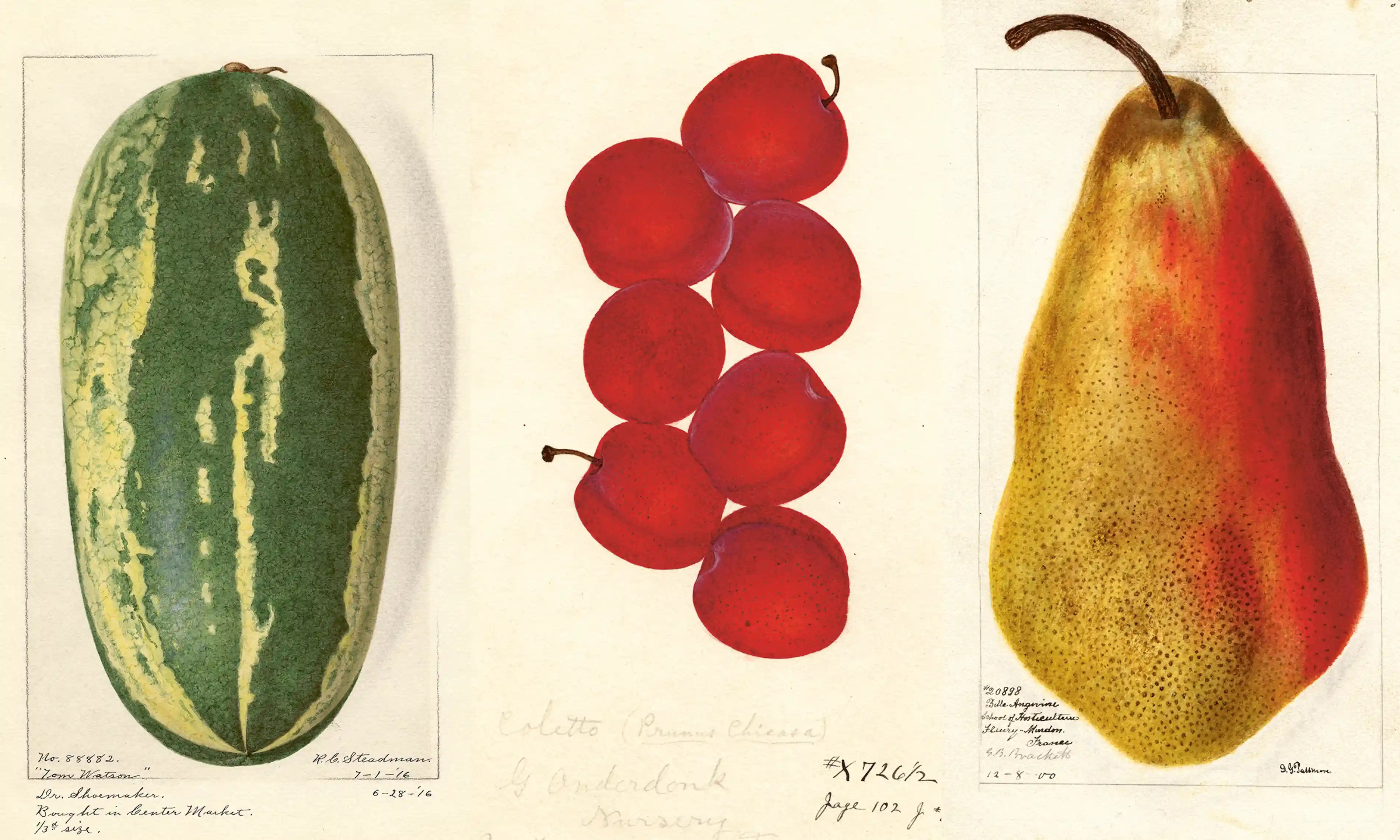
American fruit and nuts…
Pascale Georgiev, editorial director at Atelier Éditions, was researching botanical artwork a few years ago when she came across the US Department of Agriculture’s pomological watercolour collection, an archive of 7,500 watercolours of fruit and nuts grown in the US between 1886 and 1942, mostly created before photography was widespread. The discovery led to a new book, An Illustrated Catalog of American Fruits & Nuts (Atelier, £44), full of images that Georgiev describes as irresistible. “The belle angevine pear… makes my heart sing and I’m partial to a plum named tragedy.” She’s also proud that the book showcases women working in science: “Nine of this US department’s 21 artists were women. A rare thing at the time.” Most of all she’d like readers to think about biodiversity. “I hope they share my delight in discovering the history of the fruit we consume, alongside beautiful artworks.”
A glorious collection: “Get fruity: vintage botanical watercolors,” from @guardian.
* Walt Whitman
###
As we ruminate on ripeness, we might recall that it was on this date in 1950 that the daily comic strip Peanuts premiered in eight newspapers: The Washington Post, The Chicago Tribune, The Minneapolis Tribune, The Allentown Call-Chronicle, The Bethlehem Globe-Times, The Denver Post, The Seattle Times, and The Boston Globe. Its creator, Charles Schulz had developed the concept as a strip (L’il Folks) in his hometown paper, The St. Paul Pioneer Press, from 1947 to 1950. At its peak, Peanuts ran in over 2,600 newspapers, with a readership of 355 million in 75 countries, and was translated into 21 languages.

“If You Can’t Fix It, You Don’t Own It”*…
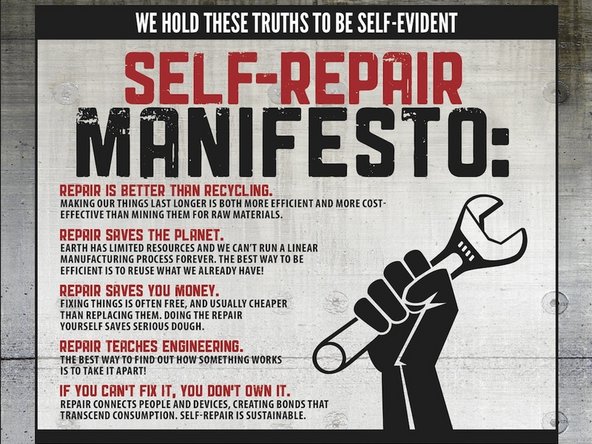
A just-issued report by the US Federal Trade Commission confirms that anti-repair actions by large companies are hurting small businesses, undermining your ownership rights, and hurting the planet. Of course, these are the very problems that we’ve been fighting for the past fifteen years—but it’s validating to see US government confirmation of the market imbalance.
The unanimous report, nearly two years in the making, follows public hearings and testimony from the FTC’s “Nixing the Fix” workshop in July 2019, and a demand from Congress in 2020 to report back. iFixit and other repair advocates told the Commission then how manufacturers design products that frustrate repair and force owners to use the manufacturers’ branded repair services, hurting consumers and stifling competition. Manufacturers claimed the market was working fine, and that opening up repair access would undermine the safety and security of their products. Today’s report is a rebuke to their arguments.
The FTC’s long-awaited report provides a thorough analysis of broad market failures, and recommendations for government action to address those failures. Some major findings included in the report:
– Warranties are being routinely voided, in violation of the Magnuson Moss Warranty Act. “The Commission takes these allegations seriously and will continue to address illegal practices in the marketplace.”
– “[T]he burden of repair restrictions may fall more heavily on communities of color and lower-income communities.”
– “The pandemic has exacerbated the effects of repair restrictions on consumers.”
…
The report summarizes the problems that consumers are facing from a variety of monopoly strategies. “Many manufacturers restrict independent repair and repair by consumers through:
– Product designs that complicate or prevent repair;
– Unavailability of parts and repair information;
– Designs that make independent repairs less safe;
– Policies or statements that steer consumers to manufacturer repair networks;
– Application of patent rights and enforcement of trademarks;
– Disparagement of non-OEM parts and independent repair;
– Software locks and firmware updates; or
– End User License Agreements.”
…
A rebuke of Apple, John Deere, and other manufacturers whose practices frustrate repair by “owners”: “FTC Report Finds Manufacturers’ Repair Restrictions Unwarranted.” Via @kwiens and @stewartbrand
###
As we resist rentiers, we might recall that it was on this date in 1893 that the U.S. Supreme court unanimously ruled that a tomato is a vegetable. In reaching their decision in Nix v. Hedden, a dispute over the appropriate duties to be levied pursuant to the Tarriff Act of 1883, the justices found that the “ordinary” understanding of a tomato as a vegetable should take precedence over the scientific fact that it is a fruit.

“Art is the only way to run away without leaving home”*…

As we prepare ourselves for pumpkin carving, we might pause to recall an era in which other fruits were ornamentally hewn. As a 1905 issue of American Homes and Gardens magazine put it, “it is surprising what can be done with the conventional orange.”

More table decorating tips at “The Art of Ornamental Orange Peeling.”
* Twyla Tharp
###
As we sharpen our knives, we might pause to recall that it was on this date in 2008 that the “Sichuan Guangyuan citrus maggot event” went public; a huge portion of the region’s citrus (ornages and tangerines) were found to be afflicted by small maggot-like worms. The episode is noteworthy as an relatively early example of the power of Chinese social media: though the government did its best to support continued citrus sales by censoring any news media mention of the outbreak, BBS forums and SMS messages carried the news– sufficiently successfully (citrus sales in Beijing plummeted) that the official outlets had to relent and report the news, along with assurances that the government was responding…

Yes, we have no bananas…

Back in 2004, David Burns, Matias Viegener, and Austin Young coined the term ‘Public Fruit’ and began mapping fruit trees growing on or over public property in Los Angeles. Their collaboration has expanded to include serialized public art projects and site-specific installations and happenings in cities around the world– always working with fruit as a material or medium.
Fallen Fruit’s visual work includes an ongoing series of narrative photographs, wallpapers, everyday objects and video works that explore the social and political implications of our relationship to fruit and world around us. Recent curatorial projects reindex the social and historical complexities of museums and archives by re-installing permanent collections through syntactical relationships of fruit as subject.
See the world through the lens of fruit at Fallen Fuit. (And find your own palette at Falling Fruit‘s interactive map of urban fruit trees.)
###
As we ask ourselves if we dare to eat a peach, we might recall that it was on this date in 1887 that the Horlick brothers first sold “malted milk” to the public. In 1873, James and William Horlick had formed a company to manufacture their own brand of infant food; ten years later, they earned a patent for a new formula enhanced with dried milk. The company originally marketed its new product as “Diastoid”; but, looking for a broader market, trademarked the name “malted milk” in 1887. Just after the turn of the century, Horlick’s malted became popular as a provision for North and South Pole expeditions by Robert Peary, Roald Amundsen, Ejnar Mikkelsen, Ernest de Koven Leffingwell, and Robert Falcon Scott– and profited mightily from the attendant publicity. Still, competition (Ovaltine, et al.) flooded into the market; eventually Horlick’s sold out to Beecham (now part of GlaxoSmithKline).

Polar explorer Ernest deKoven Leffingwell posing with crates of Horlick’s Malted Milk
You must be logged in to post a comment.