Posts Tagged ‘Florence’
Freudian Slips…
From Fox News, announcing the big news story of May 1:
 BREAKING NEWS
Obama Bin Laden Dead
Still, Happy World Press Freedom Day!
As we remember that, to paraphrase Craig Newmark, a free press is the immune system of a democracy, we might wish a crafty Happy Birthday to Niccolò di Bernardo dei Machiavelli; he was born on this date in 1469. Machiavelli wrote comedies, poetry, and some of the best-known personal correspondence in Italian; but he is best remembered as a Man of Affairs, first as a servant of the Florentine Republic in a time during which Medici influence was on the wane. His most famous work, The Prince— first published as a pamphlet in 1513– was written mid-career to gain favor with the Medici, who were at that point regaining dominance in Florence. The essay on the exercise of power (inspired by Cesare Borgia) not only failed to win over the Medici, it alienated Machiavelli from the Florentine public; he never again played an important role in government. Indeed, when the Florentine Republic was established in 1527, Machiavelli was effectively ostracized.
But published in book form posthumously (in 1532), The Prince began its steady growth in influence. And indeed today, Machiavelli is considered one of the fathers of modern political theory.
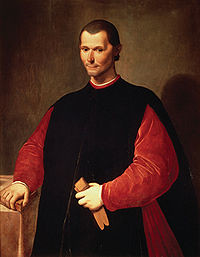 Niccolò Machiavelli by Santi di Tito (source)
Oh say can you see…?
 source: Dark Roasted Blend
On the heels of a weekend of frankfurter-fortified patriotism here in the U.S., the good folks at Dark Roasted Blend have published a momento mori– “Flags of Forgotten Countries“…
Consider the beauty above– the standard of one of the superpowers of its time, The Most Serene Republic of Venice. A version of this pennant waved for most of the thousand years– from the late seventh century to 1797– that Venice stood sovereign… a period that ended with the city-state’s defeat by Napoleon, himself the author of a number of now-redundant flags.
See the whole collection here.
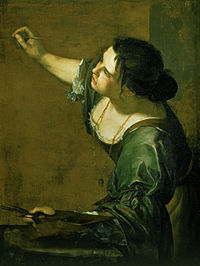
As we think timeless thoughts, we might recall that in the midst of Venetian ascendancy, on this date in 1593, across the boot in Rome, Artemisia Gentileschi was born. Influenced by her father Orazio and his mentor Caravaggio, she was the first female painter to tackle historic and heroic themes that were at the time believed to be “beyond the reach of women,” and to become a member of the Accademia di Arte del Disegno in Florence.
You must be logged in to post a comment.