Posts Tagged ‘catastrophe’
“It is not enough for code to work”*…
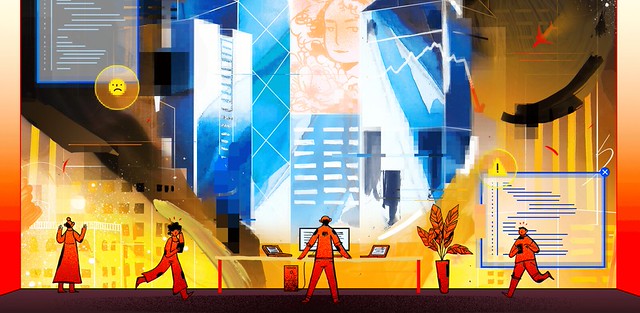
It’s been said that software is “eating the world.” More and more, critical systems that were once controlled mechanically, or by people, are coming to depend on code. This was perhaps never clearer than in the summer of 2015, when on a single day, United Airlines grounded its fleet because of a problem with its departure-management system; trading was suspended on the New York Stock Exchange after an upgrade; the front page of The Wall Street Journal’s website crashed; and Seattle’s 911 system went down again, this time because a different router failed. The simultaneous failure of so many software systems smelled at first of a coordinated cyberattack. Almost more frightening was the realization, late in the day, that it was just a coincidence…
Our standard framework for thinking about engineering failures—reflected, for instance, in regulations for medical devices—was developed shortly after World War II, before the advent of software, for electromechanical systems. The idea was that you make something reliable by making its parts reliable (say, you build your engine to withstand 40,000 takeoff-and-landing cycles) and by planning for the breakdown of those parts (you have two engines). But software doesn’t break… Software failures are failures of understanding, and of imagination…
Invisible– but all too real and painful– problems, and the attempts to make them visible: “The Coming Software Apocalypse.”
* Robert C. Martin, Clean Code: A Handbook of Agile Software Craftsmanship
###
As we Code for America, we might recall that it was on this date in 1983 that Microsoft released its first software application, Microsoft Word 1.0. For use with MS-DOS compatible systems, Word was the first word processing software to make extensive use of a computer mouse. (Not coincidentally, Microsoft had released a computer mouse for IBM-compatible PCs earlier in the year.) A free demo version of Word was included with the current edition of PC World— the first time a floppy disk was included with a magazine.

“Just because you’re paranoid doesn’t mean they aren’t after you”*…

Pieter Bruegel the Elder, “The Triumph of Death” c. 1562
* Joesph Heller, Catch-22
###
As we count the ways, we might send heavenly birthday greetings to Nicolaus Copernicus. the Renaissance polyglot and polymath– he was a canon lawyer, a mathematician, a physician, a classics scholar, a translator, a governor, a diplomat, and an economist– best remembered as an astronomer ; he was born on this date in 1473. Copernicus’ De revolutionibus orbium coelestium (On the Revolutions of the Celestial Spheres; published just before his death in 1543), with its heliocentric account of the solar system, is often regarded as the beginning both of modern astronomy and of the scientific revolution.
Of all discoveries and opinions, none may have exerted a greater effect on the human spirit than the doctrine of Copernicus. The world had scarcely become known as round and complete in itself when it was asked to waive the tremendous privilege of being the center of the universe. Never, perhaps, was a greater demand made on mankind – for by this admission so many things vanished in mist and smoke! What became of our Eden, our world of innocence, piety and poetry; the testimony of the senses; the conviction of a poetic – religious faith? No wonder his contemporaries did not wish to let all this go and offered every possible resistance to a doctrine which in its converts authorized and demanded a freedom of view and greatness of thought so far unknown, indeed not even dreamed of.
– Goethe

You must be logged in to post a comment.