Posts Tagged ‘auto accident’
“These gems have life in them: their colors speak, say what words fail of”*…
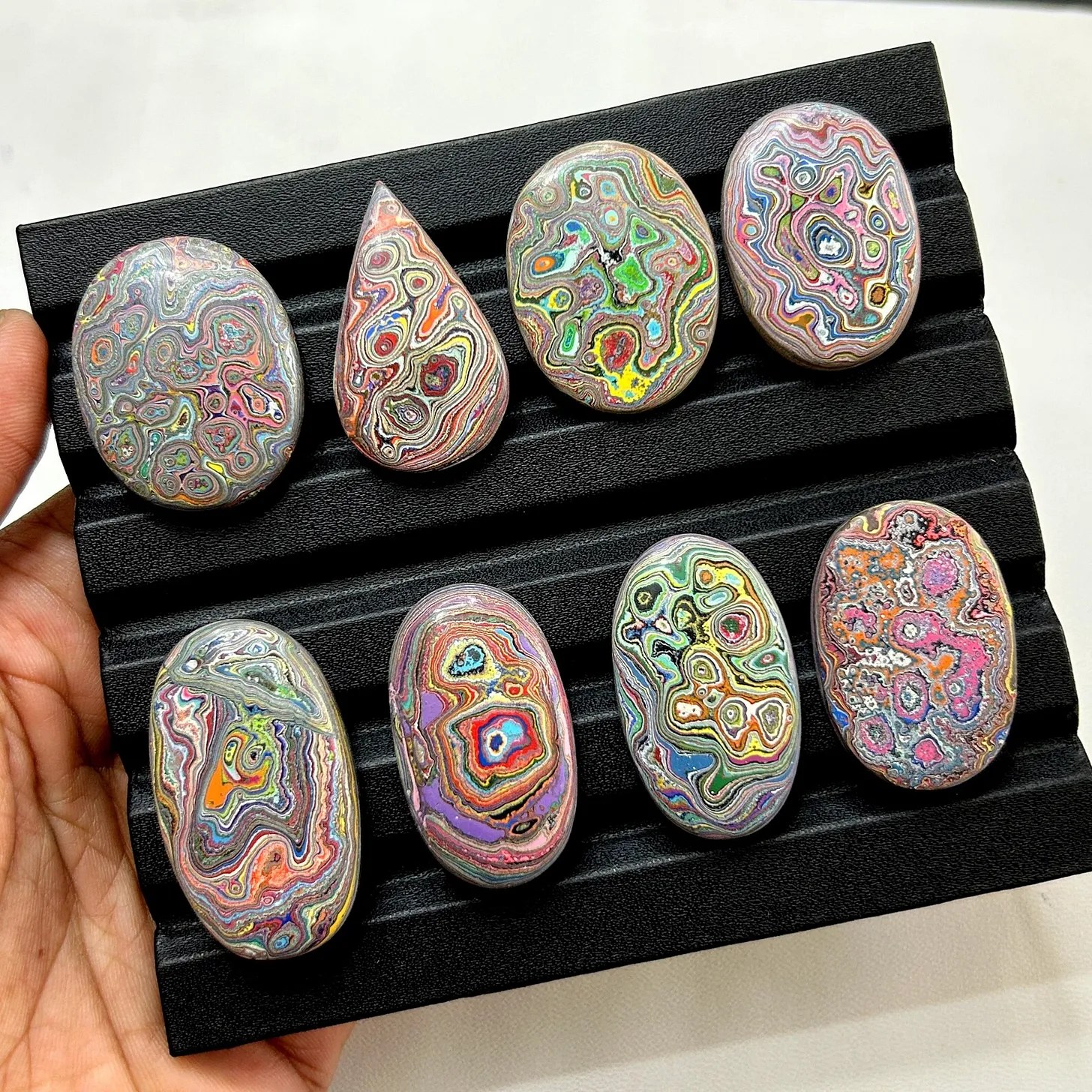
Ryan McManus on geologic byproducts, American automotive lore, and the hidden beauty of the industrial age…
Let’s be real for a second: gems are basically very pretty garbage. A byproduct of a geologic or biological process we hang on our bodies for some weird reason. Diamonds are just charcoal that has been squeezed a little longer than usual. Geodes are dried lava that got a little wet. Pearls? Oyster mucus, secreted to smooth out the bivalve equivalent of a stone in one’s shoe. They are unintentional, accidental and, due to the peculiarities of our brains, unquestionably beautiful.
So, if nature can accidentally create works of art while going about its business, why not us?
In the 1940s and 50s, Detroit’s automotive factories had a beautifully messy problem: paint. Workers hand-sprayed enamel paint onto cars on assembly lines, with excess overspray gradually building up on the tracks, skids, and walls of painting bays. This oversprayed paint accumulated over years, layer by layer—creating thick, multicolored deposits that factory workers would periodically chip away and discard.
What they were throwing out, however, would eventually become one of the most sought-after materials in contemporary jewelry making: Fordite, also known as Detroit agate.
Fordite is a man-made gemstone (technically a non-faceted gemstone, called a cabochan), but not like the rubies and diamonds grown in labs. The material represents a fascinating intersection of industrial inefficiency and geological mimicry: As cars were spray painted by hand, the hardened enamel paint built up and baked, creating sedimentary-like layers that mirror how natural agates form over millennia, except compressed into decades of automotive production.
When cut and polished, the visual result is striking—especially in the most valuable samples from the late 1960s and early 1970s, the period of bright “high impact” colors like Ford’s Grabber Blue or Mopar’s Plum Crazy purple. Fordite reveals psychedelic swirls and bands that chronicle automotive color trends year by year, strata by strata: It’s essentially a cross-section of American car culture, with each stratum representing a different model year’s palette. Like the proverbial Jurassic Age mosquito trapped in the stone of amber, the DNA of a bygone epoch is hidden inside.
But Fordite’s deeper appeal lies in its accidental scarcity and temporal specificity. By the 1980s, car manufacturers had moved away from hand-spray painting, adopting an electrostatic process that magnetizes enamels to car bodies, leaving little to no overspray. Efficient, yes—but this electrostatic process ended Fordite production in abundance by the late 1970s. The material can never be recreated—it’s a finite byproduct of a particular moment in industrial history.
This creates a curious value proposition: Fordite is valuable precisely because modern manufacturing has become more efficient. It is industrial waste transformed into luxury material through the simple passage of time and technological progress. With the old factories long gone and today’s automated systems eliminating waste, each piece of Fordite becomes increasingly rare (and expensive), turning Detroit’s former inefficiency into today’s artisanal treasure.
In an age of planned obsolescence and disposable manufacturing, Fordite stands as an accidental monument to the beauty that emerges from industrial imperfection—proof that sometimes the most interesting materials come from processes we’ve intentionally left behind.
A better poet might even see Fordite as metaphor for the City of Detroit itself—forever tied to the automobile, often written off as worthless; unrecognized as a thing of curious quality and glorious beauty waiting for its moment…
More beautiful examples at “Fordite,” from @ryantomorrow.bsky.social in the always-illuminating Why is This Interesting?
* George Eliot (Mary Ann Evans)
###
As we rethink remnants, we might recall that it was on this date in 1899 that America’s first fatal automobile accident occurred. At West 74th Street and Central Park West in New York City, Henry Hale Bliss, a 69-year-old local real estate dealer, stepped off of a south bound 8th Avenue trolley car and was struck by the driver of an electric-powered taxicab (Automobile No. 43). Bliss hit the pavement, crushing his head and chest. He was taken by ambulance to Roosevelt Hospital, but upon arrival the house surgeon, Dr. Marny, judged his injuries too severe to survive. Bliss died the next morning.

“Like so many named places.. it was less an identifiable city than a grouping of concepts– census tracts, special purpose bond-issue districts, shopping nuclei, all overlaid with access roads to its own freeway”*…

Dallas-Fort Worth has one of the world’s most extensive urban freeway systems. It is the product of the pro-growth ambition of political and business leaders, and has empowered the ambition of real estate developers, big business, the technology industry and entrepreneurs. The North Texas cultural spirit to think big and build big has guided the ongoing growth and expansion of Dallas-Fort Worth freeways, a transportation system which has propelled North Texas to be among the most economically successful regions in the United States in the post-World War II era. Dallas-Fort Worth Freeways documents the origins, politics, influence and resulting urban landscape of North Texas freeways…
The very complete– and lavishly illustrated– history of the Dallas-Fort area’s motorways: “Dallas-Fort Worth Freeways.”
See also the same author’s equally remarkable “Houston Freeways.”
* Thomas Pynchon, The Crying of Lot 49
###
As we watch for our exit, we might send motile birthday greetings to Nicolas-Joseph Cugnot, he was born on this date in 1725. In 1769, Cugnot, a military engineer, invented the world’s first fuel-propelled vehicle–a gun tractor commissioned by the French government. The following year he produced the first mechanically-driven “horseless carriage”; his steam tricycle, driven by a steam engine, carried four passengers and was the forerunner of the modern motor car.
There are reports of a minor incident in 1771, when the second prototype vehicle is said to have accidentally knocked down a brick or stone wall, either that or a Paris garden or part of the Paris Arsenal walls, in perhaps the first known automobile accident.

You must be logged in to post a comment.