Posts Tagged ‘The Artist’s Dream’
“Poetry is the art of creating imaginary gardens with real toads”*…
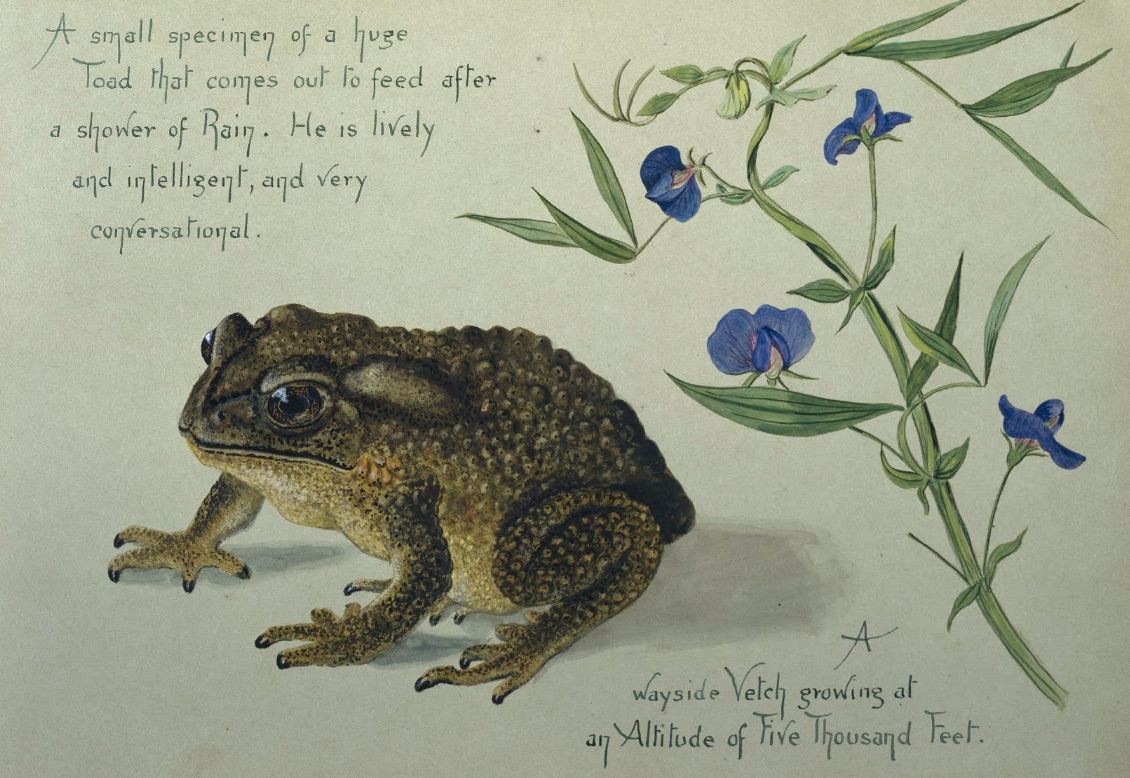
Olivia Fanny Tonge , A Toad, c. 1905
Before the swallow, before the daffodil, and not much later than the snowdrop, the common toad salutes the coming of spring after his own fashion, which is to emerge from a hole in the ground, where he has lain buried since the previous autumn, and crawl as rapidly as possible towards the nearest suitable patch of water. Something – some kind of shudder in the earth, or perhaps merely a rise of a few degrees in the temperature – has told him that it is time to wake up: though a few toads appear to sleep the clock round and miss out a year from time to time – at any rate, I have more than once dug them up, alive and apparently well, in the middle of the summer.
At this period, after his long fast, the toad has a very spiritual look, like a strict Anglo-Catholic towards the end of Lent. His movements are languid but purposeful, his body is shrunken, and by contrast his eyes look abnormally large. This allows one to notice, what one might not at another time, that a toad has about the most beautiful eye of any living creature. It is like gold, or more exactly it is like the golden-coloured semi-precious stone which one sometimes sees in signet rings, and which I think is called a chrysoberyl…
From George Orwell (in 1946): “Some Thoughts on the Common Toad.” From The Orwell Foundation, via Berfrois.
* Marianne Moore
###
As we appreciate amphibians, we might we might recall that it was on this date in 1913 that cartoonist John Randolph (J.R.) Bray first exhibited his animated film, “The Artist’s Dream” (later retitled “The Dachshund and the Sausage” for reasons that will be obvious). Bray was not the first animator; indeed, he was following purposefully in the steps of fellow cartoonist Windsor McCay, who had added animations of “Little Nemo” and “How a Mosquito Operates” to his stage presentations. But Bray earned a place in the history of the art by being among the first– arguably the first– animator to organize his work and his studio according to the principles of industrial production (that’s to say, with division of labor)– an approach that has survived to this day.

“The chief difficulty Alice found at first was in managing her flamingo”*…

Flamingos (alive)
Why do flamingos stand on one leg?
… because it’s the easiest way to stand: their knee locks up and they balance perfectly, so they don’t have to engage any muscles. They can sleep standing one one leg.
Scientists tested whether they really didn’t have to use any muscle tension by getting dead flamingos and trying to balance them on one foot. Which apparently works.
The reason flamingos sleep on one foot is because the waters they live in are toxic. They live in lakes that are either filled with blue-green algae (usually a menace, its poisonous to most animals) or lakes so salty they can strip off human skin. (I imagine this is an advantage because there’s not much competition for food and nesting space in a toxic lake.)
Their legs are covered in tough, scaly skin, but their bodies are softer. If they were to sleep floating on the water like ducks do, the water would burn them. This idea of living your whole life perched…
Via @mckinleaf and her ever-illuminating newsletter The Whippet: “Dead flamingos can stand on one foot.”
* Lewis Carroll, Alice’s Adventures in Wonderland
###
As we achieve balance, we might recall that it was on this date in 1913 that cartoonist John Randolph (J.R.) Bray first exhibited his animated film, “The Artist’s Dream” (later retitled “The Dachshund and the Sausage” for reasons that will be obvious). Bray was not the first animator; indeed, he was following purposefully in the steps of fellow cartoonist Windsor McCay, who had added animations of “Little Nemo” and “How a Mosquito Operates” to his stage presentations. But Bray earned a place in the history of the art by being among the first– arguably the first– animator to organize his work and his studio according to the principles of industrial production (that’s to say, with division of labor)– an approach that has survived to this day.
“Without libraries what have we? We have no past and no future.”*…

The Special Collections Room, University of Pittsburgh Library [source]
I travel a lot for work, and sometimes I travel to cities where I don’t know a lot of people and there’s not a lot of tourist stuff I want to do.
When I’m traveling and am at a loss for how to spend my time, I look up as many libraries I can in the area I’ll be traveling to, and I check to see if they have special collections. Then I make an appointment with the library to visit those special collections, and usually it means I get to spend a day in a quiet, climate-controlled room with cool old documents. It’s like a museum but with no people, and where you have to do all the work, which is honestly my idea of a perfect vacation.
I will sometimes mention this to people and they respond saying “Okay that sounds great but I wouldn’t know where to even start.” So this post outlines the nuts and bolts of setting up this kind of thing for yourself.
Broadly, the steps go:
- find some libraries
- check out their special collections on their website
- use a finding aid or whatever other information is there to figure out what you’d like to see
- read the rules of the special collection
- make an appointment and submit a request
Just in time for vacation planning, Darius Kazemi explains “How to be a library archive tourist.”
* Ray Bradbury
###
As we unearth gems, we might recall that it was on this date in 1913 that cartoonist John Randolph (J.R.) Bray first exhibited his animated film, “The Artist’s Dream” (later reititled “The Dachshund and the Sausage” for reasons that will be obvious). Bray was not the first animator; indeed, he was following purposefully in the steps of fellow cartoonist Windsor McCay, who had added animations of “Little Nemo” and “How a Mosquito Operates” to his stage presentations. But Bray earned a place in the history of the art by being among the first– arguably the first– animator to organize his work and his studio according to the principles of industrial production (that’s to say, with division of labor)– an approach that has survived to this day.
You must be logged in to post a comment.