“You don’t have to be in shape to bowl. It’s the only sport where there’s a way to signal for a cocktail waitress.”*…

Bowling has been around for over 5,000 years; it’s played by over 120 million people in more than 90 countries, almost 70 million of whom are in the U.S. But, as Dave Denison reports, the state of play is challenged…
Bowling is an old sport—ancient, really… There’s a lot of churn in the bowling world; alleys go out of business all the time. I bowled in leagues for several years at a venerable old heap just outside of Boston. Opened in 1942 and originally called the Turnpike Bowladrome (for its location on the Concord Turnpike in Cambridge), it had one level devoted to candlepin bowling, a once-popular New England variant, and an upper floor for regular tenpin. I met people in the leagues with whom I would otherwise never have rubbed shoulders: a genial postal worker with noticeably less genial political views; a retired military man who also ran the nearby Air Force base’s bowling alley; and a Thai immigrant who told me he developed his technique by watching YouTube videos—he delivered the ball with a precise, balletic style. I even got to know the mechanic who fixed the automatic pinsetters and ran the machine that oiled the lanes. But developers had been eyeing the land for years, and finally, in its seventy-fifth year, the place then called Lanes & Games fell to the wrecking ball, replaced by a “luxury” apartment complex.
Most longtime bowlers can tell a similar story. Their home lanes were sitting on land too valuable to justify its use as a bowling alley. Or their family-owned center had no one to maintain the business. Or there just weren’t as many regulars as there used to be. It’s been said that the industry overbuilt when the development of automatic pinsetters in the 1940s led to a bowling boom in the 1950s and 1960s. Bowling leagues were especially popular in the industrial Midwest, where factory workers could bowl and drink beer after a shift. Budweiser sponsored a team in 1954 that launched bowlers Dick Weber and Don Carter to fame. Four years later, the Professional Bowlers Association was founded in Akron, Ohio, giving superstars like Weber, Carter, and the dominant left-hander Earl Anthony the chance to go on tour and make a good living.
But the number of bowling centers in the United States, which peaked at about twelve thousand in the mid-1960s, has been steadily falling for four decades. The number was down to about 3,800 in 2023, according to the USBC. Political scientist Robert D. Putnam [see here] famously cited the decline of league bowling in his 2000 book Bowling Alone as one of many indicators that civic engagement was collapsing across America, noting that league bowling declined by 40 percent between 1980 and 1993. The updated figure is even more dramatic: from a high of about 9.8 million league bowlers at the end of the 1970s, the number of USBC members in leagues for the 2022–23 season was 1.09 million. That’s a decline of 89 percent…
Denison explores the consequences of the consolidation of ownership (of both lanes and equipment manufacturers– spoiler alert: private equity) and the impact of technology. But mostly (and best), he explores the culture of the pastime.
Bowling, America’s most popular declining sport: “Changing Lanes,” from @thebaffler.com
* Robin Roberts
###
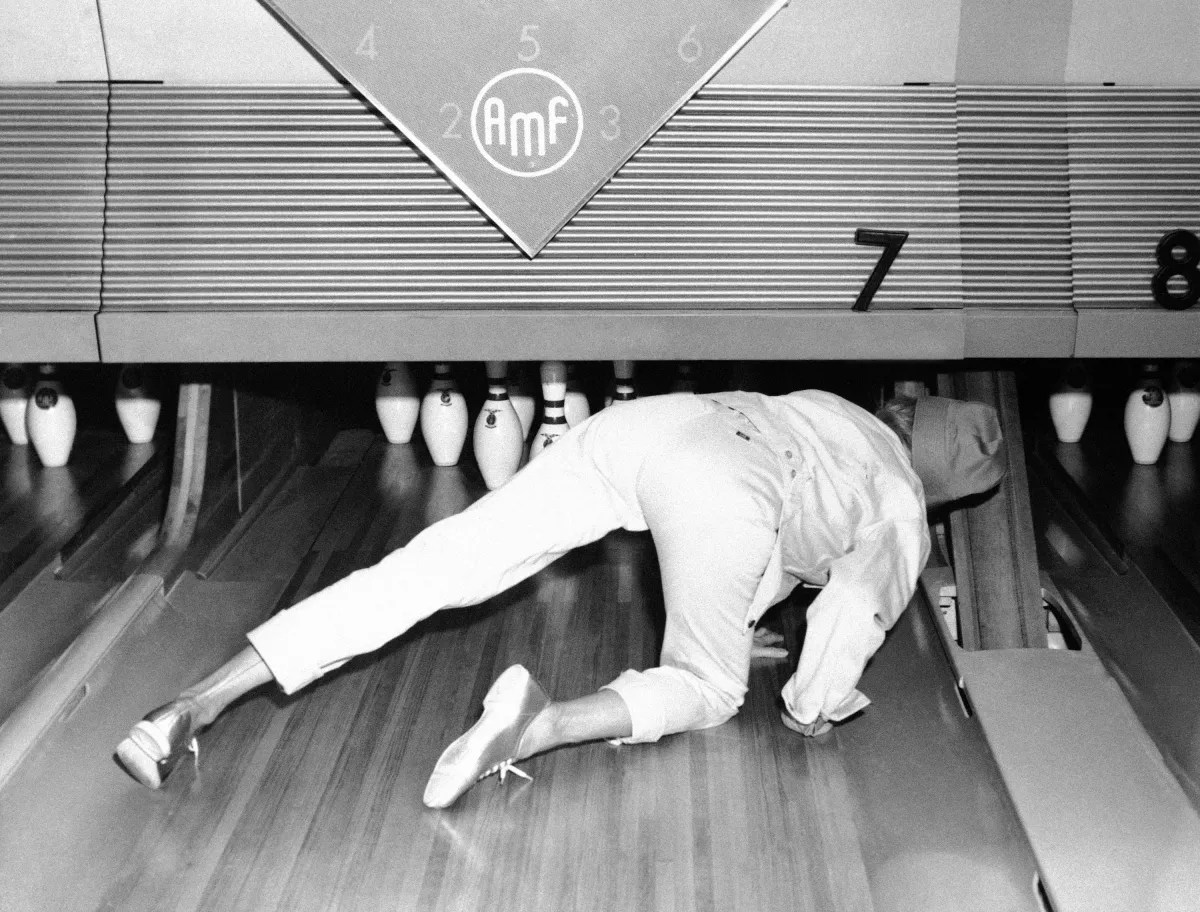
As we grab our balls, we might recall that it was on this date in 1960 that Marlene Dietrich visited a new bowling facility in Knokke-le Zoute, Belgium to roll a few frames and to inspect their new automatic pin-setting equipment.
You must be logged in to post a comment.