“Frederick Douglass taught that literacy is the path from slavery to freedom. There are many kinds of slavery and many kinds of freedom, but reading is still the path”*…
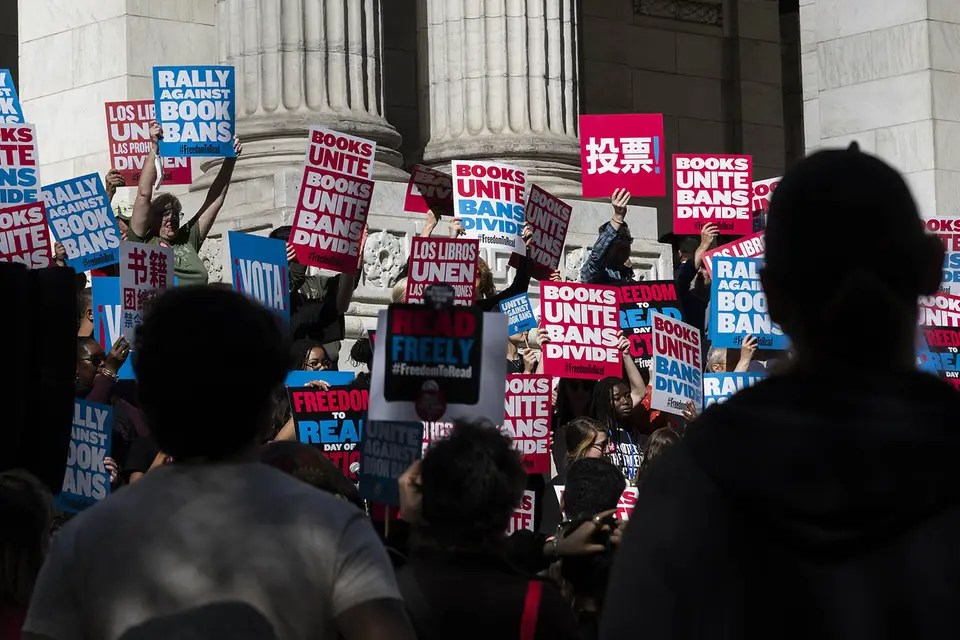
The attack on libraries, in the U.S. and beyond, has been a recurring theme here– precisely because it is so threatening. The estimable Richard Ovenden considers the titles banned, the data deleted, the nation’s librarians sacked without explanation, and explains that Donald Trump’s war on books is a threat to democracy across the world…
I am a librarian. I am fortunate enough to run one of the world’s largest and best known libraries – the Bodleian in Oxford – but my experience of libraries began as a reader. My mother took me as a child to the Deal public library in Kent, and it was there, in its modest book-filled rooms, that I discovered new worlds. My life was transformed by a public library (and its librarians) that allowed me to read freely from its well-stocked shelves. Throughout my career, I have seen at first-hand how libraries underpin the education and self-improvement of all of our citizens, rich and poor, young and old, of all creeds and colours, through providing access to a multitude of ideas and knowledge.
They celebrate the history and identity of our communities; they are stout defenders of facts and truth in an age of misinformation; and they are places where people can learn about their rights and how to protect them. This year we celebrate the 175th anniversary of the Public Libraries Act of 1850, which created our system of free public libraries – a kind of “NHS for the mind”. But what has been happening to American libraries rings a loud alarm bell for our own cherished library system.
Libraries large and small in the US are now on the frontline of the battles over knowledge that have intensified since the second presidency of Donald Trump began. The attack on libraries and librarians there is shocking and happening at a disorienting pace. Thousands of books have been banned from public and school libraries, librarians have received death threats and many have been fired. The heads of both the National Archives and the Library of Congress have been sacked on spurious grounds. Data has been deleted and funding for critical initiatives ceased.
Why is the US, the land of the free, where the realm of ideas and knowledge has been enabled by the first amendment, now turning on institutions that have been among the most trusted in society?
The first dispatches from the war on libraries began to reach me in 2022. I had recently published Burning the Books, which highlighted the role of libraries in society through a long history of attacks on the written word. Librarians began to send me messages and tagged me on social media, sharing news of assaults on public and school libraries in Florida and Texas. As one librarian put it, my book was fast beginning to look as if it would need updating. A pattern was forming: an epidemic of book banning, driven by groups from the far right of the political spectrum, empowered through social media, and funded, it seemed, by larger and darker organisations.
Throughout Joe Biden’s presidency, a coalition of extremist groups, with interests ranging from Christian nationalism to white supremacy, and anti-gay protesters were able to mobilise around common themes such as opposing sex education, LGBTQ+ issues and race equality. They began a concerted campaign to control what young people could read. Two tactics were deployed. The first was to seize control of the boards that oversee small public and school libraries. The boards then censored the books available to library users, especially young people. The second was the mobilisation of supporters using social media, manufacturing outrage through spreading lies, and encouraging challenges to libraries and attacks on librarians.
These tactics have been highly successful. The American Library Association (ALA) collects data on book bans in US libraries. Between 2001 and 2020 an average of 273 unique titles were challenged each year. In 2023, 9,021 individual titles were challenged across hundreds of libraries…
[Richard elaborates on those attacks…]
… Trump’s second presidency has heralded a more ferocious phase in the book-banning wars, moving these acts of local censorship to state and federal level. In April, I received an email letting me know that the Rutherford County’s board of education in Tennessee ordered 145 books to be removed from circulation, citing their “sexually explicit” content; they included Beloved by Toni Morrison and Forever by Judy Blume. In May, a judge ruled that users of Llano County library in Texas have no first amendment right to receive information in the form of books held by public libraries, and that the choice of books a library holds is a form of allowable “government speech” immune from constitutional scrutiny. At a stroke, in Trump’s US, public libraries are the mouthpiece of central government…
… The great civic public libraries, such as those in New York, Brooklyn, San Diego, Boston and Los Angeles, have not sat idly by as the smaller libraries drew the fire. They have digitised banned books to make them available freely online and they have helped develop toolkits to support libraries facing book banning. Despite these efforts, Friedman’s assessment of the future of the free circulation of ideas in the US is sobering: “Between Llano County and Mahmoud v Taylor, we are now seeing a radical upheaval in the legal frameworks for freedom to read,” he explained. It is hard to believe, but in Tennessee, the works of Bill Watterson, the cartoonist author of Calvin and Hobbes, are now considered a danger to young people and are banned in school libraries in many counties…
[Richard unpacks the assault on the Library of Congrees and teh national Archive, and explores the ways on which this particularly heinous form of censorship is being “exported” to other countries…]
… On 10 May 1933, in the heart of Berlin, a mass book-burning was held, where texts considered to be “un-German” – including, of course, Jewish texts, but also books from a library of human sexuality on LGBTQ+ themes – were burned on a pyre on the Unter den Linden boulevard. It is tempting to draw the analogy between this event and the mass burning of books across the US right now.
But if we do we should also remember that new libraries were founded, such as the German Freedom Library in Paris, to counteract Nazi censorship. “You may burn my books and the books of the best minds in Europe,” Helen Keller wrote in 1933, “but the ideas those books contain have passed through millions of channels and will go on.”
We should, in this anniversary year, not only defend the bold and ambitious idea of the Victorian age – that society would benefit from its citizens having access to a free library – but ensure that all people can read freely. To do so, we must empower, support and celebrate the role of libraries and librarians as defenders of an open, pluralist society – the hidden but essential infrastructure of democracy itself…
Eminently worth reading in full: “There is no political power without power over the archive,” from @richove.bsky.social in @theobserveruk.bsky.social.
We might note that, while the primary energy behind this threat is political, it is being supported by the same folks who are hollowing out journalism in the U.S. and capitalizing on the rush to incarcerate immigrants— private equity, which is supporting book banners and local defunding of libraries, then angling to take over the public libraries that they denude.
Your correspondent supports libraries and archives like Richard’s (Oxford’s Bodleian Library), the Harvard Libraries, The New York Public Library, my own local San Francisco Public Library, and the remarkable Internet Archive. You might consider contributing to your local library and to the other libraries and archives of your choice.
* Carl Sagan
###
As we opt for open, we might recall that on this date in 1951 J. D. Salinger’s The Catcher in the Rye was published by Little, Brown and Co. Almost immediately, it was the subject of bans. From 1961 to 1982 it was the most challenged book in the U.S. There was a resurgence of challenges in 2005 and 2009… and it is again the subject of broad removal efforts. In spite of (or more probably, because of) this, it keeps finding its way into adolescent hands, often as assigned reading by high school English teachers.

You must be logged in to post a comment.