“Monsters never die”*…

Neither do some myths. Ross MacFarlane on the lore of the seas…
Whether through their gleaming, glittering promotion of imagined (ever-improving) technological futures or their troubling “human zoo” displays of colonial peoples, a few World Fairs and Universal Expositions — the Great Exhibition of 1851 or Chicago World’s Fair of 1890 perhaps — have lived long in the imagination. Most, however, have not: the International Fisheries Exhibition of 1883 is among their number.
Between May and October of 1883, more than 2.6 million visitors travelled to see the spectacle in the grounds of the Royal Horticultural Society in London. At the centre of its displays from over thirty countries and colonies was an aquarium containing 65,000 gallons of water — the largest exhibition aquarium ever constructed. With an eye to posterity, the organisers did their best to promote themselves, creating a Literary Department that produced a variety of guides and handbooks for the exhibition throughout its six-month run. Two of these tie-in publications — Sea Monsters Unmasked and Sea Fables Explained — spoke particularly to the paradoxical place of the sea in both the imagination and science of the late nineteenth century: as a setting for tales of mysterious beasts, but also an increasingly scrutinised space for research on a shrinking globe.
Both books were written by Henry Lee (ca. 1826–1883), the former naturalist at the Brighton Aquarium and a prominent science communicator du jour. Numbering just over 100 pages each, Lee’s two brief works exude a Darwinian confidence. In them, a professional man of science, following in the great naturalist’s wake, exposes the follies of the past, rationalising traditional accounts through logical reasoning and recent discoveries in the marine world.
Although Lee narrates accounts of sea beasts to disprove them, the pamphlets also serve as unintended compendia of maritime folklore on aquatic cryptids…
And with riveting illustartions– for example:

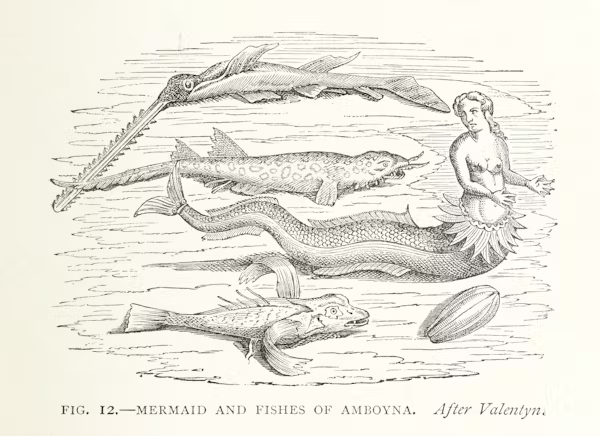
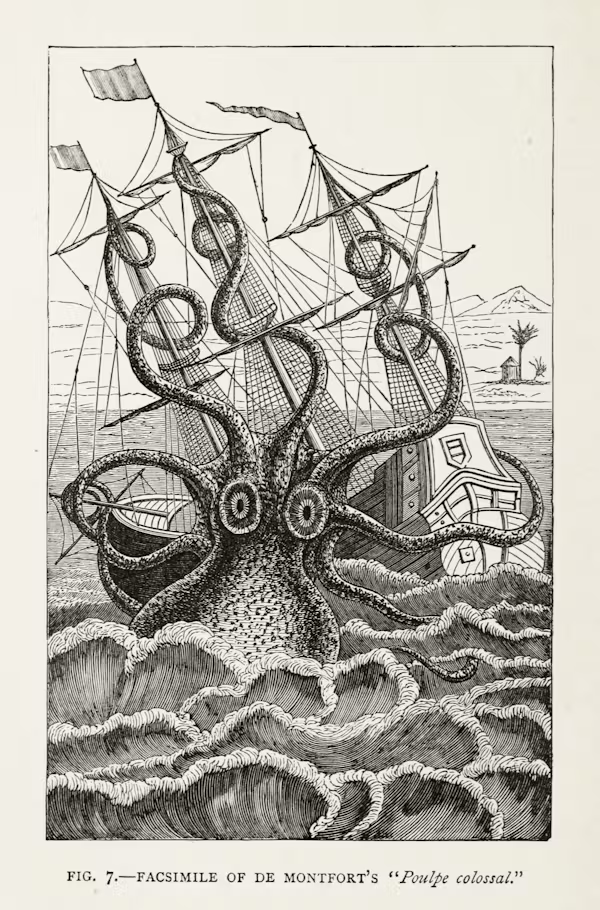
More deep sea excitement: “Sea Monsters Unmasked and Sea Fables Explained by Henry Lee (1883)” from @publicdomainrev.bsky.social.
* Rick Riordan, The Sea of Monsters
###
Just when you thought it was safe to go back in the water, we might recall that it was on this date in 1881 that a pertpetual motion machine was patented by John Sutliff…
Patent examiners are busy people, and when this application arrived at the U.S. Patent Office in 1881 it seemed innocuous enough — the inventor, John Sutliff, had called it simply “motor.” So they issued the patent.
It is, in fact, a perpetual motion machine. When ball L rolls to the left, it depresses the bellows, which fills the submerged bulb, raising the lever and turning cogwheel F. This pivots the box, which sends the ball back to the right, drawing air into the bellows and submerging the bulb again, “and so on alternately.”
Thus the cogwheel turns forever, driving shaft H, which you can hook up to anything you like. A convenient source of endless free energy, and it’s been under our noses all this time.
– source

You must be logged in to post a comment.